


Genome-wide association study reveals new insights into the heritability and genetic correlates of developmental dyslexia
- PMID: 33057169
- PMCID: PMC8505236
- DOI: 10.1038/s41380-020-00898-x
Genome-wide association study reveals new insights into the heritability and genetic correlates of developmental dyslexia
Abstract
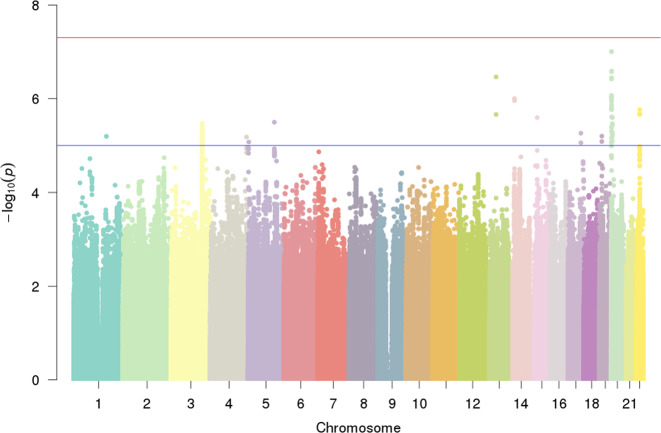
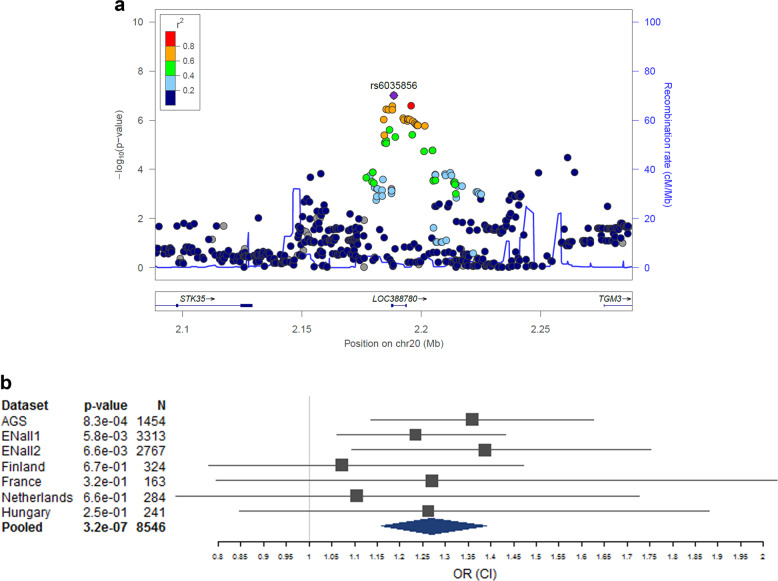
Developmental dyslexia (DD) is a learning disorder affecting the ability to read, with a heritability of 40-60%. A notable part of this heritability remains unexplained, and large genetic studies are warranted to identify new susceptibility genes and clarify the genetic bases of dyslexia. We carried out a genome-wide association study (GWAS) on 2274 dyslexia cases and 6272 controls, testing associations at the single variant, gene, and pathway level, and estimating heritability using single-nucleotide polymorphism (SNP) data. We also calculated polygenic scores (PGSs) based on large-scale GWAS data for different neuropsychiatric disorders and cortical brain measures, educational attainment, and fluid intelligence, testing them for association with dyslexia status in our sample. We observed statistically significant (p < 2.8 × 10⁻⁶) enrichment of associations at the gene level, for LOC388780 (20p13; uncharacterized gene), and for VEPH1 (3q25), a gene implicated in brain development. We estimated an SNP-based heritability of 20-25% for DD, and observed significant associations of dyslexia risk with PGSs for attention deficit hyperactivity disorder (at pT = 0.05 in the training GWAS: OR = 1.23[1.16; 1.30] per standard deviation increase; p = 8 × 10-13), bipolar disorder (1.53[1.44; 1.63]; p = 1 × 10-43), schizophrenia (1.36[1.28; 1.45]; p = 4 × 10-22), psychiatric cross-disorder susceptibility (1.23[1.16; 1.30]; p = 3 × 10-12), cortical thickness of the transverse temporal gyrus (0.90[0.86; 0.96]; p = 5 × 10⁻⁴), educational attainment (0.86[0.82; 0.91]; p = 2 × 10⁻⁷), and intelligence (0.72[0.68; 0.76]; p = 9 × 10-29). This study suggests an important contribution of common genetic variants to dyslexia risk, and novel genomic overlaps with psychiatric conditions like bipolar disorder, schizophrenia, and cross-disorder susceptibility. Moreover, it revealed the presence of shared genetic foundations with a neural correlate previously implicated in dyslexia by neuroimaging evidence.
© 2020. The Author(s).
Conflict of interest statement
The authors declare that they have no conflict of interest.
Figures
References
-
- American Psychiatric Association. Diagnostic and statistical manual of mental disorders. American Psychiatric Association: Washington, DC; 2013.
-
- Gilger JW, Hanebuth E, Smith SD, Pennington BF. Differential risk for developmental reading disorders in the offspring of compensated versus noncompensated parents. Read Writ. 1996;8:407–17.
Publication types
MeSH terms
Substances
Grants and funding
LinkOut - more resources
Full Text Sources
