. 2020 Oct 15;15(10):e0240785.
doi: 10.1371/journal.pone.0240785. eCollection 2020.

Who is wearing a mask? Gender-, age-, and location-related differences during the COVID-19 pandemic

Affiliations

Who is wearing a mask? Gender-, age-, and location-related differences during the COVID-19 pandemic

Michael H Haischer et al. PLoS One. .

Abstract

Masks are an effective tool in combatting the spread of COVID-19, but some people still resist wearing them and mask-wearing behavior has not been experimentally studied in the United States. To understand the demographics of mask wearers and resistors, and the impact of mandates on mask-wearing behavior, we observed shoppers (n = 9935) entering retail stores during periods of June, July, and August 2020. Approximately 41% of the June sample wore a mask. At that time, the odds of an individual wearing a mask increased significantly with age and was also 1.5x greater for females than males. Additionally, the odds of observing a mask on an urban or suburban shopper were ~4x that for rural areas. Mask mandates enacted in late July and August increased mask-wearing compliance to over 90% in all groups, but a small percentage of resistors remained. Thus, gender, age, and location factor into whether shoppers in the United States wear a mask or face covering voluntarily. Additionally, mask mandates are necessary to increase mask wearing among the public to a level required to mitigate the spread of COVID-19.


Conflict of interest statement

The authors have declared that no competing interests exist.

Figures
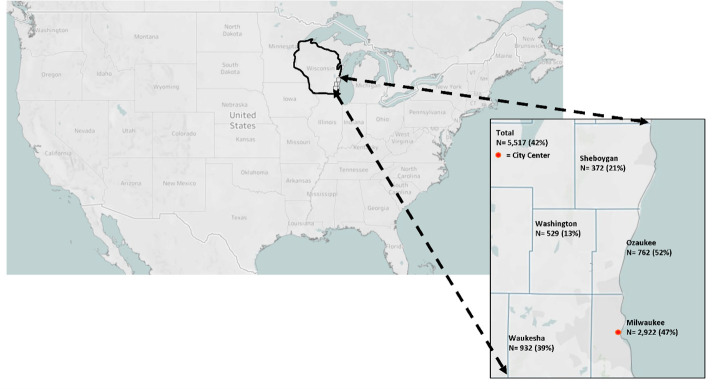
Fig 1
Fig 1. Mask-wearing percentages by Wisconsin county.
Data shown indicates the number of observations collected and percentage of people wearing a mask (vs. no mask) in each county where retail stores were visited during the initial data collection period from June 3rd through June 9th, 2020. The Milwaukee county city center location was used for identifying urban, suburban, and rural stores. Created in Tableau Public 2020.2.1 (Tableau Software, LLC., Seattle, WA, USA).
Fig 2
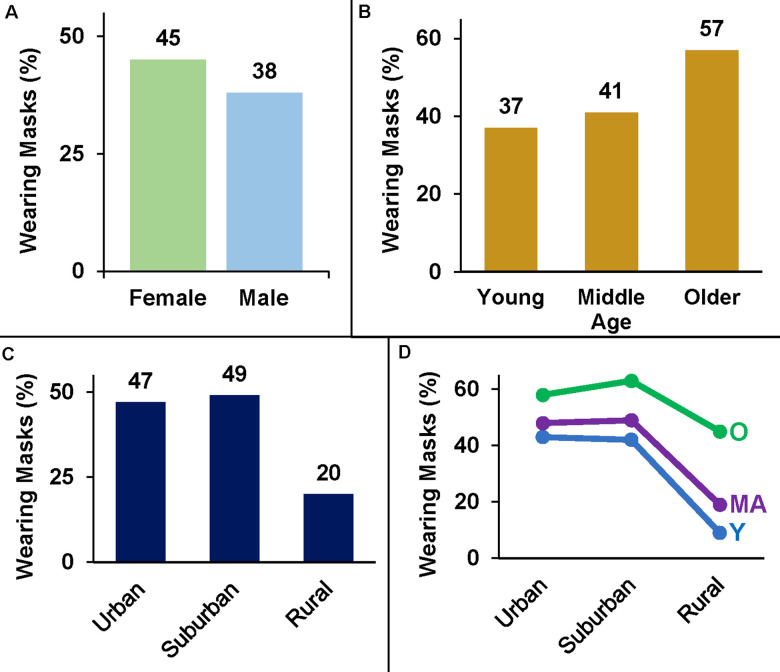
Fig 2. Mask-wearing percentages across gender, age, and location.
Data shown indicates percentage of individuals wearing a mask (vs. no mask) during the initial data collection period from June 3rd through June 9th, 2020. A. Females wear masks more than males. B. Older adults wear masks more than other individuals. C. Mask-wearing habits are similar in urban and suburban areas, but usage drops off considerably at rural stores. D. Mask wearing plotted by location highlights how the mask-wearing behavior of older adults (O) is less impacted by shopping in a rural area than the behavior of young (Y) and middle-age (MA) individuals.
Fig 3
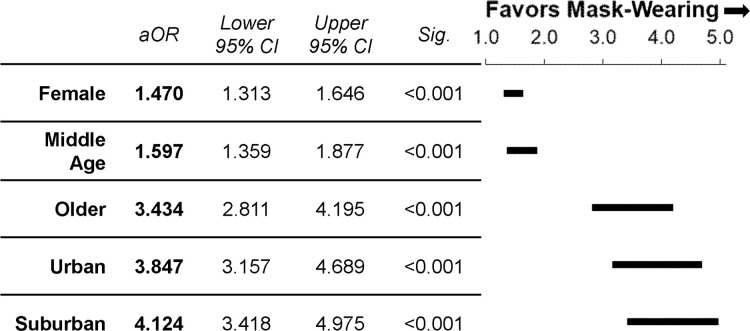
Fig 3. Odds of wearing a mask.
Adjusted odds ratios (aOR) and 95% confidence interval plots of mask usage for gender expression, age, and location during the initial data collection period from June 3rd-9th, 2020. Odds ratios are expressed in relation to reference groups (gender: male; age: young; location: rural).
Fig 4
Fig 4. Mask-wearing percentages between June and August 2020.
Mask-wearing compliance was poor in June but had improved immediately before mandates began. Compliance rose to > 90% with a mandate in place across all demographics, but a small percentage of the population still resisted. The overlap in “before” and “with store mandates” dates is related to corporate differences in the dates mask mandates began.

References

    1. Coronaviridae Study Group of the International Committee on Taxonomy of Viruses. The species severe acute respiratory syndrome-related coronavirus: classifying 2019-nCoV and naming it SARS-CoV-2. Nat Microbiol. 2020;5: 536–544. 10.1038/s41564-020-0695-z - DOI - PMC - PubMed
    1. Prather KA, Wang CC, Schooley RT. Reducing transmission of SARS-CoV-2. Science. 2020;368(6498): 1422–1424. 10.1126/science.abc6197 - DOI - PubMed
    1. Stutt ROJH, Retkute R, Bradley M, Gilligan CA, Colvin J. A modelling framework to assess the likely effectiveness of facemasks in combination with ‘lock-down’ in managing the COVID-19 pandemic. Proc R Soc A. 2020;476: 20200376 10.1098/rspa.2020.0376 - DOI - PMC - PubMed
    1. WorldOMeter [Internet]. United States Coronavirus Info; c2020 [cited 2020 Sept 23]. Available from: https://www.worldometers.info/coronavirus/country/us/
    1. He X, Lau EHY, Wu P, Deng W, Wang J, Hao X, et al. Temporal dynamics in viral shedding and transmissibility of COVID-19. Nat Med. 2020;26(5): 672–675. 10.1038/s41591-020-0869-5 - DOI - PubMed