Review
. 2020 Nov 11;56(87):13313-13322.
doi: 10.1039/d0cc02605k. Epub 2020 Oct 15.

Revisiting peptidoglycan sensing: interactions with host immunity and beyond

Affiliations
Review

Revisiting peptidoglycan sensing: interactions with host immunity and beyond

Geneva Maddison Crump et al. Chem Commun (Camb). .

Abstract

The interaction between host immunity and bacterial cells plays a pivotal role in a variety of human diseases. The bacterial cell wall component peptidoglycan (PG) is known to stimulate an immune response, which makes PG a distinctive recognition element for unveiling these complicated molecular interactions. Pattern recognition receptor (PRR) proteins are among the critical components of this system that initially recognize molecular patterns associated with microorganisms such as bacteria and fungi. These molecular patterns are mostly embedded in the bacterial or fungal cell wall structure and can be released and presented to the immune system in various situations. Nonetheless, detailed knowledge of this recognition is limited due to the diversity among the PG polymer and its fragments; the subsequent responses by multiple hosts add more complexity. Here, we discuss how our understanding of the role and molecular mechanisms of the well-studied PRR, the NOD-like receptors (NLRs), in the human immune system has evolved in recent years. We highlight the instances of other classes of proteins with similar behavior in the recognition of PG that have been identified in other microorganisms such as yeasts. These proteins are particularly interesting because a network of cellular interactions exists between human host cells, bacteria and yeast as a part of the normal human flora. To support our understanding of these interactions, we provide insight into the chemist's toolbox of peptidoglycan probes that aid in the investigations of the behaviors of these proteins and other biological contexts relevant to the sensing and recognition of peptidoglycan. The importance of these interactions in human health for the development of biomarkers and biotherapy is highlighted.


Conflict of interest statement

Conflicts of interest

There are no conflicts to declare.

Figures
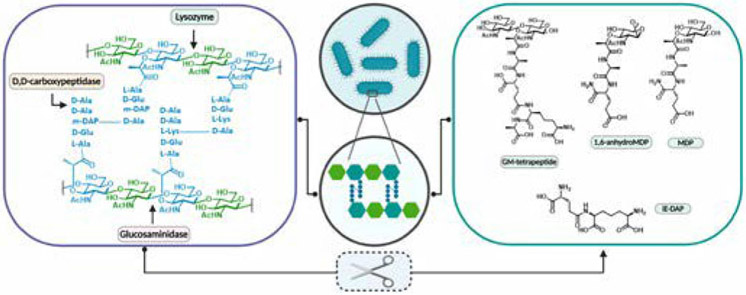
Figure 1:
Figure 1:
Schematic representation of peptidoglycan and corresponding fragments upon enzymatic digestion. Left: Cross-linked peptidoglycan. Depicted in green is N-acetyl glucosamine and in blue N-acetyl muramic acid with the corresponding representative peptide linkage. Right: representative set of possible PG fragments upon digestion with enzymes such as Lysozyme and Carboxypeptidases. Note that MDP is a synthetic fragment and has not been shown to be produced in a biological context. The remaining fragments have been observed upon peptidoglycan enzymatic digestion with various enzymes, for example muramidase, lysozyme, and lytic transglycosylases.,
Figure 2:
Figure 2:
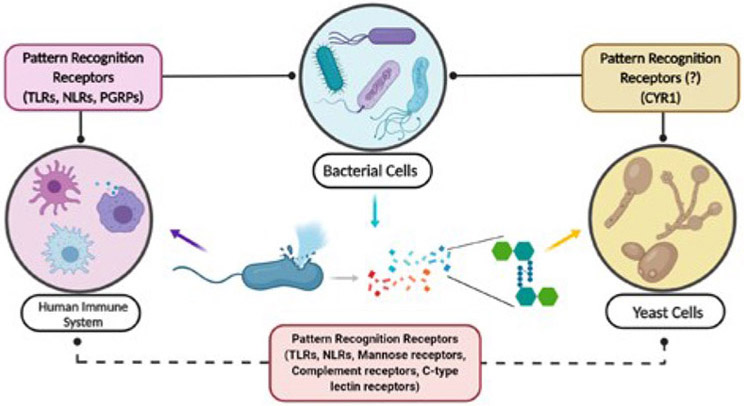
Pathogen Recognition Receptor interplay in bacterial cell wall recognition. Homologous PG receptors exist for mammals, plants, and insects. A common domain found in these receptors is the evolutionary and structurally conserved Leucine Rich Repeat protein domain, which is not only responsible for the sensing and detection of PG fragments but is found across innate immune receptors.
Figure 3:
Figure 3:
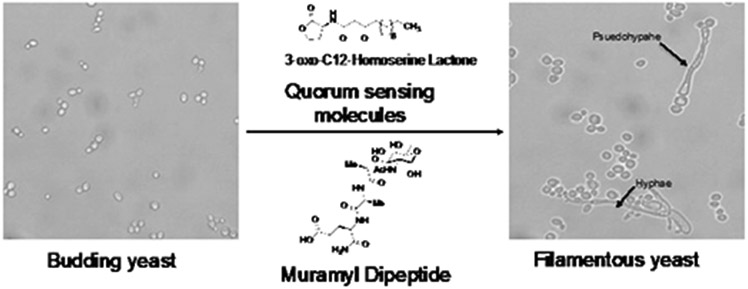
Molecular signals involved in the direct morphological transition from budding yeast to filamentous yeast. Budding yeast is activated by molecules such as 3-oxo-C12-homoserine lactone and Muramyl Dipeptide via the Cyr1p Leucine Rich Repeat domain. Once activated, budding yeast is transitioned into filamentous yeast in the form of hyphae or psuedophyape.100X magnification.
Figure 4:
Figure 4:
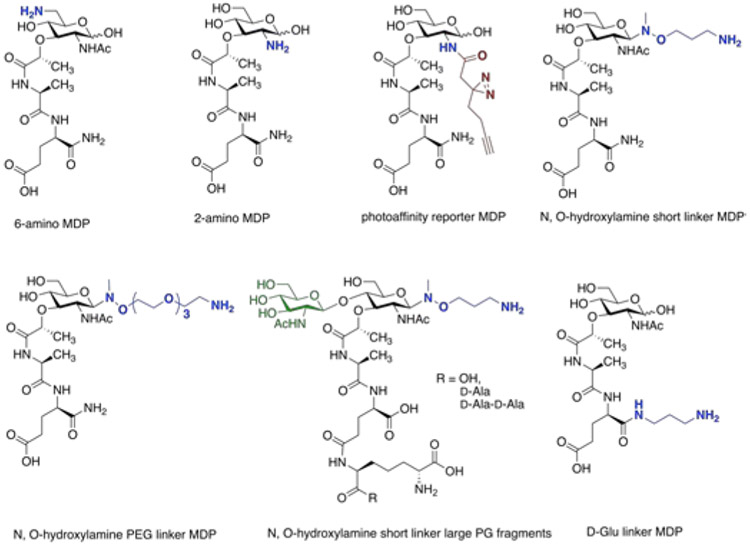
MDP chemical probes. The synthetic fragment MDP can be functionalized with various chemical handles allowing for variability in biological assay development. Green =GlcNac. Blue=variable amine linker. Brown=photoactivatable moiety. The disaccharide fragments were generated by lysozyme digestion, reacted with N-hydroxy-ethylamine and detected via mass spectrometric analysis.
Figure 5:
Figure 5:
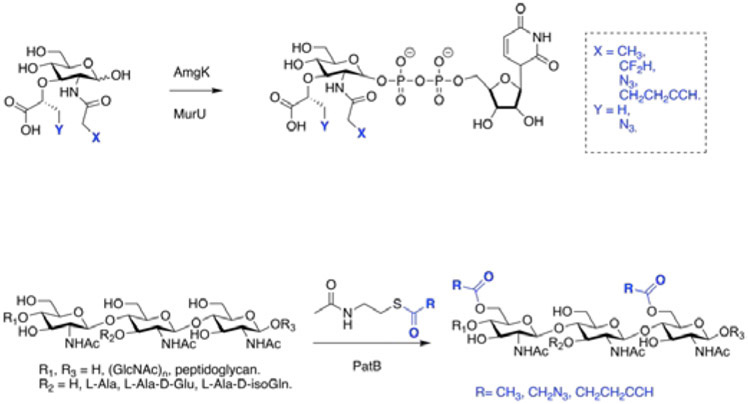
Chemoenzymatic modified PG fragments. Top: Hijacking the biosynthetic pathway of PG, UDP MurNac can be chemoenzymatically modified to contain bioorthogonal probes for biological assays. Modified fragments can be labeled with fluorophores, and varying functionalities. Recycling enzymes Amgk and MurU are native to the PG biosynthetic pathway and synthesize UDP-MurNac using NAM as the building block. Bottom: Peptidoglycan O-acetyltransferase (PatB) catalyzes the O-acetylation in Gram (−) bacteria permitting the installation of biorthogonal handles.
Figure 6:
Figure 6:
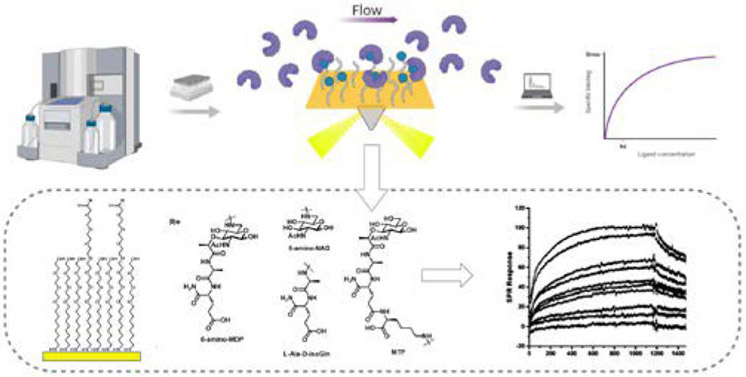
Surface Plasmon Resonance assay. The binding between the immobilized ligand and the analyte is detected as the analyte flow interacts with the ligand. The recorded sensograms can be further processed to obtain the kinetic parameters.
Figure 7:
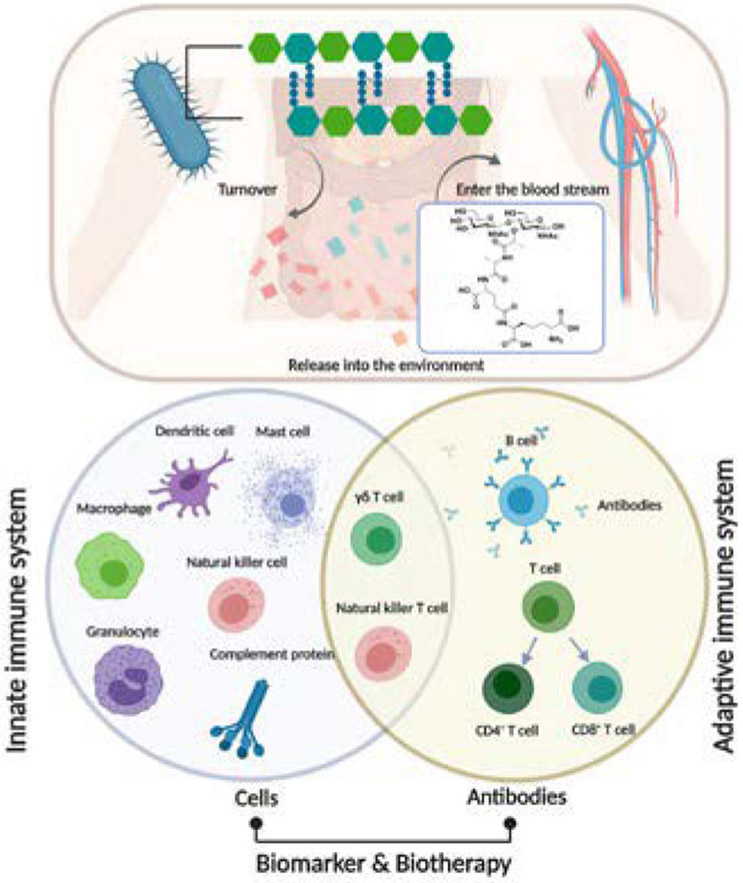
Figure 7:. The interaction between bacterial cell wall fragments and the human immune system.
PG turnover and subsequent fragment release to the environment; non-septic PG fragments appear to enter the bloodstream (as shown). The innate immune system response to potential PG antigen is the first line of defense against infection. Many of the cells in the innate immune system (such as dendritic cells, macrophages, mast cells) produce cytokines or interact with other cells directly to activate the adaptive immune system. γδ T cells and Nature Killer cells are lymphocytes without antigen specificity. Therefore, they are considered to be innate cells with some similarities to effector lymphocytes. The adaptive immune system is based on clonal selection of lymphocytes with antigen receptors (B cell receptors and T cell receptors) and recent studies suggest that antibodies for specific PG fragment exist. A more detailed understanding of PG related immune response provides new opportunities for improving immunotherapy for autoimmune diseases.

References

    1. Janeway CA and Medzhitov R, Annu. Rev. Immunol, 2002, 20, 197–216. - PubMed
    1. Vollmer W, Blanot D and De Pedro MA, FEMS Microbiol. Rev, 2008, 32, 149–167. - PubMed
    1. Rogers HJ, Ann. N. Y. Acad. Sci, 1974, 235, 29–51. - PubMed
    1. Porfírio S, Carlson RW and Azadi P, Trends Microbiol., 2019, 27, 653–654. - PubMed
    1. Vollmer W and Höltje JV, J. Bacteriol, 2004, 186, 5978–5987. - PMC - PubMed