Virtual Standardized Patients vs Academic Training for Learning Motivational Interviewing Skills in the US Department of Veterans Affairs and the US Military: A Randomized Trial
- PMID: 33057643
- PMCID: PMC7563071
- DOI: 10.1001/jamanetworkopen.2020.17348
Virtual Standardized Patients vs Academic Training for Learning Motivational Interviewing Skills in the US Department of Veterans Affairs and the US Military: A Randomized Trial
Abstract
Importance: Despite the need for effective and scalable training in motivational interviewing (MI) that includes posttraining coaching and feedback, limited evidence exists regarding the effectiveness of using virtual (computerized) standardized patients (VSPs) in such training.
Objective: To evaluate the efficacy of training with a VSP on the acquisition and maintenance of MI skills compared with traditional academic study.
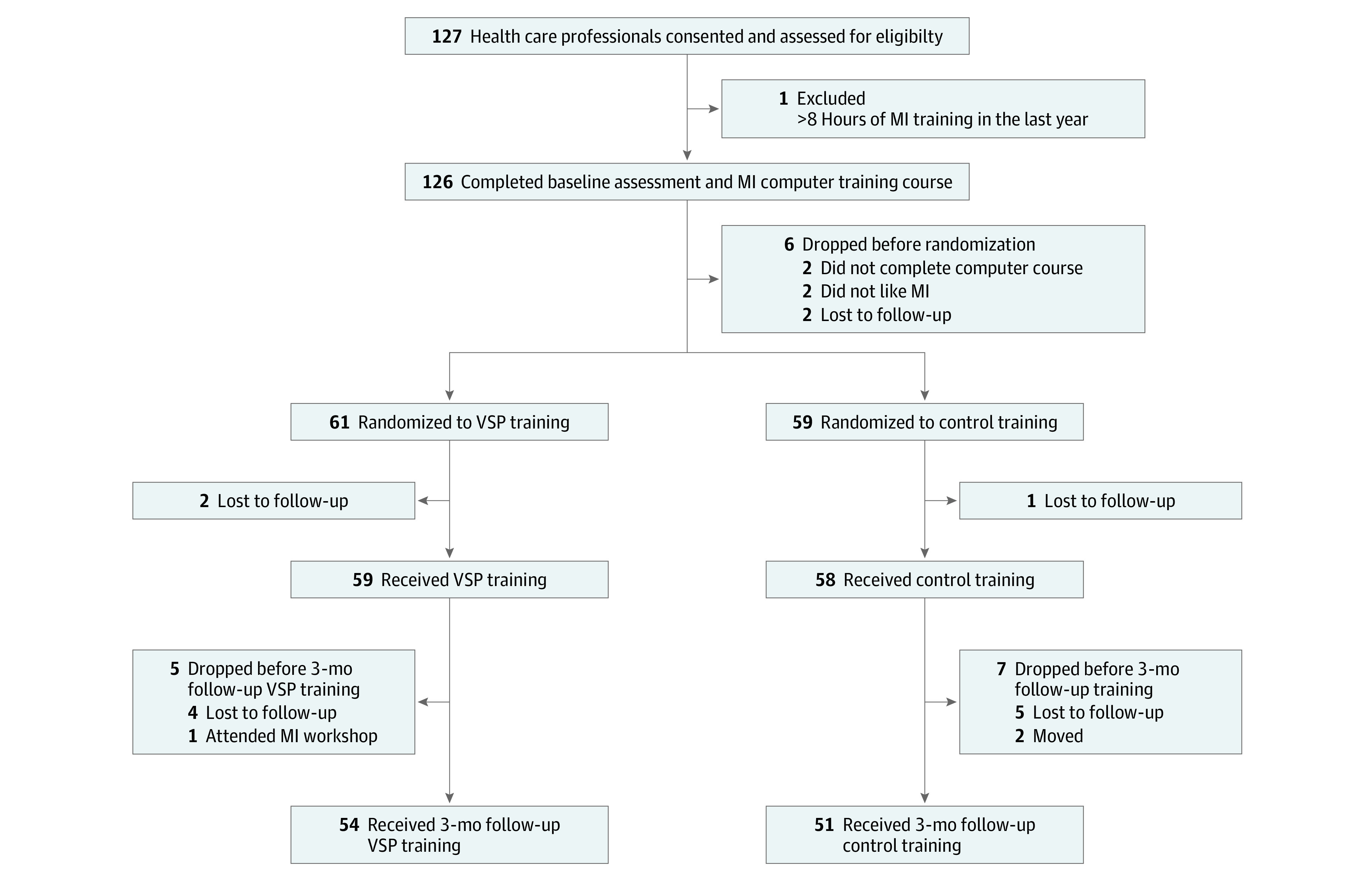
Design, setting, and participants: This study was a 2-group, parallel-training randomized trial of 120 volunteer health care professionals recruited from a Department of Veterans Affairs and Department of Defense medical facility. Motivational interviewing skill was coded by external experts blinded to training group and skill assessment time points. Data were collected from October 17, 2016, to August 12, 2019.
Interventions: After a computer course on MI, participants trained during two 45-minute sessions separated by 3 months. The 2 randomized training conditions included a branching storyline VSP, which provided MI skill rehearsal with immediate and summative feedback, and a control condition, which included academic study of content from the computerized MI course.
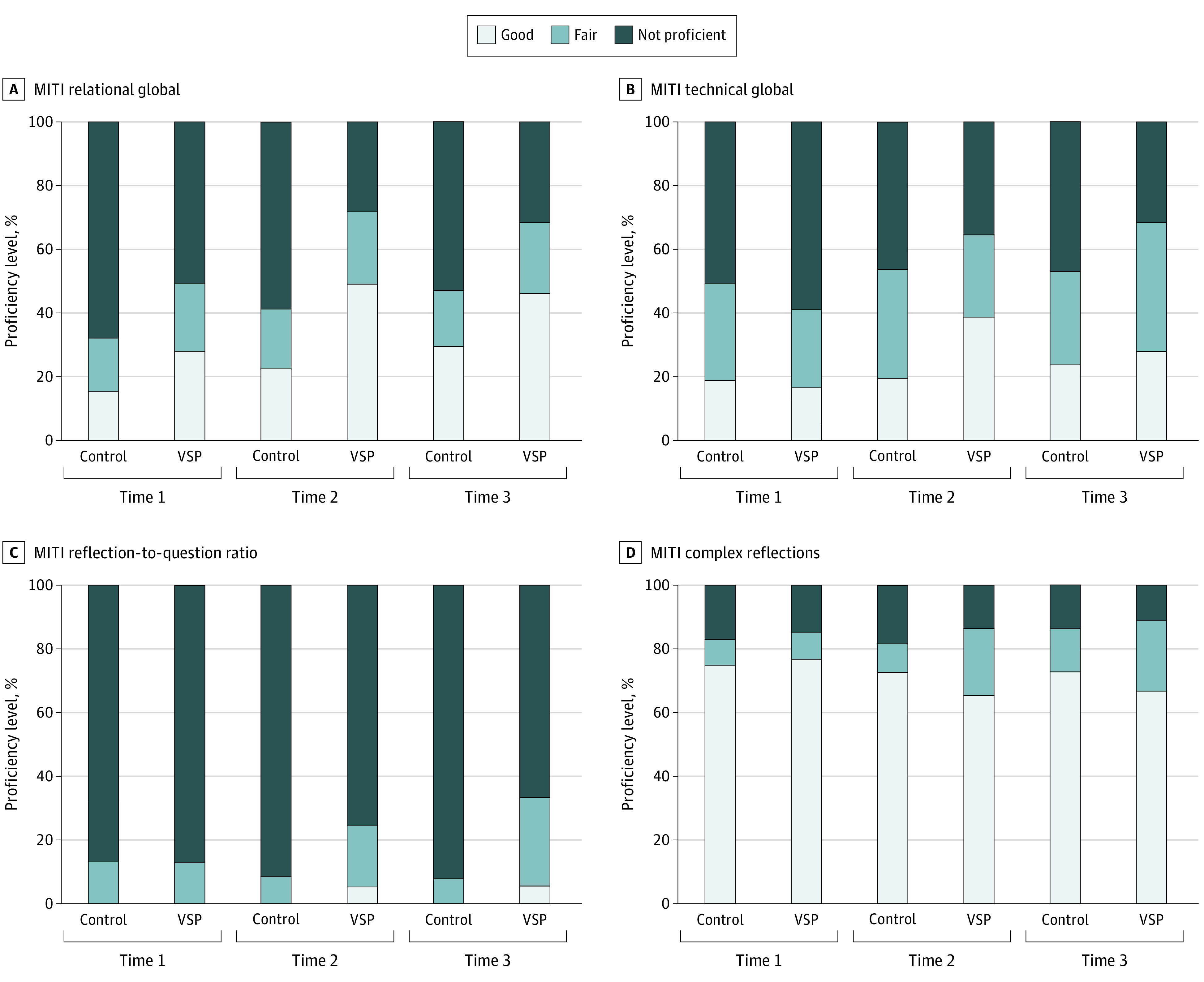
Main outcomes and measures: Measurement of MI skill was based on recorded conversations with human standardized patients, assessed using the Motivational Interviewing Treatment Integrity 4.2.1 coding system, measured at baseline, after training, and after additional training in the randomized condition 3 months later.
Results: A total of 120 volunteers (83 [69%] women), with a mean (SD) of 13.6 (10.3) years of health care experience, participated in the study; 61 were randomized to receive the intervention, and 59 were randomized to the control group. Those assigned to VSP training had significantly greater posttraining improvement in technical global scores (0.23; 95% CI, 0.03-0.44; P = .02), relational global scores (0.57; 95% CI, 0.33-0.81; P = .001), and the reflection-to-question ratio (0.23; 95% CI, 0.15-0.31; P = .001). Differences were maintained after the 3-month additional training session, with more improvements achieved after the 3-month training for the VSP trainees on the reflection-to- question ratio (0.15; 95% CI, 0.07-0.24; P = .001).
Conclusions and relevance: This randomized trial demonstrated a successful transfer of training from a VSP to human standardized patients. The VSP MI skill outcomes were better than those achieved with academic study and were maintained over time. Virtual standardized patients have the potential to facilitate dissemination of MI and may be useful for training in other evidence-based skills and treatments.
Trial registration: ClinicalTrials.gov Identifier: NCT04558060.
Conflict of interest statement
Figures
References
-
- Miller WR, Rollnick S. Motivational Interviewing: Helping People Change. 3rd ed Guilford Press; 2013.
-
- Lundahl BW, Kunz C, Brownell C, Tollefson D, Burke BL. A meta-analysis of motivational interviewing: twenty-five years of empirical studies. Res Soc Work Pract. 2010;20(2):137-160. doi: 10.1177/1049731509347850 - DOI