


Polyclonal B-cell lymphocytosis in English bulldogs
- PMID: 33058280
- PMCID: PMC7694837
- DOI: 10.1111/jvim.15913
Polyclonal B-cell lymphocytosis in English bulldogs
Abstract
Background: English bulldogs disproportionally develop an expansion of small B-cells, which has been interpreted as B-cell chronic lymphocytic leukemia (BCLL). However, clonality testing in these cases has often not been supportive of neoplasia.
Hypothesis: English bulldogs have a syndrome of nonneoplastic B-cell expansion.
Animals: Eighty-four English bulldogs with small-sized CD21+ B-cell lymphocytosis in the blood as determined by flow cytometry.
Methods: This is a retrospective study. We characterized this syndrome by assessing B-cell clonality, clinical presentation, flow cytometric features, and immunoglobulin gammopathy patterns. We identified 84 cases with CD21+ lymphocytosis among 195 English bulldogs with blood samples submitted to the Colorado State University-Clinical Immunology laboratory for immunophenotyping between 2010 and 2019. Flow cytometry features were compared to normal B-cells and BCLL cases. PCR for antigen receptor rearrangements (PARR) by multiple immunoglobulin primers was performed to assess B-cell clonality. A subset of cases with gammopathy were examined by protein electrophoresis, immunofixation, and immunoglobulin subclass ELISA quantification.
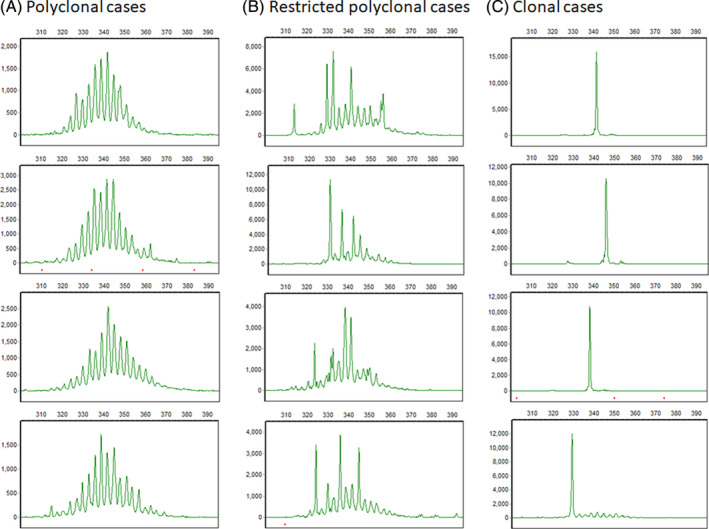
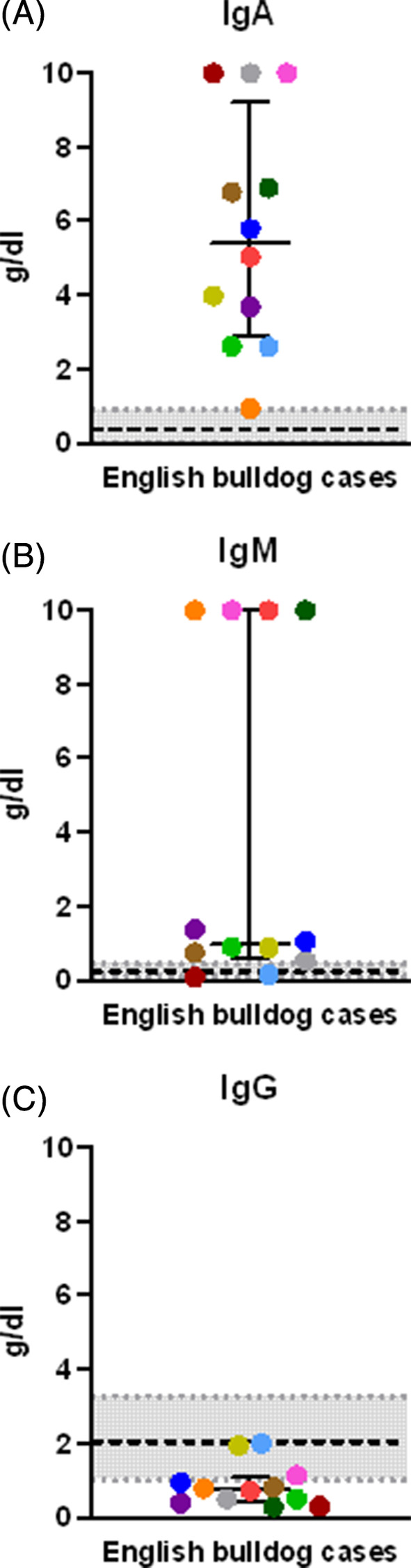
Results: Seventy percent (58/83) of cases had polyclonal or restricted polyclonal immunoglobulin gene rearrangements, suggesting nonmalignant B-cell expansion. The median age of all dogs in the study was 6.8 years and 74% were male. The median (range) lymphocyte count was 22 400/μL (2000-384 400/μL) and B-cells had low expression of class II MHC and CD25. Splenomegaly or splenic masses were detected in 57% (26/46) of cases and lymphadenopathy in 11% (7/61). Seventy-one percent (52/73) of cases had hyperglobulinemia and 77% (23/30) with globulin characterization had IgA ± IgM polyclonal or restricted polyclonal gammopathy patterns.
Conclusions and clinical importance: Polyclonal B-cell lymphocytosis in English bulldogs is characterized by low B-cell class II MHC and CD25 expression, splenomegaly and hyperglobulinemia consisting of increased IgA ± IgM. We hypothesize that this syndrome has a genetic basis.
Keywords: IgA gammopathy; PCR for antigen receptor rearrangements; canine; clinical pathology; clonality; flow cytometry; hyperglobulinemia.
© 2020 The Authors. Journal of Veterinary Internal Medicine published by Wiley Periodicals LLC on behalf of American College of Veterinary Internal Medicine.
Conflict of interest statement
Authors declare no conflict of interest.
Figures




References
-
- Avery AC, Avery PR. Determining the significance of persistent lymphocytosis. Vet Clin North Am Small Anim Pract. 2007;37(2):267‐282. - PubMed
-
- Weiser M, Thrall M, Fulton R, Beck E, Wise L, Van Steenhouse J. Granular lymphocytosis and hyperproteinemia in dogs with chronic ehrlichiosis. J Am Anim Hosp Assoc. 1991;27:84‐88.
-
- Peterson ME, Kintzer PP, Kass PH. Pretreatment clinical and laboratory findings in dogs with hypoadrenocorticism: 225 cases (1979‐1993). J Am Vet Med Assoc. 1996;208(1):85‐91. - PubMed
-
- Burton AG, Borjesson DL, Vernau W. Thymoma‐associated lymphocytosis in a dog. Vet Clin Pathol. 2014;43(4):584‐588. - PubMed
-
- Batlivala TP, Bacon NJ, Avery AC, et al. Paraneoplastic T cell lymphocytosis associated with a thymoma in a dog. J Small Anim Pract. 2010;51(9):491‐494. - PubMed
MeSH terms
Grants and funding
LinkOut - more resources
Full Text Sources
Research Materials
Miscellaneous
