Reduction in US Health Care Spending Required to Meet the Institute of Medicine's 2030 Target
- PMID: 33058710
- PMCID: PMC7661993
- DOI: 10.2105/AJPH.2020.305793
Reduction in US Health Care Spending Required to Meet the Institute of Medicine's 2030 Target
Abstract
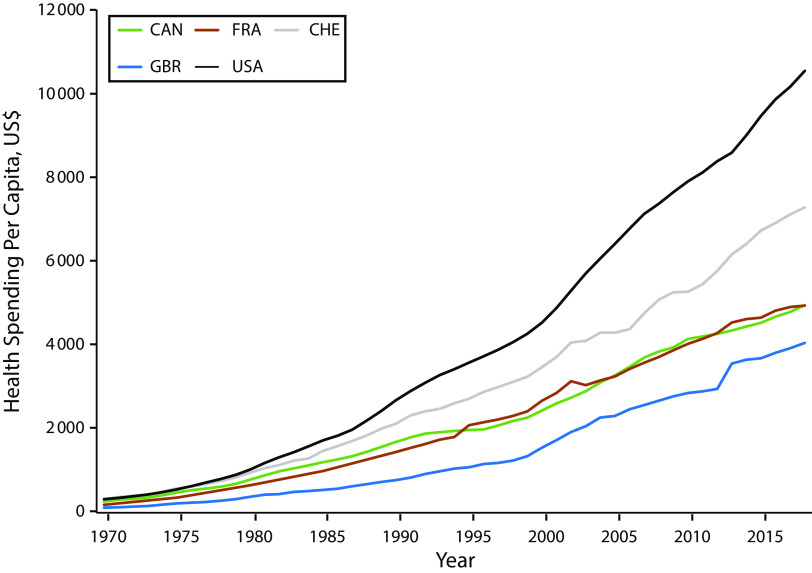
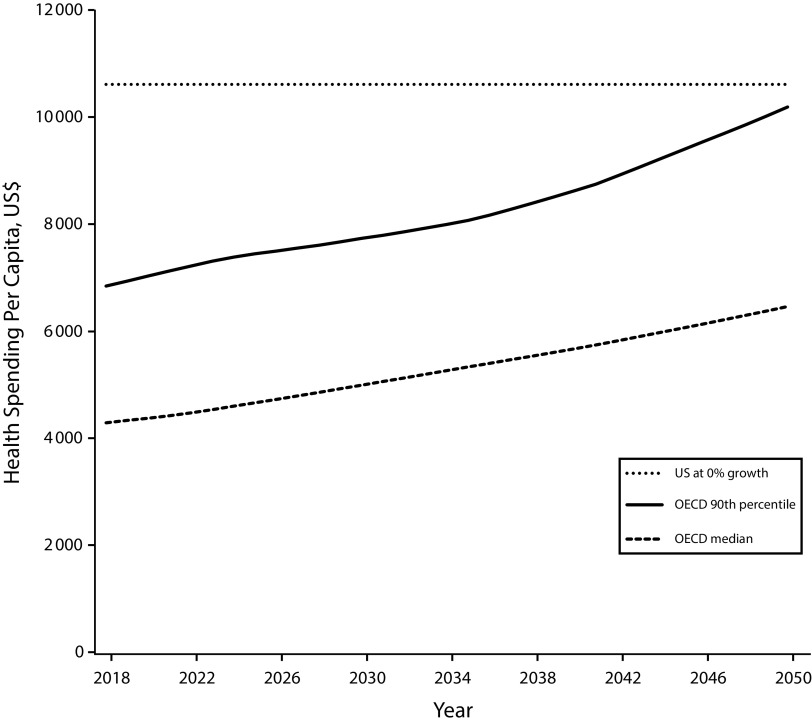
Objectives. To quantify changes in US health care spending required to reach parity with high-resource nations by 2030 or 2040 and identify historical precedents for these changes.Methods. We analyzed multiple sources of historical and projected spending from 1970 through 2040. Parity was defined as the Organisation for Economic Co-operation and Development (OECD) median or 90th percentile for per capita health care spending.Results. Sustained annual declines of 7.0% and 3.3% would be required to reach the median of other high-resource nations by 2030 and 2040, respectively (3.2% and 1.3% to reach the 90th percentile). Such declines do not have historical precedent among US states or OECD nations.Conclusions. Traditional approaches to reducing health care spending will not enable the United States to achieve parity with high-resource nations; strategies to eliminate waste and reduce the demand for health care are essential.Public Health Implications. Excess spending reduces the ability of the United States to meet critical public health needs and affects the country's economic competitiveness. Rising health care spending has been identified as a threat to the nation's health. Public health can add voices, leadership, and expertise for reversing this course.
Figures
Comment in
-
Why Did Cross-National Divergences in Life Expectancy and Health Care Expenditures Both Appear in the 1980s?Am J Public Health. 2020 Dec;110(12):1741-1742. doi: 10.2105/AJPH.2020.305909. Am J Public Health. 2020. PMID: 33180576 Free PMC article. No abstract available.
-
Commonsense Questions to Move Beyond Health Care at All Costs.Am J Public Health. 2020 Dec;110(12):1758-1759. doi: 10.2105/AJPH.2020.305985. Am J Public Health. 2020. PMID: 33180592 Free PMC article. No abstract available.
-
Less Health Care, More Health: The Inverse U of Medical Spending and Health in the United States.Am J Public Health. 2020 Dec;110(12):1755-1757. doi: 10.2105/AJPH.2020.305981. Am J Public Health. 2020. PMID: 33180593 Free PMC article. No abstract available.
References
-
- Institute of Medicine. For the Public’s Health: Investing in a Healthier Future. Washington, DC: National Academies Press; 2012. - PubMed
-
- Organisation for Economic Co-operation and Development. Health expenditure indicators. Available at: https://www.oecd-ilibrary.org/content/data/data-00349-en. Accessed January 20, 2020.
MeSH terms
LinkOut - more resources
Full Text Sources