


Association among serum and salivary A. actinomycetemcomitans specific immunoglobulin antibodies and periodontitis
- PMID: 33059645
- PMCID: PMC7565341
- DOI: 10.1186/s12903-020-01258-5
Association among serum and salivary A. actinomycetemcomitans specific immunoglobulin antibodies and periodontitis
Abstract
Background: The aim of this study was to assess the association between serum and salivary Immunoglobulin (Ig) Aggregatibacter actinomycetemcomitans (A. actinomycetemcomitans) specific antibodies in healthy controls (HC) and periodontitis (PT) patients. Furthermore, the objectives were to determine whether PT influenced serum A. actinomycetemcomitans specific antibodies and whether serum or salivary antibodies against A. actinomycetemcomitans IgG were mediated by serum high-sensitivity c-reactive protein (hs-CRP).
Methods: Fifty-three patients with periodontitis and 48 HC were enrolled in the present study. Patients were regularly examined and characterized by clinical, salivary and blood samples analyses. A. actinomycetemcomitans IgA and IgG antibodies and hs-CRP were evaluated using a commercially available kit. The Spearman Correlation Test and Jonckheere-Terpstra Test were applied in order to assess the interdependence between serum A. actinomycetemcomitans IgG antibodies and clinical periodontal parameters. To evaluate the dependence of the serum and salivary A. actinomycetemcomitans IgG levels from possible confounders, univariate and multivariable linear regression analyses were performed.
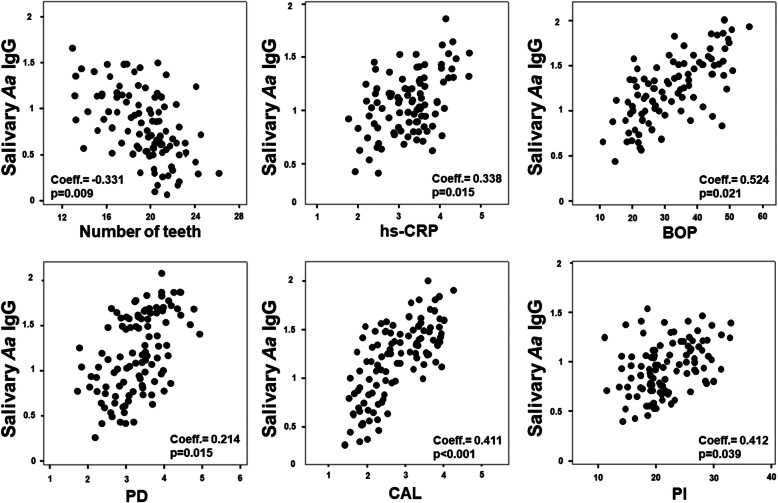
Results: Compared to HC, patients with PT had significantly higher IgA [serum: PT, 1.89 (1.2-2.2) EU vs HC, 1.37 (0.9-1.8) EU (p = 0.022); saliva: PT, 1.67 (1.4-2.1) EU vs HC, 1.42 (0.9-1.6) EU (p = 0.019)] and A. actinomycetemcomitans IgG levels [serum: PT, 2.96 (2.1-3.7) EU vs HC, 2.18 (1.8-2.1) EU (p < 0.001); saliva, PT, 2.19 (1.8-2.5) EU vs HC, 1.84 (1.4-2) EU (p = 0.028)]. In PT patients, serum A. actinomycetemcomitans IgG were associated with a proportional extent of PT and tooth loss (P-trend value< 0.001). The univariate regression analysis demonstrated that PT (p = 0.013) and high hs-CRP (p < 0.001) had a significant negative effect on serum and salivary A. actinomycetemcomitans IgG levels. The multivariate regression analysis showed that PT (p = 0.033), hs-CRP (p = 0.014) and BMI (p = 0.017) were significant negative predictors of serum A. actinomycetemcomitans IgG while hs-CRP (p < 0.001) and BMI (P = 0.025) were significant negative predictors of salivary A. actinomycetemcomitans IgG.
Conclusions: PT patients presented a significantly higher serum and salivary A. actinomycetemcomitans IgA and IgG compared to HC. There was a significant increase in serum A. actinomycetemcomitans IgG when patients presented a progressive extent of PT. Moreover, PT and hs-CRP were significant negative predictors of increased salivary and serum A. actinomycetemcomitans IgG levels.
Trial registration: The study was retrospectively registered at clinicaltrials.gov ( NCT04417322 ).
Conflict of interest statement
The authors declare that they have no conflicts of interest in the present study.
Figures




References
-
- Masumoto R, Kitagaki J, Fujihara C, Matsumoto M, Miyauchi S, Asano Y, Imai A, Kobayashi K, Nakaya A, Yamashita M, et al. Identification of genetic risk factors of aggressive periodontitis using genomewide association studies in association with those of chronic periodontitis. J Periodontal Res. 2019;54(3):199–206. doi: 10.1111/jre.12620. - DOI - PubMed
Publication types
MeSH terms
Substances
Associated data
LinkOut - more resources
Full Text Sources
Medical
Molecular Biology Databases
Research Materials
Miscellaneous
