


Impact of pulmonary rehabilitation on patients' health care needs and asthma control: a quasi-experimental study
- PMID: 33059650
- PMCID: PMC7559596
- DOI: 10.1186/s12890-020-01301-9
Impact of pulmonary rehabilitation on patients' health care needs and asthma control: a quasi-experimental study
Abstract
Background: Pulmonary rehabilitation offers potential benefits to people with asthma. It is however unknown if rehabilitation favourably affects patients' health care needs. We therefore examined if rehabilitation reduced needs and, in addition, if it improved asthma control.
Methods: One hundred fifty patients with asthma were surveyed in three rehabilitation clinics at admission and at discharge. Additionally, we surveyed 78 participants with asthma twice 4 weeks apart. The latter sample (i.e. the control group) was recruited through other pathways than rehabilitation clinics. The Patient Needs in Asthma Treatment (NEAT) questionnaire and the Asthma Control Test (ACT) were completed at baseline and follow-up. Differences between baseline and follow-up and between rehabilitation and control group were examined by t-tests and chi-squared-tests. Univariate ANCOVAS were used to examine if NEAT and ACT follow-up scores differed significantly between groups. Within the rehabilitation group, linear regressions were used to examine if self-reported utilization of more interventions that addressed needs were associated with NEAT scores at follow-up.
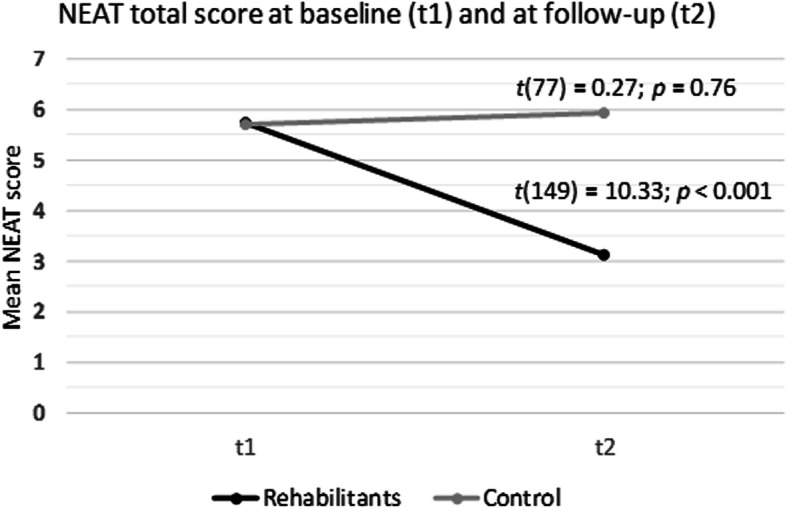
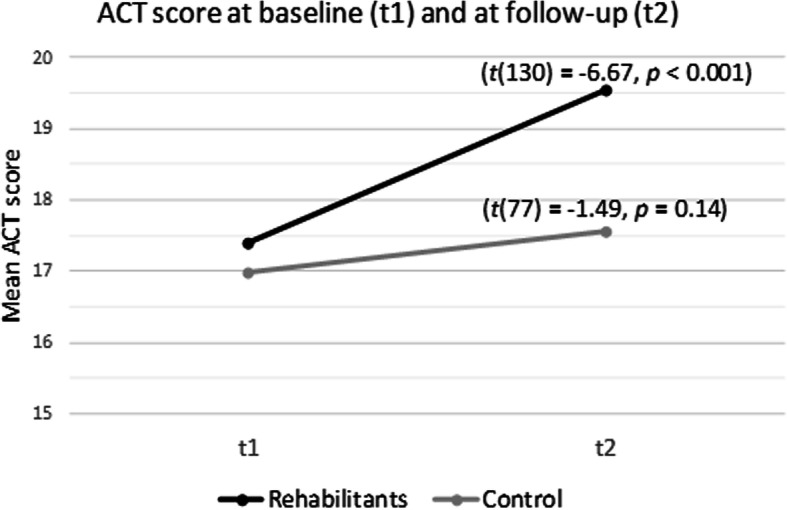
Results: At baseline, there were no differences between the rehabilitation and the control group regarding needs and asthma control. At follow-up, the rehabilitation group showed reduced needs (t(149) = 10.33, p < 0.01) and increased asthma control (t(130) = -6.67, p < 0.01), whereas members of the control group exhibited no changes. Univariate ANCOVAS showed that unmet follow-up needs (F(1, 212) = 36.46, p < 0.001) and follow-up asthma control (F(1, 195) = 6.97, p = 0.009) differed significantly between groups. In the rehabilitation group, self-reported utilization of more interventions was associated with reduced needs (β = 0.21; p = 0.03).
Conclusions: This study provides preliminary evidence suggestion that pulmonary rehabilitation in adults with asthma may reduce asthma-related needs and confirms previous findings that rehabilitation may improve asthma control.
Keywords: Asthma; Needs; Patient-reported outcome measures; Rehabilitation.
Conflict of interest statement
Three of the co-authors are (or were at the time of the survey) hospital directors in the clinics where the survey was conducted: Jalal Gholami (Nordseeklinik Borkum), Dr. Stefan Hummel: (MEDIAN Klinik Heiligendamm), Dr. Konrad Schultz (Klinik Bad Reichenhall).
Figures
References
-
- Bundesärztekammer (BÄK), editor. Nationale VersorgungsLeitlinie Asthma – Langfassung, 3. Auflage. Version 1. 2018. https://www.aezq.de/mdb/downloads/nvl/asthma/archiv/asthma-3aufl-konsult.... Accessed 15 May 2019.
-
- Menz G, Kronenberger H, Lecheler J, Schultz K. Rehabilitation bei Asthma bronchiale. Pneumologie. 2007;61(11):710–18. - PubMed
-
- Fischer J, Schnabel M, Sitter H. Rehabilitation von Patienten mit chronisch obstruktiver Lungenerkrankung (COPD). Pneumologie. 2007;61(04):233-48. - PubMed
MeSH terms
Grants and funding
LinkOut - more resources
Full Text Sources
Medical
