. 2020 Nov 3;117(44):27285-27291.
doi: 10.1073/pnas.2012520117. Epub 2020 Oct 15.

Gender differences in COVID-19 attitudes and behavior: Panel evidence from eight countries

Affiliations

Gender differences in COVID-19 attitudes and behavior: Panel evidence from eight countries

Vincenzo Galasso et al. Proc Natl Acad Sci U S A. .

Abstract

The initial public health response to the breakout of COVID-19 required fundamental changes in individual behavior, such as isolation at home or wearing masks. The effectiveness of these policies hinges on generalized public obedience. Yet, people's level of compliance may depend on their beliefs regarding the pandemic. We use original data from two waves of a survey conducted in March and April 2020 in eight Organisation for Economic Co-operation and Development countries (n = 21,649) to study gender differences in COVID-19-related beliefs and behaviors. We show that women are more likely to perceive COVID-19 as a very serious health problem, to agree with restraining public policy measures, and to comply with them. Gender differences in attitudes and behavior are sizable in all countries. They are accounted for neither by sociodemographic and employment characteristics nor by psychological and behavioral factors. They are only partially mitigated for individuals who cohabit or have direct exposure to the virus. We show that our results are not due to differential social desirability bias. This evidence has important implications for public health policies and communication on COVID-19, which may need to be gender based, and it unveils a domain of gender differences: behavioral changes in response to a new risk.

Keywords: COVID-19 public health rules; compliance with rules; gender differences.


Conflict of interest statement

The authors declare no competing interest.

Figures
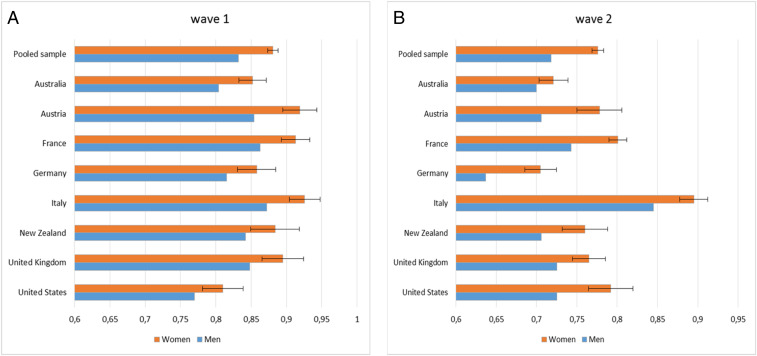
Fig. 1.
Fig. 1.
Compliance index. We show the compliance index for men and women, in the pooled sample and by country, in the first wave of the survey (A) and in the second wave (B). The compliance index is the average of a set of dummy variables equal to 1 if the respondent follows a specific recommended rule (such as washing hands more often and avoiding crowed places) and 0 otherwise (see the Results section for the full list of rules included in the index). We also report the 95% CIs from OLS regressions of this compliance index on the female dummy.
Fig. 2.
Fig. 2.
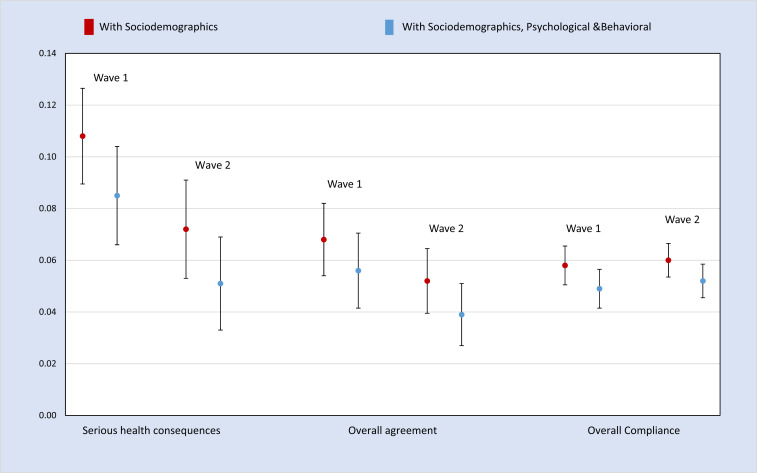
Estimates of gender effects. We show differences between men and women for our main outcomes: serious health consequences, agreement index, and compliance index. The point estimates and corresponding 95% CIs are obtained from OLS specifications regressing the outcome variables on the female dummy. We also control for sociodemographic variables (results in red), as well as psychological and behavioral factors (results in blue). All regressions use pooled data from all countries and from the first and second waves of the survey. Serious health consequences is a dummy variable taking value 1 if the respondent perceives COVID-19 as a very serious health problem and 0 otherwise. The agreement index (compliance index) is the average of a set of dummy variables equal to 1 if the respondent completely agrees with (complies with) a specific restraining public policy measure (such as isolation at home or wearing masks) and 0 otherwise (see the text for the full list of policy measures included in the indices).

References

    1. Maharaj S., Kleczkowski A., Controlling epidemic spread by social distancing: Do it well or not at all. BMC Public Health 12, 679 (2012). - PMC - PubMed
    1. Leung N. H. L.et al. ., Respiratory virus shedding in exhaled breath and efficacy of face masks. Nat. Med. 26, 676–680 (2020). - PMC - PubMed
    1. Kraemer M. U. G.et al. .; Open COVID-19 Data Working Group , The effect of human mobility and control measures on the COVID-19 epidemic in China. Science 368, 493–497 (2020). - PMC - PubMed
    1. Zhang R., Li Y., Zhang A. L., Wang Y., Molina M. J., Identifying airborne transmission as the dominant route for the spread of COVID-19. Proc. Natl. Acad. Sci. U.S.A. 117, 14857–14863 (2020). - PMC - PubMed
    1. Brooks S. K.et al. ., The psychological impact of quarantine and how to reduce it: Rapid review of the evidence. Lancet 395, 912–920 (2020). - PMC - PubMed

Publication types

LinkOut - more resources