. 2020 Oct 15;11(1):5198.
doi: 10.1038/s41467-020-19071-7.

Training high-strength aluminum alloys to withstand fatigue

Affiliations

Training high-strength aluminum alloys to withstand fatigue

Qi Zhang et al. Nat Commun. .

Abstract

The fatigue performance of high strength aluminum alloys used in planes, trains, trucks and automobiles is notoriously poor. Engineers must design around this important limitation to use Al alloys for light-weighting of transportation structures. An alternative concept for microstructure design for improved fatigue strength is demonstrated in this work. Microstructures are designed to exploit the mechanical energy imparted during the initial cycles of fatigue to dynamically heal the inherent weak points in the microstructure. The fatigue life of the highest strength Aluminum alloys is improved by 25x, and the fatigue strength is raised to ~1/2 the tensile strength. The approach embraces the difference between static and dynamic loading and represents a conceptual change in microstructural design for fatigue.


Conflict of interest statement

The authors declare no competing interests.

Figures
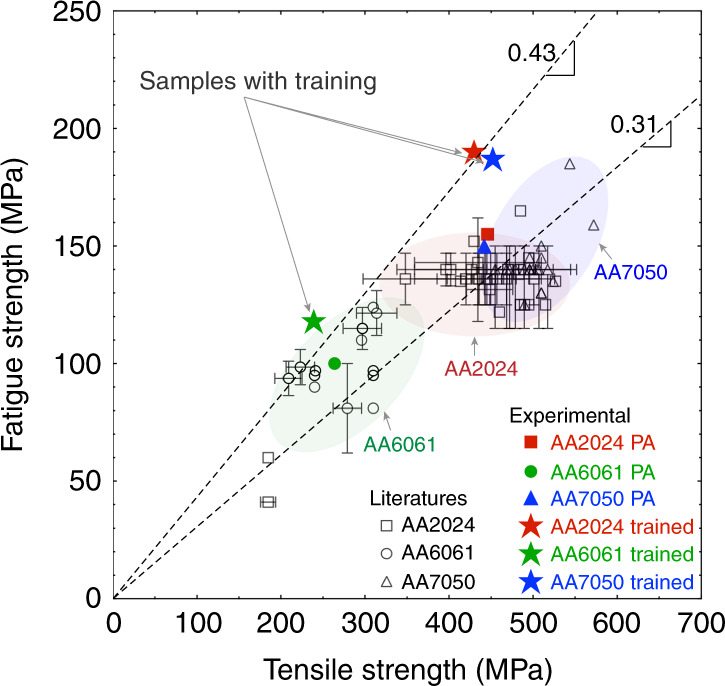
Fig. 1
Fig. 1. The fatigue strength vs. ultimate tensile strength (UTS) for commercial AA2024, AA7050, and AA6061 alloys.
Correlation between fatigue strength and tensile strength for three Al alloys..
Fig. 2
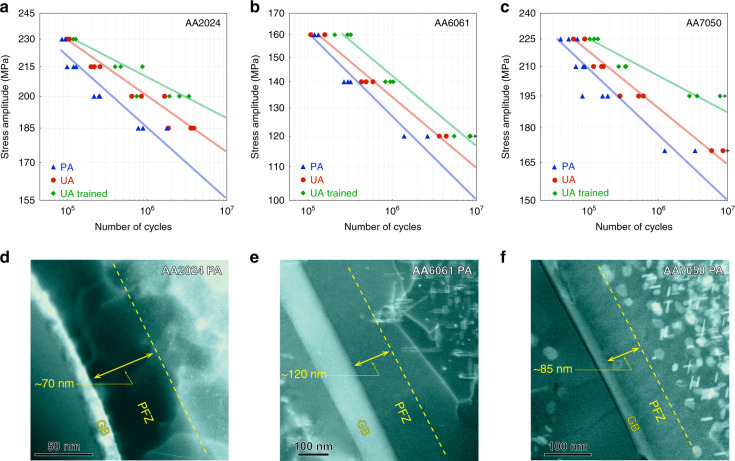
Fig. 2. High cycle fatigue (HCF) S-N curves and precipitate-free zones (PFZ’s) of the under aged (UA), peak aged (PA), and trained alloys.
ac HCF S-N curves of under aged (UA), peak aged (PA), and trained AA2024 (a), AA6061 (b), and AA7050 (c) alloys. The HCF tests were fully reversed (R = −1) at a frequency of 20 Hz. df LAADF-STEM images show PFZ’s formed in the PA alloys. The electron beam direction was parallel to <100>Al in d, e, and parallel to <110>Al in f.
Fig. 3
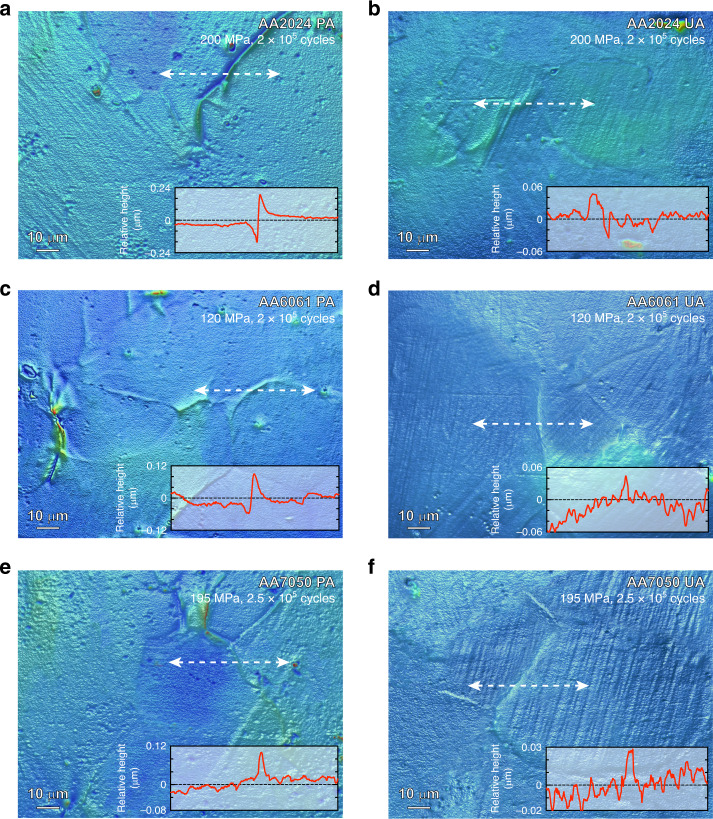
Fig. 3. Surface evolution of air quenched (AQ) AA2024, AA7050, and AA6061 alloys with obvious precipitate-free zones (PFZ’s).
a, c, e The large localized surface relief along the grain boundaries for the peak aged (PA) alloys after certain number of high cycle fatigue (HCF). b, d, f The uniform surface relief formed through the grains for the under aged (UA) alloys after certain number of high cycle fatigue (HCF). The red curves show the relative height of different surface relief highlighted by white arrows.
Fig. 4
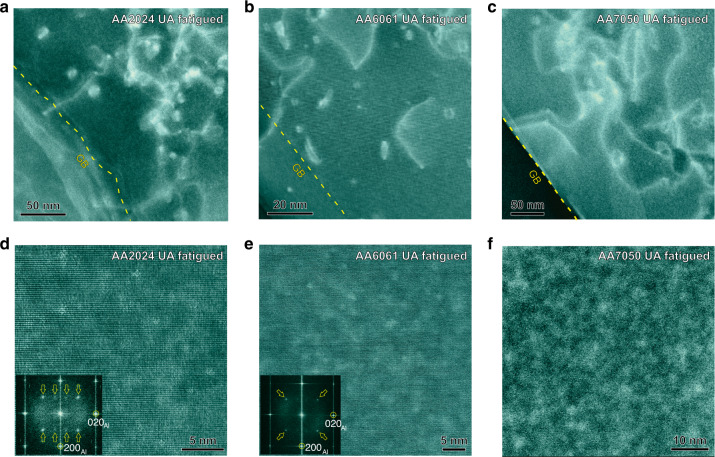
Fig. 4. LAADF-STEM images showing the microstructure of precipitate-free zones (PFZ’s) after HCF deformation.
ac PFZ’s of high cycled fatigue (HCF) treated under aged (UA) samples for AA2024 (a), AA6061 (b), and AA7050 (c). AA2024 was fatigued at 185 MPa for 3.5 × 106 cycles, AA6061 was fatigued at 120 MPa for 4 × 106 cycles, and AA7050 was fatigued at 175 MPa for 8 × 106 cycles. df High-magnification LAADF-STEM images showing nanoprecipitates existing in PFZ’s pointed out in ac. Corresponding fast Fourier transform (FFT) patterns inserted in d, e reveal diffraction from nanoprecipitates (pointed by yellow color hollow arrows). The electron beam direction was parallel to <100>Al in a, b, d, e and parallel to <110>Al in c, f.
Fig. 5
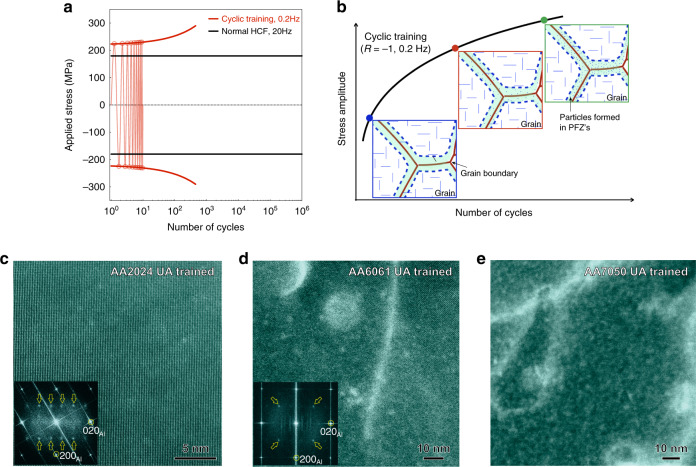
Fig. 5. Cyclic training and microstructure evolution during cyclic training for the under aged (UA) alloys.
a Schematic illustration of the fully reversed (R = −1) cyclic training at 0.2 Hz. b Schematic illustration of the precipitation in PFZ’s as the training cycle number increases. ce LAADF-STEM images showing nanoprecipitates formed in PFZ’s of AA2024 trained for 450 cycles (c), AA6061 trained for 700 cycles (d), and AA7050 trained for 450 cycles (e). Inset FFT patterns in c, d show diffraction from nanoprecipitates (indicated by yellow color hollow arrows). The electron beam direction was parallel to <100>Al in c, d and parallel to <110>Al in e.

References

    1. Sachdev, A., Mishra, R., Mahato, A. & Alpas, A. Vehicle lightweighting: challenges and opportunities in ICAA13 Pittsburgh (eds Weiland, H., Rollett, A., & Cassada, w.) 609–622 (Springer, New York, 2012).
    1. Hirsch J. Aluminium in innivative light–weight car design. Mater. Trans. 2011;52:818–824. doi: 10.2320/matertrans.L-MZ201132. - DOI
    1. Das S, et al. Vehicle lightweighting energy use impacts in U.S. light-duty vehicle fleet. Sustain. Mater. Technol. 2016;8:5–13.
    1. Orowan E. Theory of the fatigue of metals. Proc. R. Soc. Lond. A. 1939;171:79–106. doi: 10.1098/rspa.1939.0055. - DOI
    1. Suresh, S. Fatigue of Materials 2nd edn (Cambridge University Press, 1998).