


The Triage Effectiveness of an Extended High-Risk Human Papillomavirus Genotyping Assay for Women with Cytology Showing Atypical Squamous Cells of Undetermined Significance in China
- PMID: 33061708
- PMCID: PMC7522426
- DOI: 10.2147/RMHP.S270265
The Triage Effectiveness of an Extended High-Risk Human Papillomavirus Genotyping Assay for Women with Cytology Showing Atypical Squamous Cells of Undetermined Significance in China
Abstract
Purpose: Little is known about the performance of extended high-risk human papillomavirus (HR-HPV) genotyping triage of cytology showing atypical squamous cells of undetermined significance (ASC-US). This study aims to evaluate the effectiveness of triage with different HR-HPV genotype models among women with ASC-US.
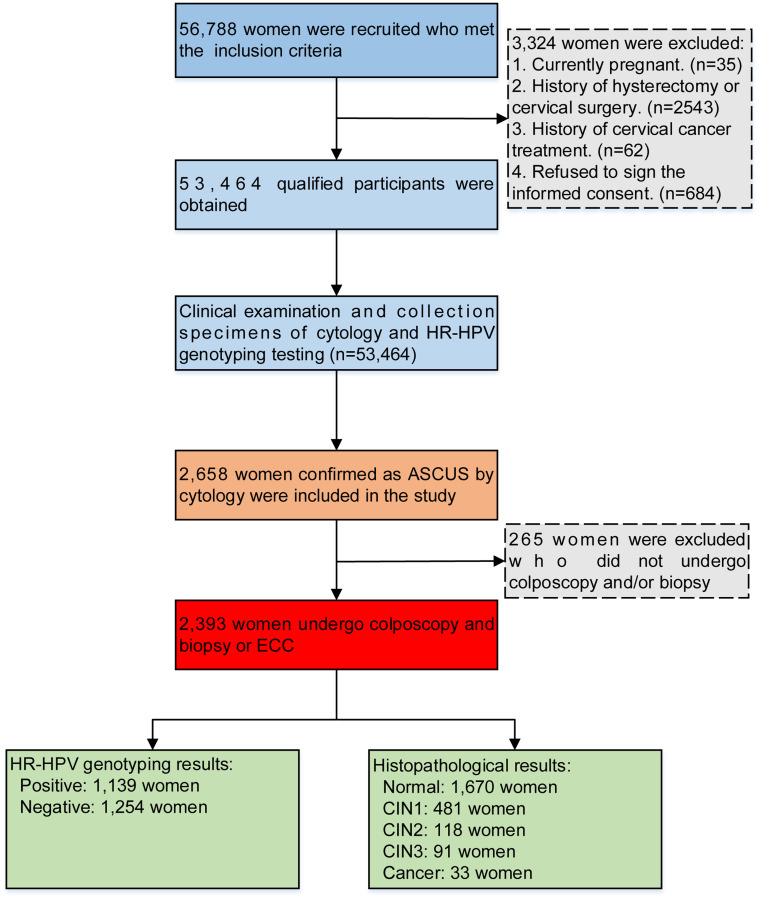
Materials and methods: In this study, all women who underwent cervical cytology and HR-HPV genotyping were enrolled from 2014 to 2017 in China, and those with cytology showing ASC-US were referred for colposcopy and/or biopsy. The endpoint was histological detection of cervical intraepithelial neoplasia grade 2 or worse (CIN2+). The outcome indicators were the sensitivity, specificity, positive predictive values (PPVs), negative predictive values (NPVs) and colposcopy referral rates.
Results: In all, 56,788 women were enrolled in this study, and 2658 (4.97%) women were reported to have ASC-US; 10.1% (242/2393) of women with ASC-US were identified as having CIN2+. The HR-HPV infection rate was 95.0% among all women with ASC-US who were identified as CIN2+, and the top five genotypes with prevalence and risk of CIN2+ were HPV16 (OR=26.38), HPV58 (OR=7.04), HPV18 (OR=4.44), HPV33 (OR=3.38), HPV31 (OR=2.97) and HPV52 (OR=2.96). The HPV16/18/31/33/52/58 model achieved higher sensitivity [91.3 (87.8-94.9)], specificity [70.0 (68.1-72.0)], PPV [25.5 (22.4-28.2)] and NPV [98.6 (97.3-98.7)] for the triage of ASC-US patients than the other HR-HPV-type combination models, but the colposcopy referral rate (36.2%) was significantly lower than that of the recommended HR-HPV nongenotyping model (47.6%).
Conclusion: This study confirms that the specific HR-HPV genotype HPV16/18/31/33/52/58 is an alternative strategy for ASC-US triage and can effectively reduce the high burden of colposcopy referrals in China.
Keywords: atypical squamous cells of undetermined significance; cervical intraepithelial neoplasia; genotyping; human papillomavirus.
© 2020 Pan et al.
Conflict of interest statement
The authors declare that they have no competing interests for this work.
Figures
References
-
- Torre LA, Bray F, Siegel RL, et al. Global cancer statistics, 2012. CA Cancer J Clin. 2015;65:87–108. - PubMed
-
- Wright T, Cox J, Massad L, et al. ASCCP Sponsored Consensus Conference. Consensus guidelines for the management of women with cervical cytological abnormalities. JAMA. 2002;287:2120–2129. - PubMed
-
- Koh WJ, Abu-Rustum NR, Bean S, et al. Cervical cancer, version 3. 2019, NCCN clinical practice guidelines in oncology. J Natl Compr Canc Netw. 2019;17:64–84. - PubMed
-
- Cox JT. Management of women with cervical cytology interpreted as ASC-US or as ASC-H. Clin Obstet Gynecol. 2005;48:160–177. - PubMed
LinkOut - more resources
Full Text Sources
Miscellaneous
