


Evaluation of Procalcitonin, C-Reactive Protein, and Interleukin-6 as Early Markers for Diagnosis of Neonatal Sepsis
- PMID: 33061986
- PMCID: PMC7547329
- DOI: 10.1155/2020/8889086
Evaluation of Procalcitonin, C-Reactive Protein, and Interleukin-6 as Early Markers for Diagnosis of Neonatal Sepsis
Abstract
Background: Neonatal sepsis diagnosis is a challenge because of its nonspecific presentation together with low sensitivity of the time-consuming bacterial cultures. So, many sepsis markers, like C-reactive protein (CRP), procalcitonin (PCT), and interleukin-6 (IL-6), are emerging to improve its diagnosis.
Aim: This study was done to investigate the role of CRP, PCT, and IL-6 in promoting the early diagnosis of neonatal sepsis in an attempt to decrease morbidity and mortality.
Methods: This cross-sectional study was conducted on 50 neonates suspected with sepsis enrolled from the neonatal intensive care unit (NICU) of Zagazig University Hospitals, Egypt. Blood cultures for these neonates were done before starting antibiotics. Also, bacterial DNA was revealed from the blood by broad-range 16S rDNA polymerase chain reaction (PCR). Measurements of CRP using the immunoturbidimetry method, PCT using fluorescence immunoassay quantitative method, and IL-6 using commercially available ELISA kit were done to all enrolled neonates.
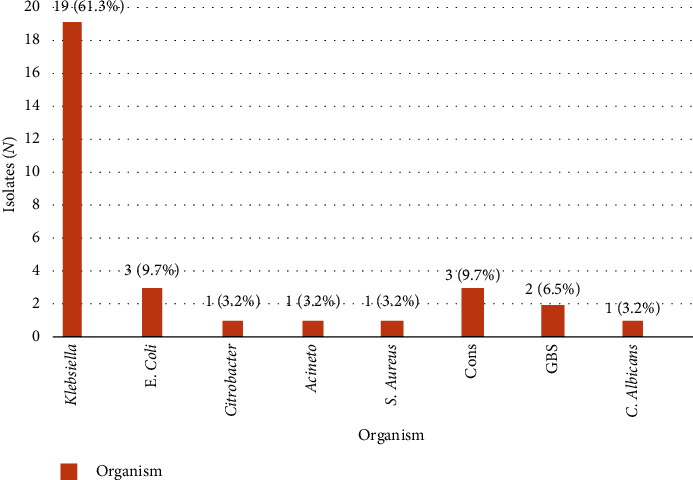
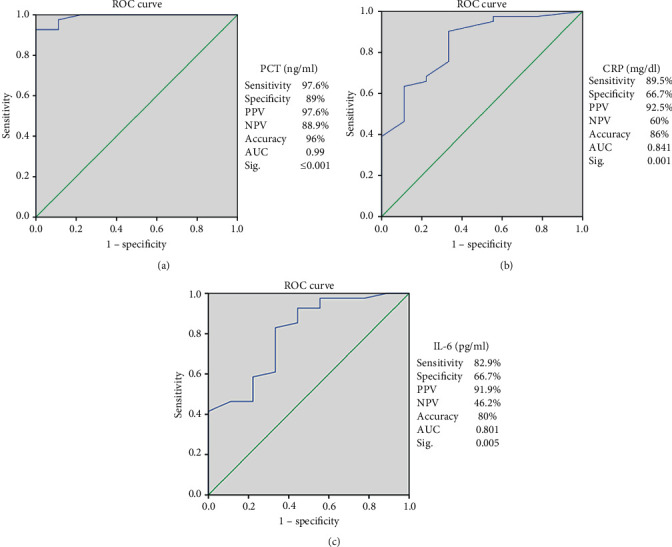
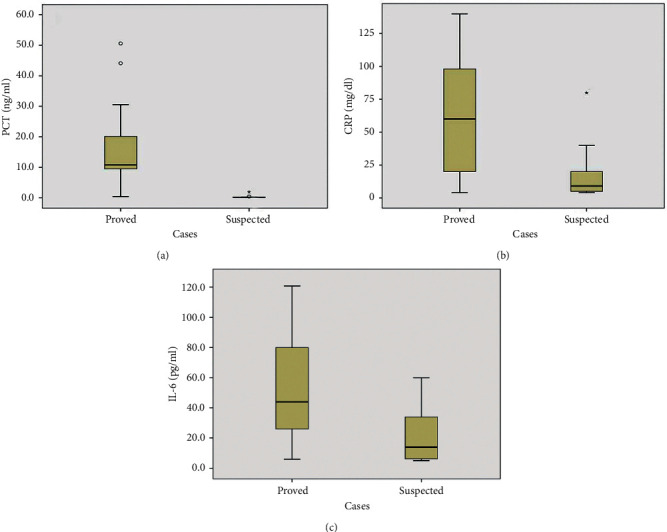
Results: Forty-one neonates with proved sepsis were found to be positive in blood culture and/or PCR for bacterial 16S rDNA. The most common isolated organisms were Klebsiella (61.3%), followed by E. coli (9.7%) and CONS (9.7%). We detected much significant higher levels of PCT, CRP, and IL-6 in the proved sepsis group than the suspected neonatal sepsis cases (p ≤ 0.001, 0.001, and 0.004, respectively). Serum PCT levels showed the highest sensitivity, specificity, PPV, NPV, and accuracy of 97.6%, 89%, 97%, 88.9%, and 96% than other studied sepsis markers.
Conclusion: PCT has satisfactory characteristics as a good marker than IL-6 and CRP for the diagnosis of neonatal sepsis.
Copyright © 2020 Emad A. Morad et al.
Conflict of interest statement
The authors declare that they have no conflicts of interest.
Figures
References
-
- Ranjan R., Jerupula S., Bhagwani D. K. Procalcitonin and CRP markers in neonatal sepsis. International Journal of Scientific Research. 2019;8(2)
-
- Draz N. I., Taha S. E., Abou Shady N. M., Abdel Ghany Y. S. Comparison of broad range 16S rDNA PCR to conventional blood culture for diagnosis of sepsis in the newborn. Egyptian Journal of Medical Human Genetics. 2013;14(4):403–411. doi: 10.1016/j.ejmhg.2013.05.004. - DOI
LinkOut - more resources
Full Text Sources
Research Materials
Miscellaneous
