


Association between Psychological Factors and Condom Use with Regular and Nonregular Male Sexual Partners among Chinese MSM: A Quantitative Study Based on the Health Belief Model
- PMID: 33062685
- PMCID: PMC7539081
- DOI: 10.1155/2020/5807162
Association between Psychological Factors and Condom Use with Regular and Nonregular Male Sexual Partners among Chinese MSM: A Quantitative Study Based on the Health Belief Model
Abstract
Objective: The Chinese men who have sex with men (MSM) population is suffering from a high HIV infection rate owing to unprotected anal sex. The Health Belief Model (HBM) has been proven to be an effective frame associated with behavior maintenance. Based on HBM, we analyzed the beliefs associated with consistent condom use behavior with regular and nonregular partners among MSM to better provide targeted interventions and services.
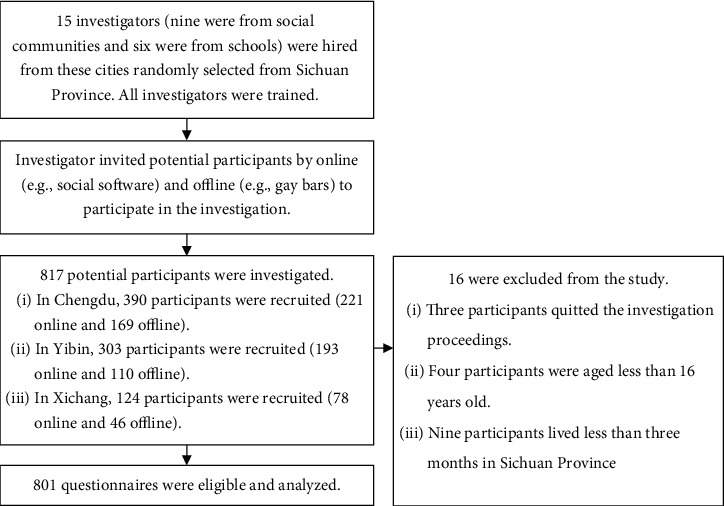
Methods: A study was conducted in Sichuan Province, China, from November 2018 to April 2019, and 801 eligible participants were recruited by snowball sampling. Sociodemographic characteristics, AIDS-related characteristics, sexual behaviors, condom use behavior, and dimensions of HBM were investigated. Univariate, single multivariate, and summary multivariate models were employed to analyze the factors associated with consistent condom use.
Results: Of all participants, 39.1% and 53.6% had had anal sex with regular and nonregular partners in the last six months, respectively. Only 56.5% of them had used condoms consistently with regular partners, and only 60% of them had used condoms consistently with nonregular partners. When taking consistent condoms use with regular partners as the dependent variable, the dimensions of perceived threats (ORM = 1.28, 95% CI: 1.10, 1.49), perceived barriers (ORM = 0.70, 95% CI: 0.60, 0.82), self-efficacy (ORM = 1.23, 95% CI: 1.14, 1.32), and cues to action (ORM = 1.21, 95% CI: 1.02, 1.43) showed significant associations with the dependent variable. When taking consistent condoms use with nonregular partners as the dependent variable, the dimensions of perceived barriers (ORM = 0.77, 95% CI: 0.67, 0.89), self-efficacy (ORM = 1.22, 95% CI: 1.13, 1.32), and cues to action (ORM = 1.53, 95% CI: 1.30, 1.80) showed significant associations with the dependent variable.
Conclusions: More attention should be focused on how to decrease the obstructive factors of condom use, how to improve the confidence of condom use, and how to layout more cues to action to promote consistent condom use behavior with regular and nonregular partners during anal sex among Chinese MSM.
Copyright © 2020 Yuling Huang et al.
Conflict of interest statement
The authors declare no conflict of interest.
References
-
- Traeger M. W., Schroeder S. E., Wright E. J., et al. Effects of pre-exposure prophylaxis for the prevention of human immunodeficiency virus infection on sexual risk behavior in men who have sex with men: a systematic review and meta-analysis. Clinical Infectious Diseases. 2018;67(5):676–686. doi: 10.1093/cid/ciy182. - DOI - PubMed
-
- Hill A. O., Bavinton B. R., Armstrong G. Prevalence and factors associated with inconsistent condom use among men who have sex with men (MSM) who use mobile geo-social networking applications in Greater Tokyo. International Journal of Environmental Research and Public Health. 2018;15(12):p. 2815. doi: 10.3390/ijerph15122815. - DOI - PMC - PubMed
-
- Ha W. Consolidated guidelines on the use of antiretroviral drugs for treating and preventing HIV infection 2013. September 2013, http://www.who.int/hiv/pub/guidelines/arv2013/en/
MeSH terms
LinkOut - more resources
Full Text Sources
Miscellaneous
