


Effect of Modulation of the Astrocytic Glutamate Transporters' Expression on Cocaine-Induced Reinstatement in Male P Rats Exposed to Ethanol
- PMID: 33063090
- PMCID: PMC11004936
- DOI: 10.1093/alcalc/agaa104
Effect of Modulation of the Astrocytic Glutamate Transporters' Expression on Cocaine-Induced Reinstatement in Male P Rats Exposed to Ethanol
Abstract
Aim: Reinforcing properties of ethanol and cocaine are mediated in part through the glutamatergic system. Extracellular glutamate concentration is strictly maintained through several glutamate transporters, such as glutamate transporter 1 (GLT-1), cystine/glutamate transporter (xCT) and glutamate aspartate transporter (GLAST). Previous findings revealed that cocaine and ethanol exposure downregulated GLT-1 and xCT, and that β-lactam antibiotics restored their expression.
Methods: In this study, we investigated the effect of ampicillin/sulbactam (AMP/SUL) (200 mg/kg, i.p.), a β-lactam antibiotic, on cocaine-induced reinstatement and locomotor activity in male alcohol preferring (P) rats using free choice ethanol (15 and 30%, v/v) and water. We also investigated the effect of co-exposure to ethanol and cocaine (20 mg/kg, i.p.) on GLT-1, xCT and GLAST expression in the nucleus accumbens (NAc) core, NAc shell and dorsomedial prefrontal cortex (dmPFC).
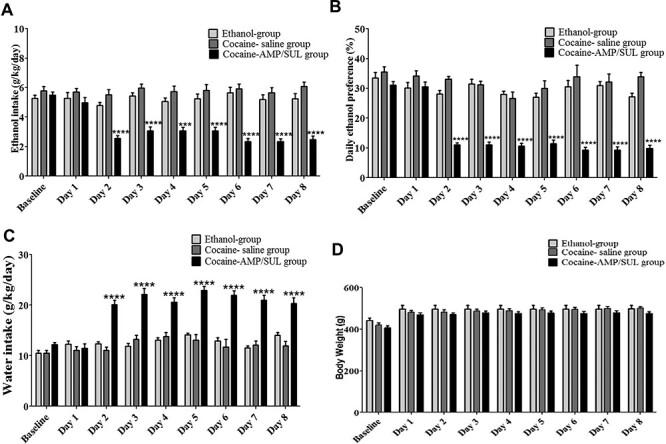
Results: Cocaine exposure decreased ethanol intake and preference. Cocaine and ethanol co-exposure acquired place preference and increased locomotor activity compared to ethanol-exposed rats. GLT-1 and xCT expression were downregulated after cocaine and ethanol co-exposure in the NAc core and shell, but not in dmPFC. AMP/SUL attenuated reinstatement to cocaine as well attenuated the decrease in locomotor activity and ethanol intake and preference. These effects were associated with upregulation of GLT-1 and xCT expression in the NAc core/shell and dmPFC. GLAST expression was not affected after ethanol and cocaine co-exposure or AMP/SUL treatment.
Conclusion: Our findings demonstrate that astrocytic glutamate transporters within the mesocorticolimbic area are critical targets in modulating cocaine-seeking behavior while being consuming ethanol.
© The Author(s) 2020. Medical Council on Alcohol and Oxford University Press. All rights reserved.
Conflict of interest statement
The authors declare no conflict of interest.
Figures


References
MeSH terms
Substances
Grants and funding
LinkOut - more resources
Full Text Sources
Medical
