How Is Geriatric Assessment Used in Clinical Practice for Older Adults With Cancer? A Survey of Cancer Providers by the American Society of Clinical Oncology
- PMID: 33064058
- PMCID: PMC8462667
- DOI: 10.1200/OP.20.00442
How Is Geriatric Assessment Used in Clinical Practice for Older Adults With Cancer? A Survey of Cancer Providers by the American Society of Clinical Oncology
Abstract
Purpose: For patients with cancer who are older than 65 years, the 2018 ASCO Guideline recommends geriatric assessment (GA) be performed. However, there are limited data on providers' practices using GA. Therefore, ASCO's Geriatric Oncology Task Force conducted a survey of providers to assess practice patterns and barriers to GA.
Methods: Cancer providers treating adult patients including those ≥ 65 years completed an online survey. Questions included those asking about awareness of ASCO's Geriatric Oncology Guideline (2018), use of validated GA tools, and perceived barriers to using GA. Descriptive statistics and statistical comparisons between those aware of the Guideline and those who were not were conducted. Statistical significance was set at P < .05.
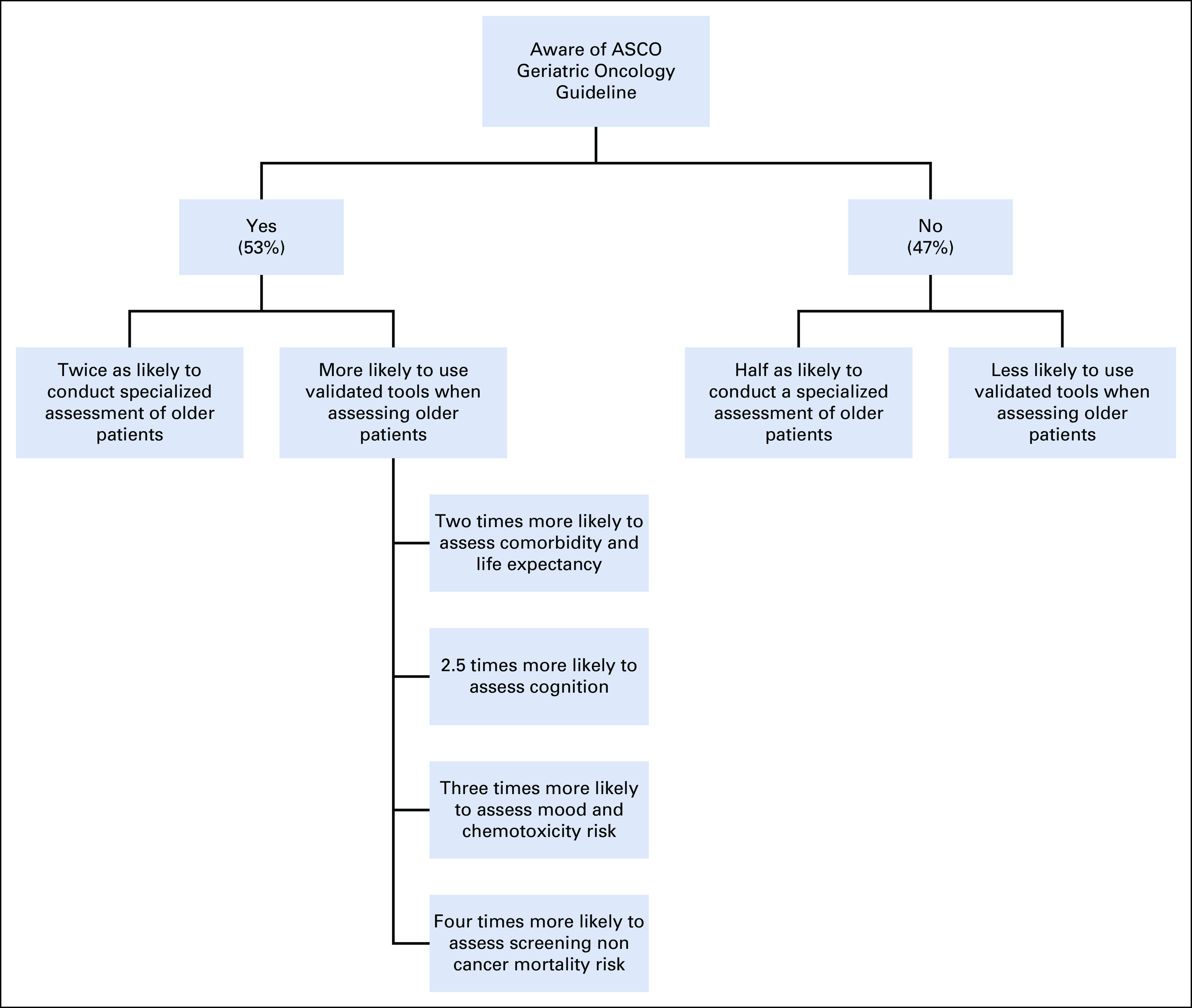
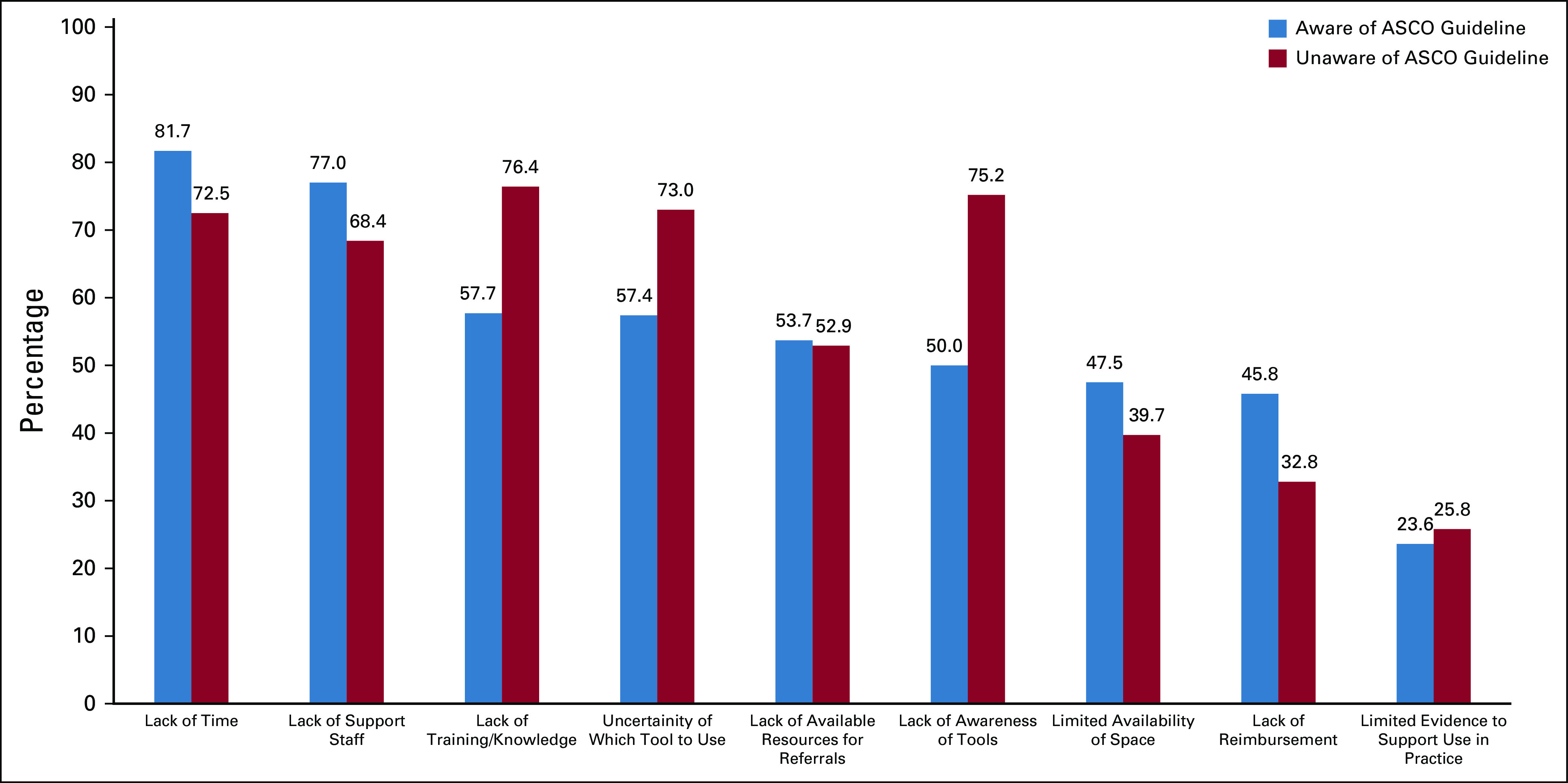
Results: Participants (N = 1,277) responded between April 5 and June 5, 2019. Approximately half (53%) reported awareness of the Guideline. The most frequently used GA tools, among those aware of the Guideline and those who were not, assessed functional status (69% v 50%; P < .001) and falls (62% v 45%; P < .001). Remaining tools were used < 50% of the time, including tools assessing weight loss, comorbidities, cognition, life expectancy, chemotherapy toxicity, mood, and noncancer mortality risk. GA use was two to four times higher among those who are aware of the Guideline. The most frequent barriers for those who reported being Guideline aware were lack of resources, specifically time (81.7%) and staff (77.0%). In comparison, those who were unaware of the Guideline most often reported the following barriers: lack of knowledge or training (78.4%), lack of awareness about tools (75.2%), and uncertainty about use of tools (75.0%).
Conclusion: Among providers caring for older adults, 52% were aware of the ASCO Guideline. Some domains were assessed frequently (eg, function, falls), whereas other domains were assessed rarely (eg, mood, cognition). Guideline awareness was associated with two to four times increased use of GA and differing perceived barriers. Interventions facilitating Guideline-consistent implementation will require various strategies to change behavior.
Conflict of interest statement
Figures


References
-
- Smith BD, Smith GL, Hurria A, et al. Future of cancer incidence in the United States: Burdens upon an aging, changing nation J Clin Oncol 272758–27652009 - PubMed
-
- National Institute on Aging: World’s older population grows dramatically: NIH-funded Census Bureau report offers details of global aging phenomenon. 2016. https://www.nih.gov/news-events/news-releases/worlds-older-population-gr....
-
- Soto-Perez-de-Celis E, de Glas NA, Hsu T, et al. Global geriatric oncology: Achievements and challenges J Geriatr Oncol 8374–3862017 - PubMed
-
- National Institutes of Health: Inclusion across the lifespan grants & funding: NIH Central Resource for grants and funding information. https://grants.nih.gov/policy/inclusion/lifespan.htm.
MeSH terms
Grants and funding
LinkOut - more resources
Full Text Sources
Medical
Miscellaneous