Review
. 2021 Apr;115(4):623-642.
doi: 10.1111/mmi.14627. Epub 2020 Nov 3.

Genes affecting the extension of chronological lifespan in Schizosaccharomyces pombe (fission yeast)

Affiliations
Review

Genes affecting the extension of chronological lifespan in Schizosaccharomyces pombe (fission yeast)

Hokuto Ohtsuka et al. Mol Microbiol. 2021 Apr.

Abstract

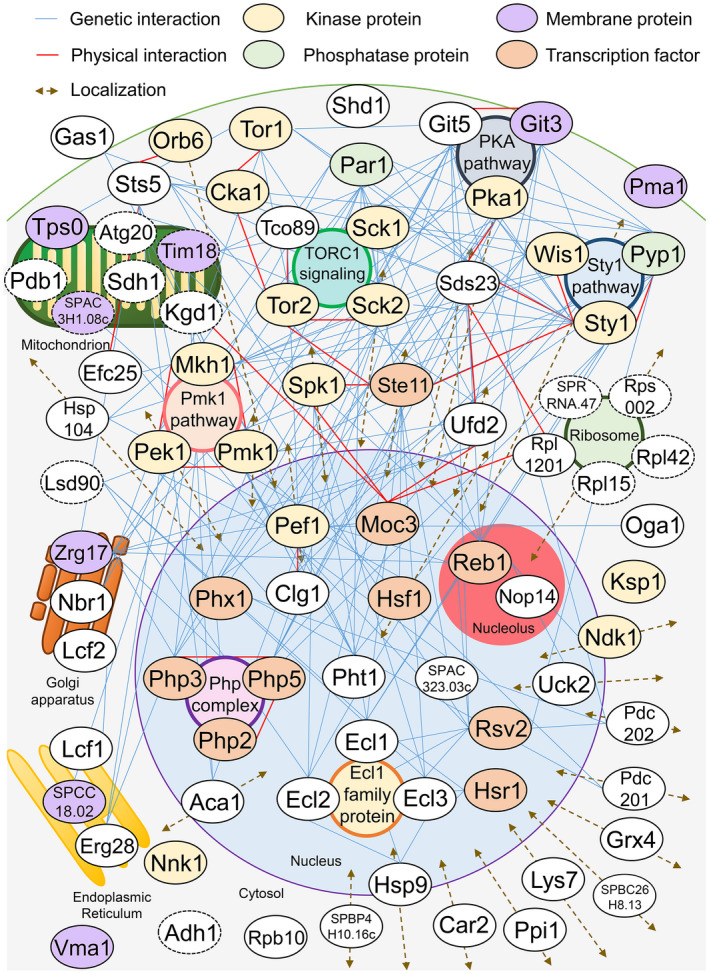
So far, more than 70 genes involved in the chronological lifespan (CLS) of Schizosaccharomyces pombe (fission yeast) have been reported. In this mini-review, we arrange and summarize these genes based on the reported genetic interactions between them and the physical interactions between their products. We describe the signal transduction pathways that affect CLS in S. pombe: target of rapamycin complex 1, cAMP-dependent protein kinase, Sty1, and Pmk1 pathways have important functions in the regulation of CLS extension. Furthermore, the Php transcription complex, Ecl1 family proteins, cyclin Clg1, and the cyclin-dependent kinase Pef1 are important for the regulation of CLS extension in S. pombe. Most of the known genes involved in CLS extension are related to these pathways and genes. In this review, we focus on the individual genes regulating CLS extension in S. pombe and discuss the interactions among them.

Keywords: Schizosaccharomyces pombe; chronological lifespan; fission yeast; longevity; signal transduction; stationary phase.


Conflict of interest statement

None declared.

Figures
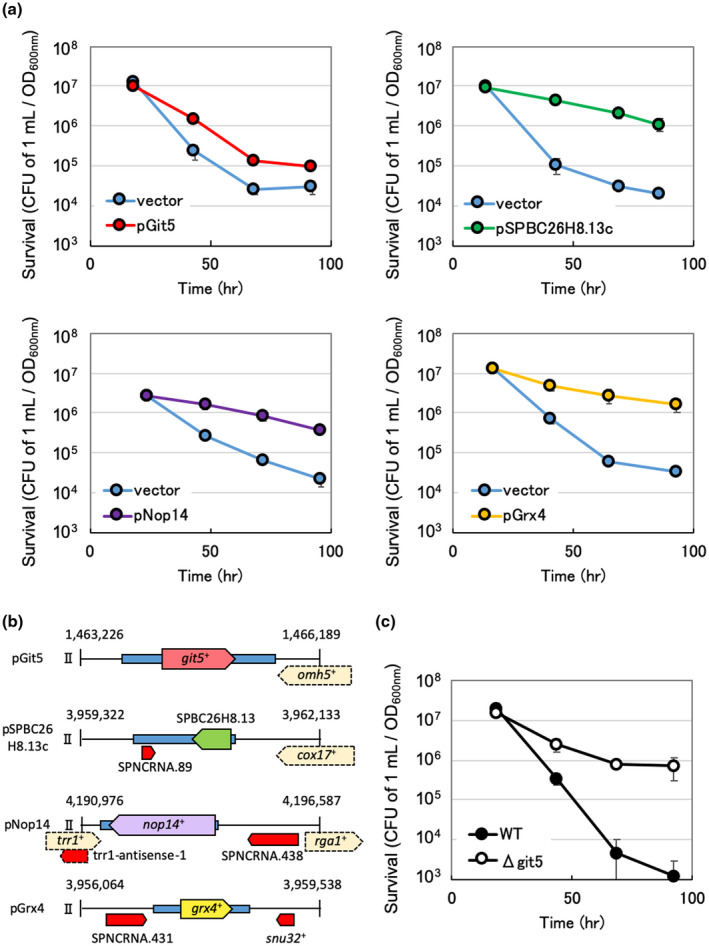
FIGURE 1
FIGURE 1
(a) The results of chronological lifespan (CLS) measurements. The strain of Schizosaccharomyces pombe used was JY333 and the plasmid vector was pLB‐Dblet. To determine cell viability, the cells were grown in SD liquid medium, sampled at each growth phase, and then, plated on YE agar plates using suitable dilutions. After incubation for several days as 30°C, the number of colonies derived from 1 ml of culture was counted. This number was divided by the cell turbidity at the sampling time. (b) The DNA fragments that were inserted into the plasmids are carried by the cells whose CLS were measured. (c) The results of CLS measurement of wild‐type JY333 and Δgit5 are shown
FIGURE 2
FIGURE 2
Factors that reportedly cause chronological lifespan extension in Schizosaccharomyces pombe. All the genetic and physical interactions reported so far are shown. Information on each factor's localization was based on the reports by Ding et al. (2000) and Matsuyama et al. (2006), in addition to those mentioned in the text. Dotted lines indicate factors with unknown localization. Studies in which two or more intracellular localization (e.g., nucleus and cytosol) were reported are indicated by double‐headed arrows
FIGURE 3
FIGURE 3
A hypothetical model summarizing the representative signal pathways and factors involved in chronological lifespan regulation in Schizosaccharomyces pombe
FIGURE 4
FIGURE 4
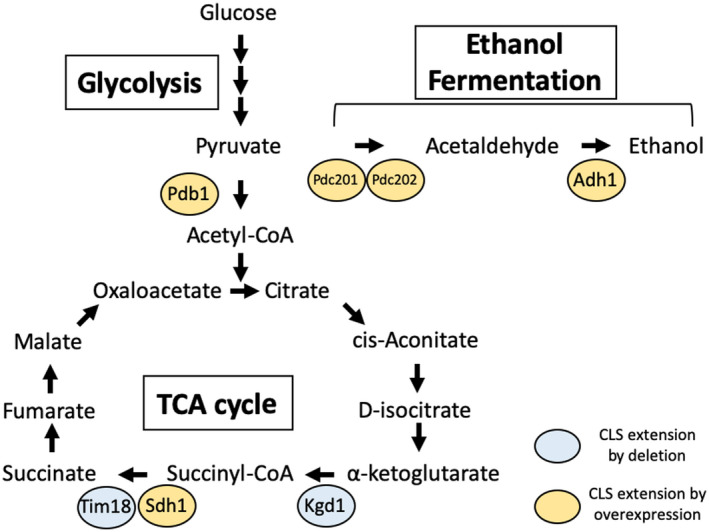
Model summarizing the chronological lifespan regulatory factors involved in energy metabolism

References

    1. Azuma, K. , Ohtsuka, H. , Mita, S. , Murakami, H. and Aiba, H. (2009) Identification and characterization of an Ecl1‐family gene in Saccharomyces cerevisiae . Bioscience, Biotechnology, and Biochemistry, 73, 2787–2789. 10.1271/bbb.90599 - DOI - PubMed
    1. Berlett, B.S. and Stadtman, E.R. (1997) Protein oxidation in aging, disease, and oxidative stress. Journal of Biological Chemistry, 272, 20313–20316. 10.1074/jbc.272.33.20313 - DOI - PubMed
    1. Bicho, C.C. , de Lima Alves, F.D.L. , Chen, Z.A. , Rappsilber, J. and Sawin, K.E. (2010) A genetic engineering solution to the ‘arginine conversion problem’ in stable isotope labeling by amino acids in cell culture (SILAC). Molecular and Cellular Proteomics, 9, 1567–1577. 10.1074/mcp.M110.000208. - DOI - PMC - PubMed
    1. Breitkreutz, A. , Choi, H. , Sharom, J.R. , Boucher, L. , Neduva, V. , Larsen, B. , et al. (2010) A global protein kinase and phosphatase interaction network in yeast. Science, 328, 1043–1046. 10.1126/science.1176495 - DOI - PMC - PubMed
    1. Burtner, C.R. , Murakami, C.J. , Olsen, B. , Kennedy, B.K. and Kaeberlein, M. (2011) A genomic analysis of chronological longevity factors in budding yeast. Cell Cycle, 10, 1385–1396. 10.4161/cc.10.9.15464 - DOI - PMC - PubMed

Publication types

MeSH terms

Substances