. 2021 Feb:146:e91-e99.
doi: 10.1016/j.wneu.2020.10.025. Epub 2020 Oct 13.

An Evaluation of Neurosurgical Practices During the Coronavirus Disease 2019 Pandemic

Affiliations

An Evaluation of Neurosurgical Practices During the Coronavirus Disease 2019 Pandemic

Panayiotis E Pelargos et al. World Neurosurg. 2021 Feb.

Abstract

Objective: We sought to understand how the coronavirus disease 2019 pandemic has affected the neurosurgical workforce.

Methods: We created a survey consisting of 22 questions to assess the respondent's operative experience, location, type of practice, subspecialty, changes in clinic and operative volumes, changes to staff, and changes to income since the pandemic began. The survey was distributed electronically to neurosurgeons throughout the United States and Puerto Rico.

Results: Of the 724 who opened the survey link, 457 completed the survey. The respondents were from throughout the United States and Puerto Rico and represented all practices types and subspecialties. Nearly all respondents reported hospital restrictions on elective surgeries. Most reported a decline in clinic and operative volume. Nearly 70% of respondents saw a decrease in the work hours of their ancillary providers, and almost one half (49.1%) of the respondents had had to downsize their practice staff, office assistants, nurses, schedulers, and other personnel. Overall, 43.6% of survey respondents had experienced a decline in income, and 27.4% expected a decline in income in the upcoming billing cycle. More senior neurosurgeons and those with a private practice, whether solo or as part of a group, were more likely to experience a decline in income as a result of the pandemic compared with their colleagues.

Conclusion: The coronavirus disease 2019 pandemic will likely have a lasting effect on the practice of medicine. Our survey results have described the early effects on the neurosurgical workforce. Nearly all neurosurgeons experienced a significant decline in clinical volume, which led to many downstream effects. Ultimately, analysis of the effects of such a pervasive pandemic will allow the neurosurgical workforce to be better prepared for similar events in the future.

Keywords: COVID-19; Neurosurgery; Neurosurgery practice; Pandemic; Survey.


Figures

Figure 1
Figure 1
Graph showing the distribution of subspecialties among survey respondents. Most respondents were general or spine neurosurgeons. Two respondents did not state their primary subspecialty.
Figure 2
Figure 2
Graph showing the respondent responses to the question of whether the respondents believed that the neurosurgical care of their patients had suffered significantly because of the coronavirus disease 2019 pandemic. Most respondents reported that the neurosurgical care of their patients had suffered during the pandemic.
Figure 3
Figure 3
Graph showing the change in clinic volumes among all respondents during the coronavirus disease 2019 pandemic. Most respondents had experienced a >50% decline in their clinic volume, and >5% of respondents had closed their clinic altogether during the pandemic.
Figure 4
Figure 4
Graph showing the change in clinic volume stratified by the years in practice, type of practice, and subspecialty during the coronavirus disease 2019 pandemic. Those in practice >20 years were significantly more likely to have closed their clinic compared with the remainder of their colleagues (8.3% vs. 2.8%; P = 0.011). Those in solo private practice were significantly more likely to have closed their clinic than were those in other practice types (19.4% vs. 4.2%; P = 0.003). Those whose primary subspecialty was the spine were significantly more likely to close their clinic than were those in other subspecialties (10.1% vs. 3.2%; P = 0.001).
Figure 5
Figure 5
Graph showing the change in operative volumes among all respondents during the coronavirus disease 2019 pandemic. Most respondents had experienced a >50% decline in their operative volume, and >7% of respondents had stopped performing surgery altogether during the pandemic.
Figure 6
Figure 6
Graph showing the change in the operative volume stratified by the years in practice, type of practice, and subspecialty during the coronavirus disease 2019 pandemic. Those in practice >15 years were significantly more likely to have completely stopped performing surgery compared with the remainder of their colleagues (9.4% vs. 3.7%; P < 0.001). Those in solo private practice were significantly more likely to have completely stopped performing surgery than were those in other practice types (19.4% vs. 6.4%; P = 0.007). Those whose primary subspecialty was the spine were significantly more likely to have completely stopped operating than were those in other subspecialties (15.1% vs. 3.8%; P < 0.001).
Figure 7
Figure 7
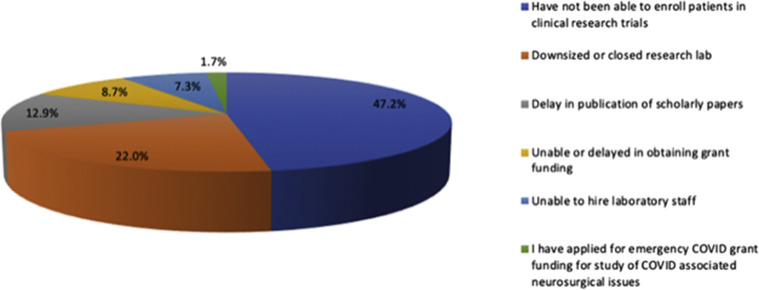
Pie chart showing how the coronavirus disease 2019 pandemic has affected the respondents' research efforts. These were not mutually exclusive categories (e.g., a respondent could select spending increased time conducting clinical research, watching remote didactic lectures, and spending time in the anatomy laboratory).

References

    1. Zhu N., Zhang D., Wang W., et al. A novel coronavirus from patients with pneumonia in China, 2019. N Engl J Med. 2020;382:727–733. - PMC - PubMed
    1. Cucinotta D., Vanelli M. WHO declares COVID-19 a pandemic. Acta Biomed. 2020;91:157–160. - PMC - PubMed
    1. American College of Surgeons COVID-19: Guidance for Triage of Non-Emergent Surgical Procedures. https://www.facs.org/covid-19/clinical-guidance/triage Available at:
    1. American College of Surgeons COVID-19: Recommendations for Management of Elective Surgical Procedures. https://www.facs.org/covid-19/clinical-guidance/elective-surgery Available at:
    1. Centers for Medicare and Medicaid Services Non-Emergent, Elective Medical Services and Treatment Recommendations. https://www.cms.gov/files/document/cms-non-emergent-elective-medical-rec... Available at:

Publication types

MeSH terms