. 2020 Oct 13;17(20):7434.
doi: 10.3390/ijerph17207434.

Malaria Transmission and Spillover across the Peru-Ecuador Border: A Spatiotemporal Analysis

Affiliations

Malaria Transmission and Spillover across the Peru-Ecuador Border: A Spatiotemporal Analysis

Annika K Gunderson et al. Int J Environ Res Public Health. .

Abstract

Border regions have been implicated as important hot spots of malaria transmission, particularly in Latin America, where free movement rights mean that residents can cross borders using just a national ID. Additionally, rural livelihoods largely depend on short-term migrants traveling across borders via the Amazon's river networks to work in extractive industries, such as logging. As a result, there is likely considerable spillover across country borders, particularly along the border between Peru and Ecuador. This border region exhibits a steep gradient of transmission intensity, with Peru having a much higher incidence of malaria than Ecuador. In this paper, we integrate 13 years of weekly malaria surveillance data collected at the district level in Peru and the canton level in Ecuador, and leverage hierarchical Bayesian spatiotemporal regression models to identify the degree to which malaria transmission in Ecuador is influenced by transmission in Peru. We find that increased case incidence in Peruvian districts that border the Ecuadorian Amazon is associated with increased incidence in Ecuador. Our results highlight the importance of coordinated malaria control across borders.

Keywords: Bayesian methods; human mobility; malaria; spatiotemporal modeling; spillover.


Conflict of interest statement

The authors declare no conflict of interest.

Figures
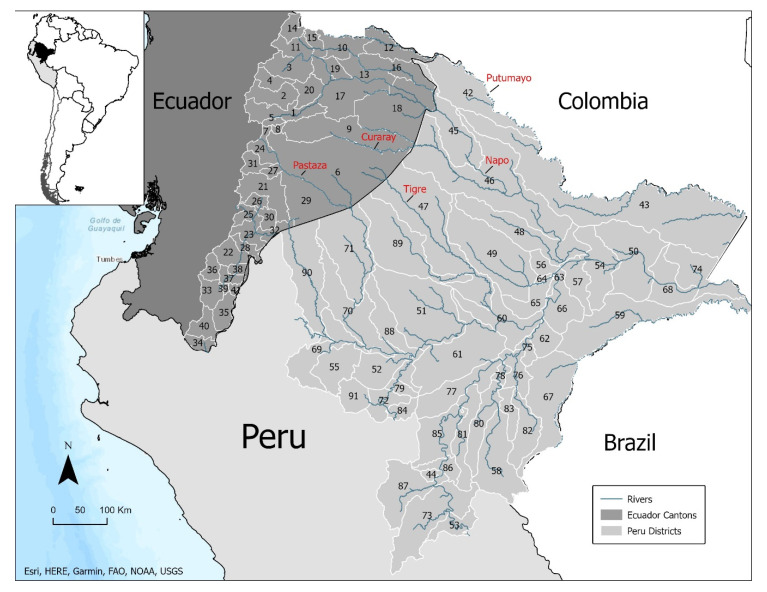
Figure 1
Figure 1
Map of the study area with cantons/districts numbered. 1: Tena, 2: Archidona, 3: El Chaco, 4: Quijos, 5: Carlos Julio Arosemena Tola, 6: Pastaza, 7: Mera, 8: Santa Clara, 9: Arajuno, 10: Lago Agrio, 11: Gonzalo Pizarro, 12: Putumayo, 13: Shushufindi, 14: Sucumbíos, 15: Cáscales, 16: Cuyabeno, 17: Orellana, 18: Aguarico, 19: La Joya De Los Sachas, 20: Loreto, 21: Morona, 22: Gualaquiza, 23: Limón Indanza, 24: Palora, 25: Santiago, 26: Sucua, 27: Huamboya, 28: San Juan Bosco, 29: Taisha, 30: Logrodo, 31: Pablo Sexto, 32: Tiwintza, 33: Zamora, 34: Chinchipe, 35: Nangaritza, 36: Yacuambi, 37: Yantzaza, 38: El Pangui, 39: Centinela Del Condor, 40: Palanda, 41: Paquisha, 42: Teniente Manuel Clavero, 43: Putumayo, 44: Inahuaya, 45: Torres Causana, 46: Napo, 47: Tigre, 48: Mazan, 49: Alto Nanay, 50: Pebas, 51: Urarinas, 52: Jeberos, 53: Padre Marquez, 54: Las Amazonas, 55: Cahuapanas, 56: Punchana, 57: Indiana, 58: Alto Tapiche, 59: Yavari, 60: Nauta, 61: Parinari, 62: Saquena, 63: Belen, 64: Iquitos, 65: San Juan Bautista, 66: Fernando Lores, 67: Yaquerana, 68: San Pablo, 69: Barranca, 70: Pastaza, 71: Andoas, 72: Yurimaguas, 73: Contamana, 74: Ramon Castilla, 75: Jenaro Herrera, 76: Requena, 77: Puinahua, 78: Capelo, 79: Santa Cruz, 80: Emilio San Martin, 81: Maquia, 82: Soplin, 83: Tapiche, 84: Teniente Cesar Lopez Rojas, 85: Sarayacu, 86: Vargas Guerra, 87: Pampa Hermosa, 88: Lagunas, 89: Trompeteros, 90: Morona, 91: Balsapuerto.
Figure 2
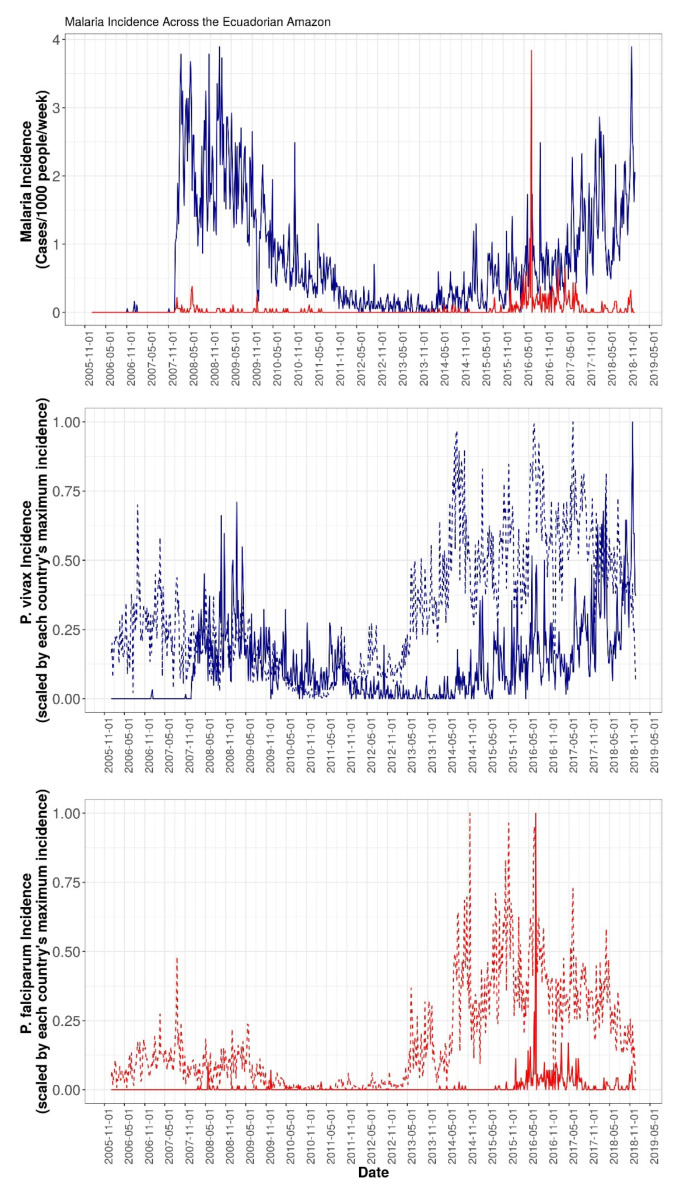
Figure 2
(Top) Incidence over time for both P. falciparum (red) and P. vivax (blue) malaria across the Ecuadorian Amazon from January 2006 to December 2018. (Middle) Incidence of P. vivax malaria in Loreto districts bordering Ecuador (dotted line) and in Ecuadorian cantons bordering Loreto (solid line). (Bottom) Incidence of P. falciparum malaria in Loreto districts bordering Ecuador (dotted line) and in Ecuadorian cantons bordering Loreto (solid line).
Figure 3
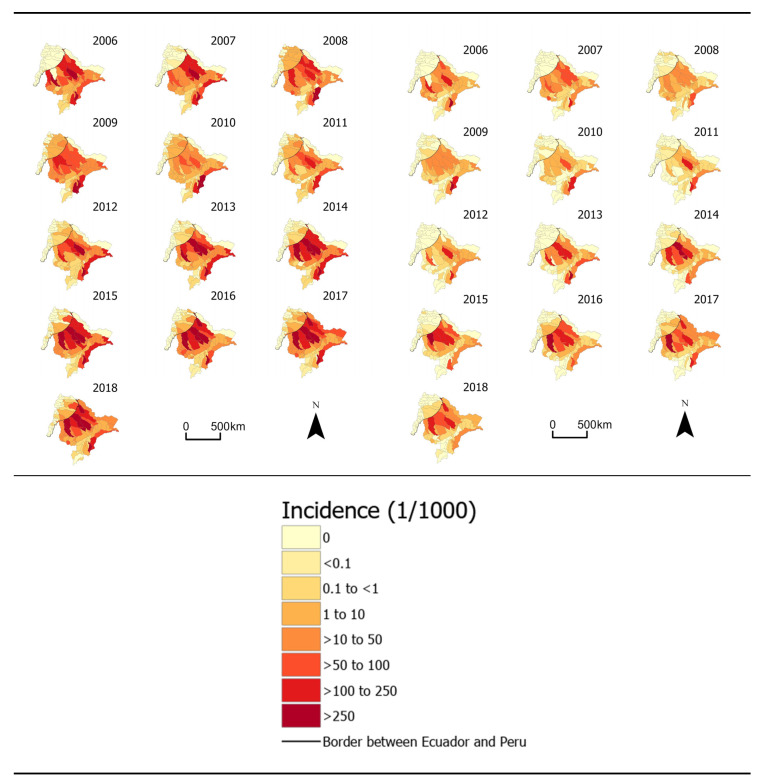
Figure 3
Maps of annual malaria incidence rates for both P. vivax (left) and P. falciparum (right) across the study region.

References

    1. Global Malaria Programme. WHO Global . World Malaria Report 2019. World Health Organization; Geneva, Switzerland: 2019.
    1. Aramburú Guarda J., Ramal Asayag C., Witzig R. Malaria reemergence in the Peruvian Amazon region. Emerg. Infect. Dis. 1999;5:209–215. doi: 10.3201/eid0502.990204. - DOI - PMC - PubMed
    1. Hay S.I., Okiro E.A., Gething P.W., Patil A.P., Tatem A.J., Guerra C.A., Snow R.W. Estimating the global clinical burden of Plasmodium falciparum malaria in 2007. PLoS Med. 2010;7:e1000290. - PMC - PubMed
    1. Cotter C., Sturrock H.J., Hsiang M.S., Liu J., Phillips A.A., Hwang J., Gueye C.S., Fullman N., Gosling R.D., Feachem R.G. The changing epidemiology of malaria elimination: New strategies for new challenges. Lancet. 2013;382:900–911. doi: 10.1016/S0140-6736(13)60310-4. - DOI - PMC - PubMed
    1. Grillet M.E., Villegas L., Oletta J.F., Tami A., Conn J.E. Malaria in Venezuela requires response. Science. 2018;359:528. - PubMed

Publication types