Review
. 2020 Oct 14;21(20):7571.
doi: 10.3390/ijms21207571.

From 1957 to Nowadays: A Brief History of Epigenetics

Affiliations
Review

From 1957 to Nowadays: A Brief History of Epigenetics

Paul Peixoto et al. Int J Mol Sci. .

Abstract

Due to the spectacular number of studies focusing on epigenetics in the last few decades, and particularly for the last few years, the availability of a chronology of epigenetics appears essential. Indeed, our review places epigenetic events and the identification of the main epigenetic writers, readers and erasers on a historic scale. This review helps to understand the increasing knowledge in molecular and cellular biology, the development of new biochemical techniques and advances in epigenetics and, more importantly, the roles played by epigenetics in many physiological and pathological situations.

Keywords: DNA methylation; epigenetics; epitranscriptomics; histones; history.


Conflict of interest statement

The authors declare no conflict of interest.

Figures
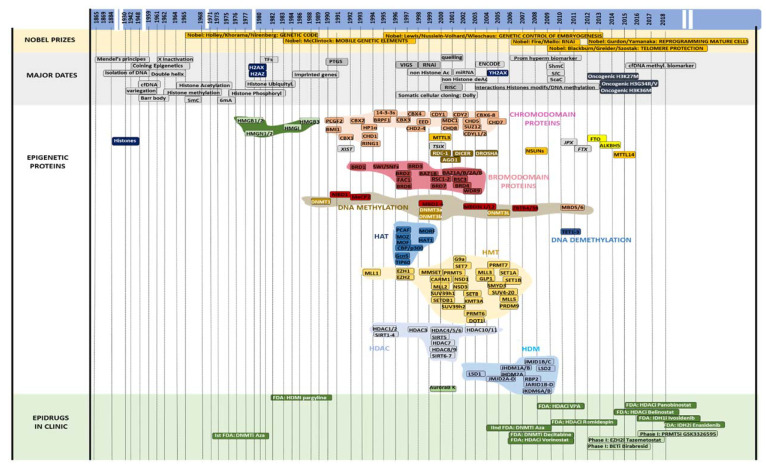
Figure 1
Figure 1
Chronology of epigenetics. From top to bottom: Dates (blue): from 1865 to today; Nobel Prizes (salmon) associated with major genetic or epigenetic discoveries; major dates (gray): important discoveries concerning DNA and chromatin; epigenetic proteins (white): year of identification or main writers, readers and erasers of epigenetics (a color code has been associated to proteins involved in a same pathway, e.g., blue for HAT (histone acetyl transferase)); epidrugs in the clinic (green): use of main epidrugs in clinical trials.

References

    1. Waddington C.H. The epigenotype. 1942. Int. J. Epidemiol. 2012;41:10–13. doi: 10.1093/ije/dyr184. - DOI - PubMed
    1. Muller H.J., Altenburg E. The frequency of translocations produced by X-rays in drosophila. Genetics. 1930;15:283–311. - PMC - PubMed
    1. Goldberg A.D., Allis C.D., Bernstein E. Epigenetics: A landscape takes shape. Cell. 2007;128:635–638. doi: 10.1016/j.cell.2007.02.006. - DOI - PubMed
    1. Surani M.A., Barton S.C., Norris M.L. Development of reconstituted mouse eggs suggests imprinting of the genome during gametogenesis. Nature. 1984;308:548–550. doi: 10.1038/308548a0. - DOI - PubMed
    1. McGrath J., Solter D. Nuclear transplantation in mouse embryos. J. Exp. Zool. 1983;228:355–362. doi: 10.1002/jez.1402280218. - DOI - PubMed

LinkOut - more resources
