Review
. 2020 Oct 14;12(10):2973.
doi: 10.3390/cancers12102973.

The Role of Translocator Protein TSPO in Hallmarks of Glioblastoma

Affiliations
Review

The Role of Translocator Protein TSPO in Hallmarks of Glioblastoma

Laura-Marie Ammer et al. Cancers (Basel). .

Abstract

Glioblastoma (GBM) is the most fatal primary brain cancer in adults. Despite extensive treatment, tumors inevitably recur, leading to an average survival time shorter than 1.5 years. The 18 kDa translocator protein (TSPO) is abundantly expressed throughout the body including the central nervous system. The expression of TSPO increases in states of inflammation and brain injury due to microglia activation. Not least due to its location in the outer mitochondrial membrane, TSPO has been implicated with a broad spectrum of functions. These include the regulation of proliferation, apoptosis, migration, as well as mitochondrial functions such as mitochondrial respiration and oxidative stress regulation. TSPO is frequently overexpressed in GBM. Its expression level has been positively correlated to WHO grade, glioma cell proliferation, and poor prognosis of patients. Several lines of evidence indicate that TSPO plays a functional part in glioma hallmark features such as resistance to apoptosis, invasiveness, and proliferation. This review provides a critical overview of how TSPO could regulate several aspects of tumorigenesis in GBM, particularly in the context of the hallmarks of cancer proposed by Hanahan and Weinberg in 2011.

Keywords: TSPO; diagnostic marker; glioblastoma; hallmarks of cancer.


Conflict of interest statement

The authors declare no conflict of interest.

Figures
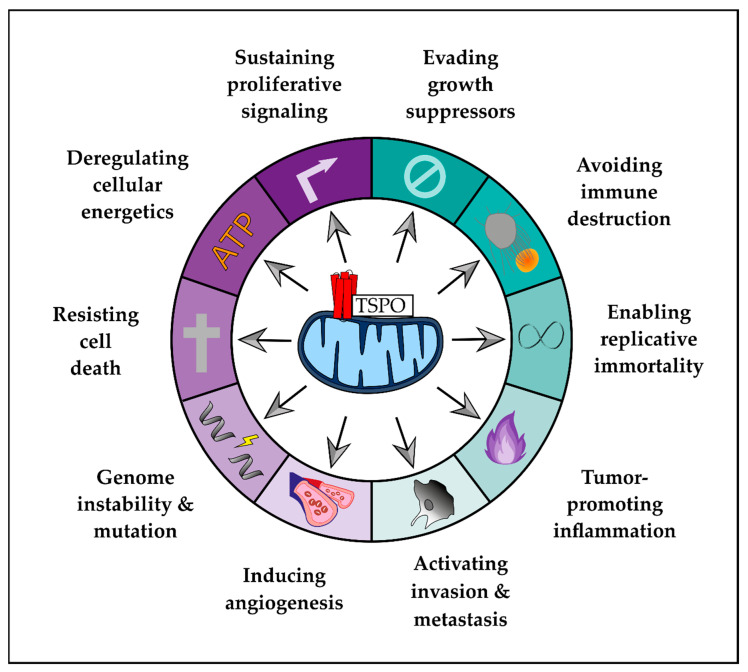
Figure 1
Figure 1
Translocator protein (TSPO) and the hallmarks of cancer. This illustration summarizes the ten hallmarks of cancer as proposed by Hanahan and Weinberg [31], which might be modulated by the translocator protein TSPO (adapted from [31]).
Figure 2
Figure 2
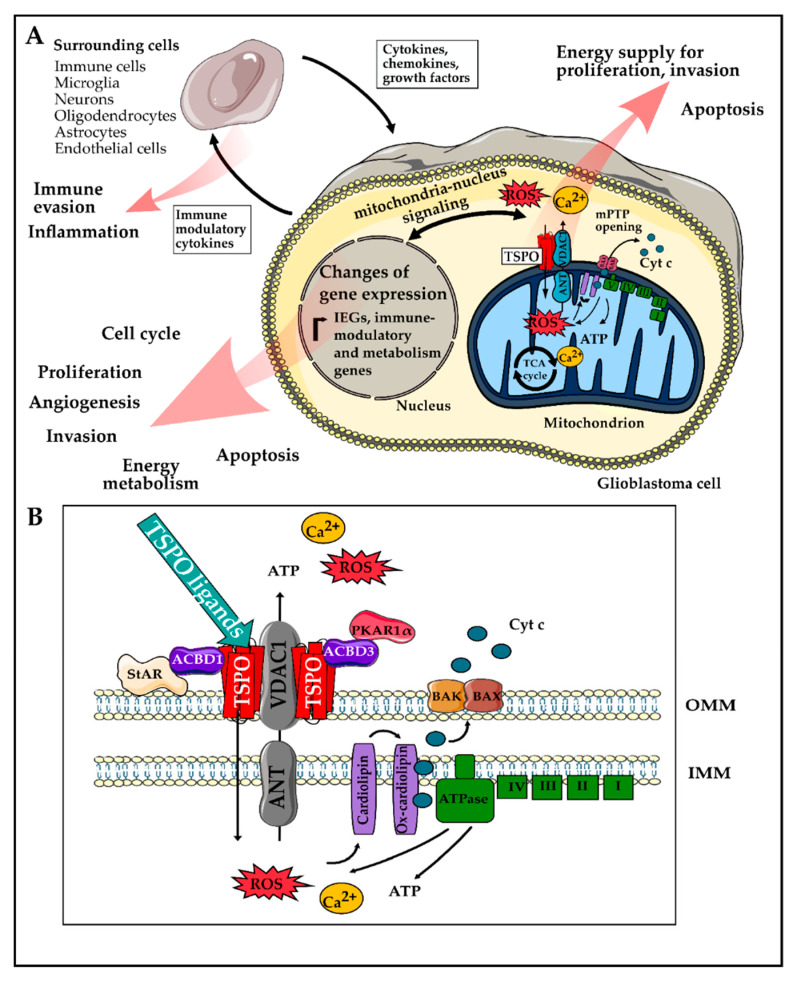
Overview of the mechanisms of how TSPO could modulate the hallmarks of Glioblastoma (GBM). (A) TSPO, together with other mitochondrial proteins such as voltage-dependent anion channel (VDAC), adenine nucleotide transporter (ANT), and ATPase can modulate mitochondrial Ca2+ release, ATP production, and reactive oxygen species (ROS) generation. The latter can then lead to the release of cyt c, which triggers the mitochondrial apoptosis cascade and ultimately apoptosis. An increase in ATP production, on the other hand, could provide energy for enhanced proliferation and invasion of GBM cells. The mitochondrial ROS, ATP, and Ca2+ release are also considered as a part of the mitochondria to nucleus signaling, which can modulate the expression of immediate early genes and transcription factors, as well as metabolism-related and immune-modulatory genes [124,127]. Several hallmarks of GBM can be modulated as a functional consequence of these gene expression changes. Furthermore, the immune-modulatory factors and cytokines secreted by the tumor cell can modulate surrounding cells contributing to immune escape and a tumor-promoting microenvironment [182,183]. (B) Close up showing the proposed working mechanism: TSPO is located in the outer mitochondrial membrane and can be found in close proximity to several cytosolic proteins such as StAR, ACBD1, ACBD3, and PKAR1α, which have been described to play a role in steroidogenesis (reviewed by [216]). Furthermore, binding of TSPO ligands to TSPO, in interaction with VDAC1, can modulate ROS and ATP production by modifying the activity of the ATPase [200,201]. An increase in the levels of ROS can result in cardiolipin oxidation and opening of the mPTP, consisting of VDAC1 and ANT [21,75,151]. The opening of the mPTP causes the release of ATP, ROS, and Ca2+ from the mitochondria into the cytosol and the collapse of the ΔΨm. The depolarization then leads to the opening of BAK/BAX channels, allowing the passage of cyt c into the cytosol. Abbreviations: ACBD, acyl-CoA-binding domain protein; cyt c, cytochrome c; IEG, immediate early genes; ROS, reactive oxygen species; mPTP, mitochondrial permeability pore; ΔΨm, mitochondrial membrane potential; PRKAR1α, protein kinase cAMP-dependent type I regulatory subunit alpha; StAR, steroidogenic acute regulatory protein.

References

    1. Louis D.N., Perry A., Reifenberger G., von Deimling A., Figarella-Branger D., Cavenee W.K., Ohgaki H., Wiestler O.D., Kleihues P., Ellison D.W. The 2016 World Health Organization Classification of Tumors of the Central Nervous System: A summary. Acta Neuropathol. 2016;131:803–820. doi: 10.1007/s00401-016-1545-1. - DOI - PubMed
    1. Tso C.-L., Freije W.A., Day A., Chen Z., Merriman B., Perlina A., Lee Y., Dia E.Q., Yoshimoto K., Mischel P.S., et al. Distinct transcription profiles of primary and secondary glioblastoma subgroups. Cancer Res. 2006;66:159–167. doi: 10.1158/0008-5472.CAN-05-0077. - DOI - PubMed
    1. Li C., Wang S., Yan J.-L., Piper R.J., Liu H., Torheim T., Kim H., Zou J., Boonzaier N.R., Sinha R., et al. Intratumoral Heterogeneity of Glioblastoma Infiltration Revealed by Joint Histogram Analysis of Diffusion Tensor Imaging. Neurosurgery. 2019;85:524–534. doi: 10.1093/neuros/nyy388. - DOI - PubMed
    1. Cuddapah V.A., Robel S., Watkins S., Sontheimer H. A neurocentric perspective on glioma invasion. Nat. Rev. Neurosci. 2014;15:455–465. doi: 10.1038/nrn3765. - DOI - PMC - PubMed
    1. Vitorino P., Meyer T. Modular control of endothelial sheet migration. Genes Dev. 2008;22:3268–3281. doi: 10.1101/gad.1725808. - DOI - PMC - PubMed

LinkOut - more resources