Sex differences in the association between major risk factors and the risk of stroke in the UK Biobank cohort study
- PMID: 33067404
- PMCID: PMC7734722
- DOI: 10.1212/WNL.0000000000010982
Sex differences in the association between major risk factors and the risk of stroke in the UK Biobank cohort study
Abstract
Objective: To determine whether there are sex differences in the association between risk factors and incident stroke, including stroke subtypes.
Methods: A total of 471,971 (56% women) UK Biobank participants without a history of cardiovascular disease were included. During 9 years of follow-up, 4,662 (44% women) cases of stroke were recorded. Cox models yielded adjusted hazard ratios (HRs) and women-to-men ratios of HRs (RHRs) for stroke associated with 7 risk factors.
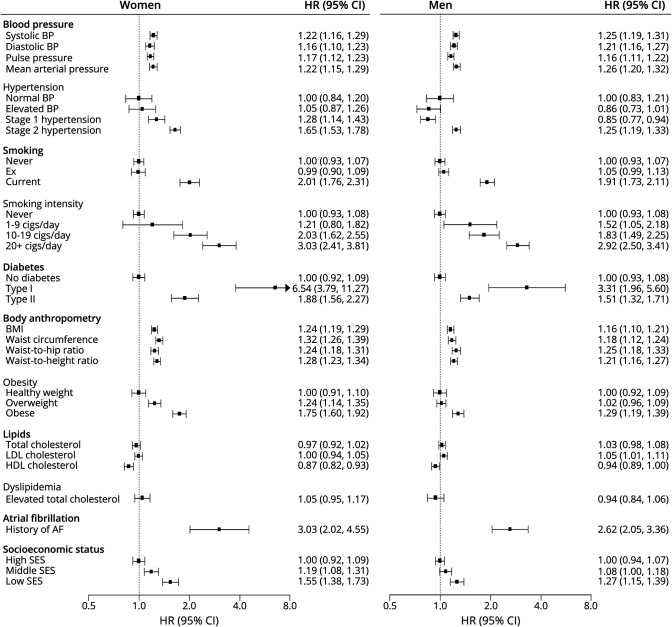
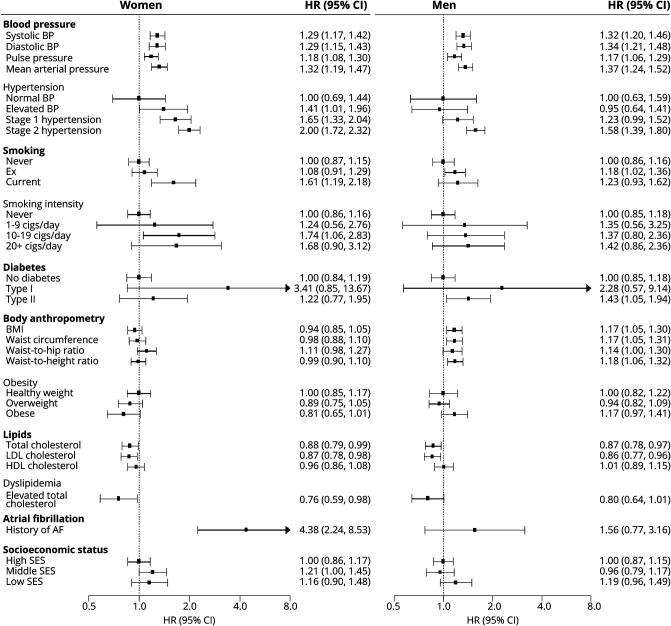
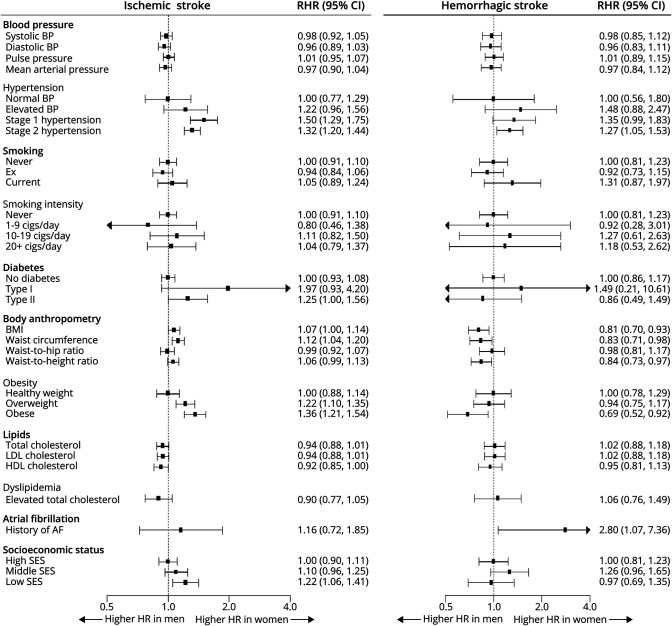
Results: The incidence rate per 10,000 person-years was 8.66 (8.29-9.04) in women and 13.96 (13.44-14.50) in men for any stroke, 6.06 (5.75-6.38) in women and 11.35 (10.88; 11.84) in men for ischemic stroke, and 1.56 (1.41-1.73) in women and 2.23 (2.02-2.45) in men for hemorrhagic stroke. The association between increases in blood pressure, body anthropometry, and lipids, diabetes, and atrial fibrillation and any stroke was similar between men and women. Hypertension, smoking, and a low socioeconomic status were associated with a greater HR of any stroke in women than men; the RHRs were 1.36 (1.26-1.47), 1.18 (1.02-1.36), and 1.17 (1.03-1.33), respectively. Diabetes was associated with a higher HR of ischemic stroke in women than men (RHR 1.25 [1.00-1.56]). Atrial fibrillation was associated with a higher HR of hemorrhagic stroke in women than men (RHR 2.80 [1.07-7.36]).
Conclusion: Several risk factors are more strongly associated with the risk of any stroke or stroke subtypes in women compared with men. Despite this, the incidence of stroke remains higher among men than women.
Copyright © 2020 The Author(s). Published by Wolters Kluwer Health, Inc. on behalf of the American Academy of Neurology.
Figures
Comment in
-
Sex differences in modifiable stroke risk factors: The next step in personalized stroke prevention.Neurology. 2020 Nov 17;95(20):891-892. doi: 10.1212/WNL.0000000000010983. Epub 2020 Oct 16. Neurology. 2020. PMID: 33067407 No abstract available.
References
-
- Institute for Health Metrics and Evaluation. GBD compare data visualization. 2017. Available at: vizhub.healthdata.org/gbd-compare.
-
- O'Donnell MJ, Chin SL, Rangarajan S, et al. Global and regional effects of potentially modifiable risk factors associated with acute stroke in 32 countries (INTERSTROKE): a case-control study. Lancet 2016;388:761–775. - PubMed
-
- Backholer K, Peters SAE, Bots SH, Peeters A, Huxley RR, Woodward M. Sex differences in the relationship between socioeconomic status and cardiovascular disease: a systematic review and meta-analysis. J Epidemiol Community Health 2017;71:550–557. - PubMed
Publication types
MeSH terms
Grants and funding
LinkOut - more resources
Full Text Sources
Medical