


Perinatal factors contributing to chronic kidney disease in a cohort of Japanese children with very low birth weight
- PMID: 33068163
- PMCID: PMC7910374
- DOI: 10.1007/s00467-020-04791-1
Perinatal factors contributing to chronic kidney disease in a cohort of Japanese children with very low birth weight
Abstract
Background: Developmental programming of chronic kidney disease (CKD) in young adults is linked to preterm birth and intrauterine growth restriction (IUGR). Which confers a higher risk of progression to chronic kidney damage in children with very low birth weight (VLBW; born weighing < 1500 g): prematurity or IUGR?
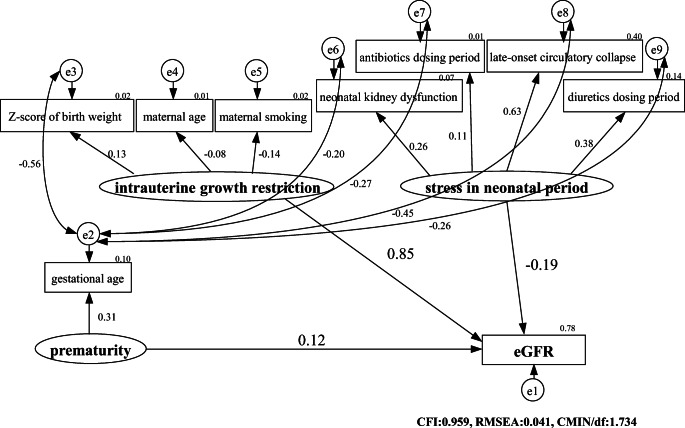
Methods: This is a national historical cohort study of children with VLBW cared for in perinatal medical centers in Japan. Predictive factors included three latent variables (prematurity, IUGR, stress during neonatal period) and eight observed variables (gestational age, birth weight Z-score, maternal age, duration of treatment with antibiotics and diuretics, maternal smoking, late-onset circulatory collapse, kidney dysfunction) during the perinatal period. The primary endpoint was estimated glomerular filtration rate (eGFR) at age ≥ 3 years. A structural equation model was used to examine the pathologic constitution.
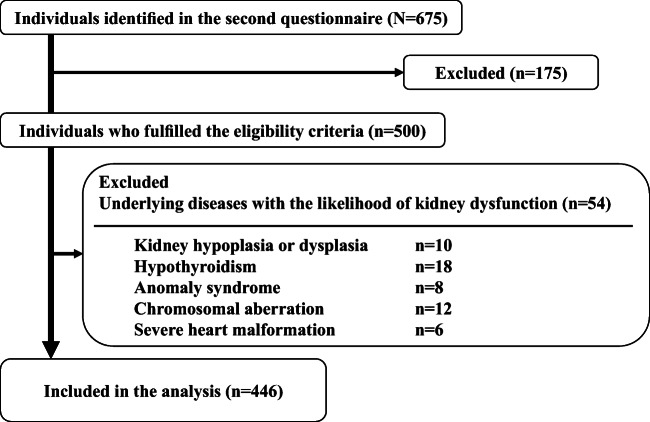
Results: The 446 children with VLBW included 253 boys and 193 girls, of mean age 5.8 ± 2.6 years and mean eGFR 111.7 ml/min/1.73 m2 at last encounter. Pathway analyses showed intrauterine malnutrition (β = 0.85) contributed more to chronic kidney damage than stress during the neonatal period (β = - 0.19) and prematurity (β = 0.12), and kidney dysfunction and late-onset circulatory collapse were important observed variables in stress during the neonatal period.
Conclusions: IUGR was more harmful to future kidneys of VLBW neonates. Neonatal kidney dysfunction and late-onset circulatory collapse were important risk factors for subsequent CKD development. This emphasizes the need for obstetricians to monitor for fetal growth restriction and neonatologists to minimize neonatal stress to prevent CKD in later life.
Keywords: Chronic kidney disease; Intrauterine growth restriction; Maternal smoking; Neonatal events; Prematurity; Very low birth weight.
Conflict of interest statement
The authors declare that they have no conflict of interest.
Figures
References
Publication types
MeSH terms
LinkOut - more resources
Full Text Sources
Medical
Research Materials
Miscellaneous
