


How do intrinsically disordered protein regions encode a driving force for liquid-liquid phase separation?
- PMID: 33069007
- PMCID: PMC8044266
- DOI: 10.1016/j.sbi.2020.09.004
How do intrinsically disordered protein regions encode a driving force for liquid-liquid phase separation?
Abstract
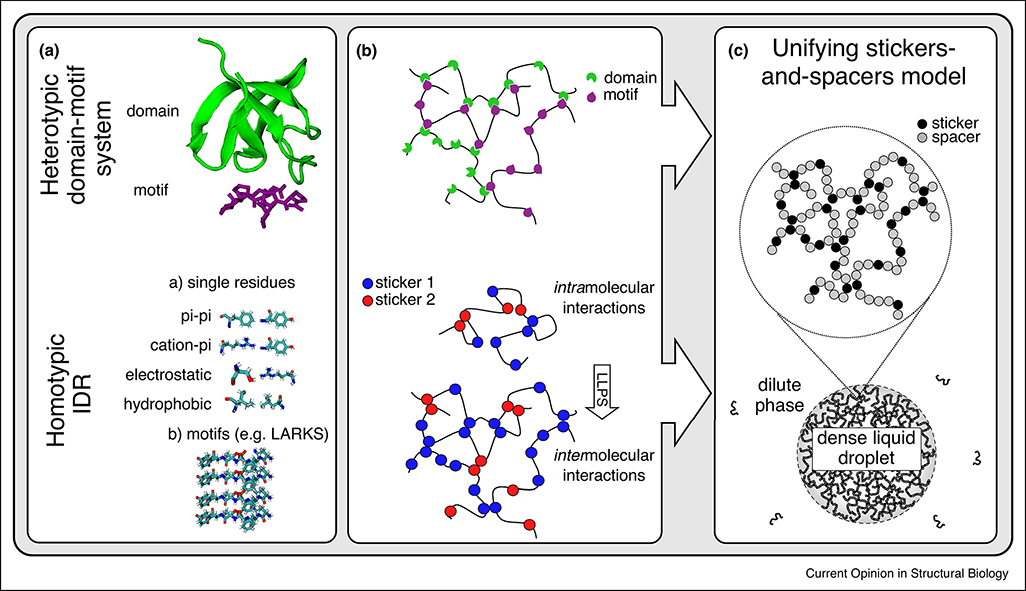
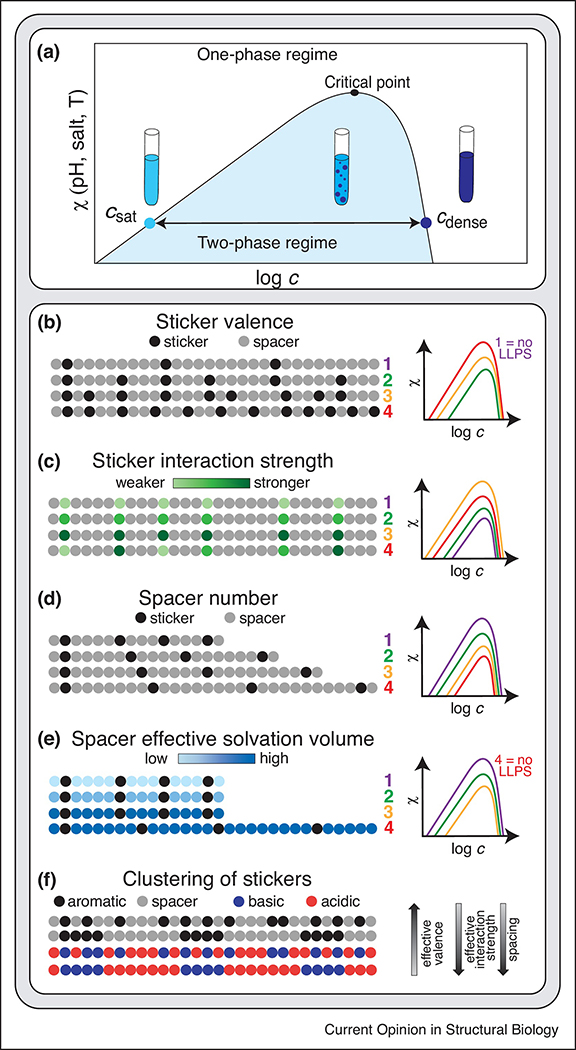
Liquid-liquid phase separation is the mechanism underlying the formation of biomolecular condensates. Disordered protein regions often drive phase separation, but the molecular interactions mediating this phenomenon are not well understood, sometimes leading to the conflation that all disordered protein regions drive phase separation. Given the critical role of phase separation in many cellular processes, and that dysfunction of phase separation can lead to debilitating diseases, it is important that we understand the interactions and sequence properties underlying phase behavior. A conceptual framework that divides IDRs into interacting and solvating regions has proven particularly useful, and analytical instantiations and coarse-grained models can test our understanding of the driving forces against experimental phase behavior. Validated simulation paradigms enable the exploration of sequence space to help our understanding of how disordered protein regions can encode phase behavior, which IDRs may mediate phase separation in cells, and which IDRs are highly soluble.
Copyright © 2020 Elsevier Ltd. All rights reserved.
Conflict of interest statement
Conflict of Interest
T.M. is a consultant for Faze Medicines. This affiliation has not influenced the scientific content of this review.
Figures
References
-
- Shin Y, Brangwynne CP: Liquid phase condensation in cell physiology and disease. Science 2017, 357. - PubMed
-
-
Harmon TS, Holehouse AS, Rosen MK, Pappu RV: Intrinsically disordered linkers determine the interplay between phase separation and gelation in multivalent proteins. Elife 2017, 6.
** The authors use a stickers-and-spacers model to characterize how linker length and spacer effective solvation volume affect the cooperativity of the sticker elements and thus phase behavior. Importantly, they show that natural linkers have a wide distribution of negative to positive effective solvation volumes implying that some multivalent proteins encode phase behavior, others do not.
-
-
-
Wang J, Choi JM, Holehouse AS, Lee HO, Zhang XJ, Jahnel M, Maharana S, Lemaitre R, Pozniakovsky A, Drechsel D, et al. : A Molecular Grammar Governing the Driving Forces for Phase Separation of Prion-like RNA Binding Proteins. Cell 2018, 174:688-+.
** This foundational paper uses large-scale mutagenesis of FET family proteins to determine the major amino acid residues types that determine LCD phase behavior. They established an analytical stickers-and-spacers model based on their identification of tyrosine and arginine residues as the major stickers in FET family protein LCDs.
-
-
- Woodruff JB: Assembly of Mitotic Structures through Phase Separation. J Mol Biol 2018, 430:4762–4772. - PubMed
Publication types
MeSH terms
Substances
Grants and funding
LinkOut - more resources
Full Text Sources
Other Literature Sources
