. 2021 Jan;30(1):187-200.
doi: 10.1002/pro.3978. Epub 2020 Nov 23.

The BioGRID database: A comprehensive biomedical resource of curated protein, genetic, and chemical interactions

Affiliations

The BioGRID database: A comprehensive biomedical resource of curated protein, genetic, and chemical interactions

Rose Oughtred et al. Protein Sci. 2021 Jan.

Abstract

The BioGRID (Biological General Repository for Interaction Datasets, thebiogrid.org) is an open-access database resource that houses manually curated protein and genetic interactions from multiple species including yeast, worm, fly, mouse, and human. The ~1.93 million curated interactions in BioGRID can be used to build complex networks to facilitate biomedical discoveries, particularly as related to human health and disease. All BioGRID content is curated from primary experimental evidence in the biomedical literature, and includes both focused low-throughput studies and large high-throughput datasets. BioGRID also captures protein post-translational modifications and protein or gene interactions with bioactive small molecules including many known drugs. A built-in network visualization tool combines all annotations and allows users to generate network graphs of protein, genetic and chemical interactions. In addition to general curation across species, BioGRID undertakes themed curation projects in specific aspects of cellular regulation, for example the ubiquitin-proteasome system, as well as specific disease areas, such as for the SARS-CoV-2 virus that causes COVID-19 severe acute respiratory syndrome. A recent extension of BioGRID, named the Open Repository of CRISPR Screens (ORCS, orcs.thebiogrid.org), captures single mutant phenotypes and genetic interactions from published high throughput genome-wide CRISPR/Cas9-based genetic screens. BioGRID-ORCS contains datasets for over 1,042 CRISPR screens carried out to date in human, mouse and fly cell lines. The biomedical research community can freely access all BioGRID data through the web interface, standardized file downloads, or via model organism databases and partner meta-databases.

Keywords: COVID-19; CRISPR screen; biological network; chemical interaction; drug target; genetic interaction; phenotype; post-translational modification; protein interaction; ubiquitin-proteasome system.


Conflict of interest statement

The authors have no conflict of interest to declare.

Figures
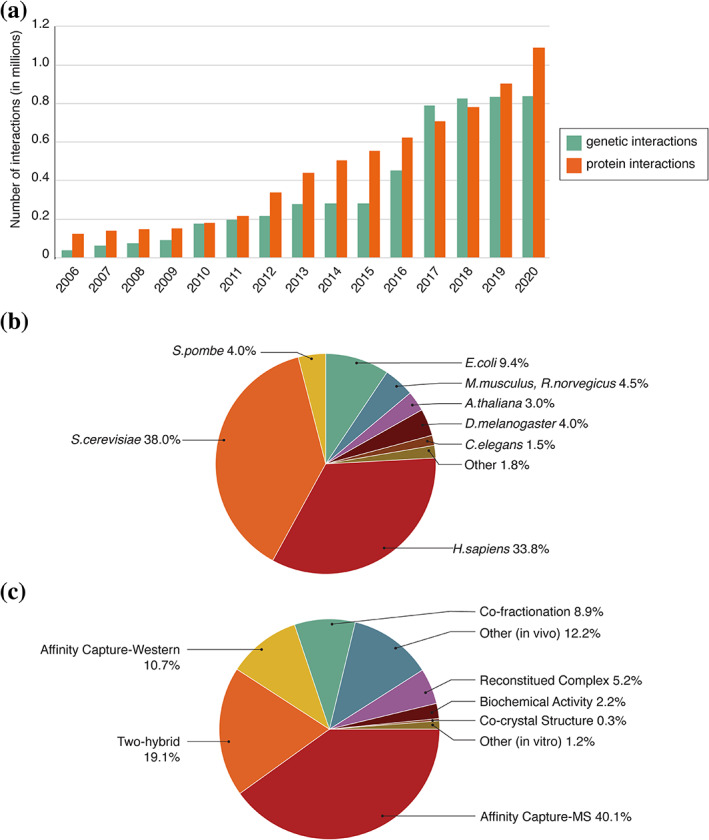
FIGURE 1
FIGURE 1
Summary of biological interactions in BioGRID. (a) Annual increase of protein and genetic interaction records in BioGRID. (b) Percentage of interactions from human, yeast, mouse/rat, worm, fly, and other species in BioGRID release 4.1.190. (c) Protein interactions as a function of experimental evidence codes. Main evidence codes are indicated, minor evidence codes are grouped as “other.” Detailed description of evidence codes can be found at https://wiki.thebiogrid.org/doku.php/experimental_systems
FIGURE 2
FIGURE 2
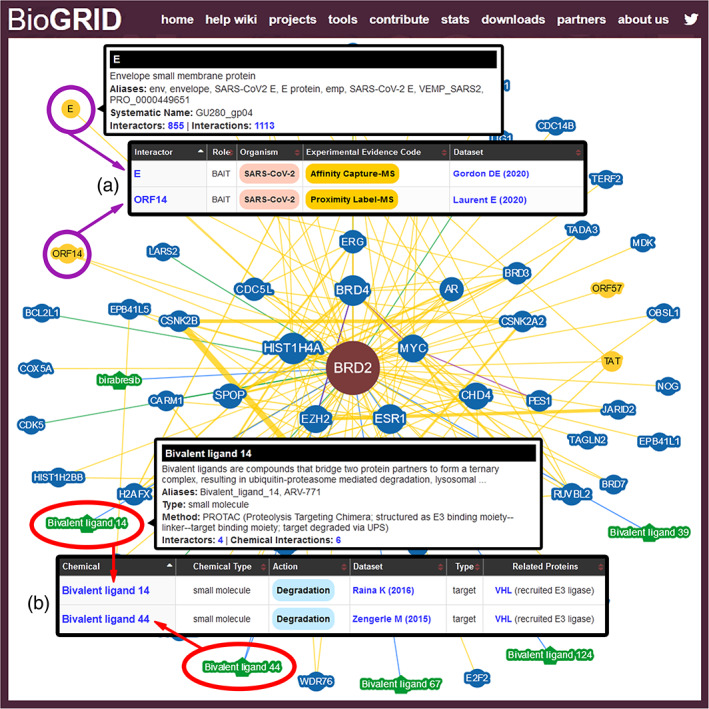
BioGRID result summary page (a) Network viewer provides a graphical representation of the protein, genetic and chemical interactions for any protein/gene of interest. Results can be filtered for interaction type and evidence threshold. Heterologous interactions between two different species are indicated in yellow, as shown here for the interaction between human BRD2 and SARS‐CoV‐2 proteins (purple circles). (b) Chemical interaction nodes are shown in green and can also be viewed as a list by selecting the Chemical Interaction view in the Switch View bar, as shown here for Bivalent ligand 14 and Bivalent ligand 44 (red circles)
FIGURE 3
FIGURE 3
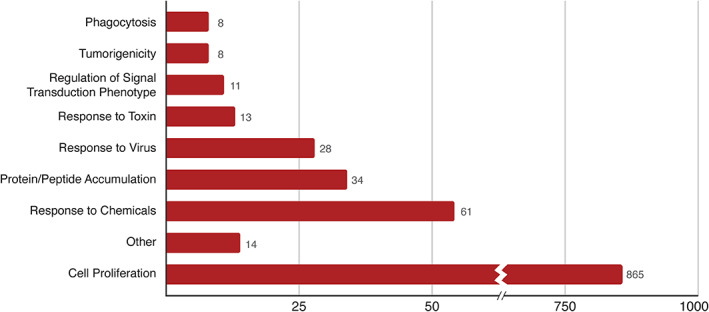
Phenotypes represented in BioGRID‐ORCS dataset. Distribution of screen phenotypes annotated in BioGRID‐ORCS release 1.1.6
FIGURE 4
FIGURE 4
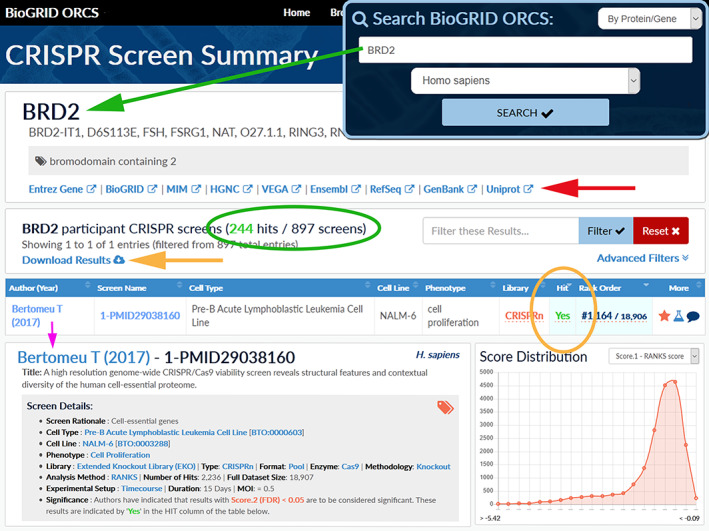
BioGRID‐ORCS screen summary page. Datasets can be browsed by screens or by searching for a gene of interest, as shown here for BRD2. Selecting the species of interest takes the user to a screen results page that lists all screens in which the gene has been tested (large green arrow). Screens in which the gene is designated a hit are listed first and hit rank order in each screen is indicated (orange circle). Overall statistics for the gene are also indicated (green circle). The screen metadata and screen score distribution are displayed by clicking the author link (pink arrow). The full screen dataset can be retrieved by clicking the download button (orange arrow). Linkouts to other resources are also provided (red arrow)

References

    1. Stark C, Breitkreutz BJ, Reguly T, Boucher L, Breitkreutz A, Tyers M. BioGRID: A general repository for interaction datasets. Nucleic Acids Res. 2006;34:D535–D539. - PMC - PubMed
    1. Reguly T, Breitkreutz A, Boucher L, et al. Comprehensive curation and analysis of global interaction networks in Saccharomyces cerevisiae . J Biol. 2006;5:11. - PMC - PubMed
    1. Ma J, Yu MK, Fong S, et al. Using deep learning to model the hierarchical structure and function of a cell. Nat Methods. 2018;15:290–298. - PMC - PubMed
    1. Botstein D, Fink GR. Yeast: An experimental organism for 21st Century biology. Genetics. 2011;189:695–704. - PMC - PubMed
    1. Oughtred R, Stark C, Breitkreutz BJ, et al. The BioGRID interaction database: 2019 update. Nucleic Acids Res. 2019;47:D529–D541. - PMC - PubMed

Publication types