


Caregiver willingness to vaccinate their children against COVID-19: Cross sectional survey
- PMID: 33071002
- PMCID: PMC7547568
- DOI: 10.1016/j.vaccine.2020.09.084
Caregiver willingness to vaccinate their children against COVID-19: Cross sectional survey
Abstract
Background: More than 100 COVID-19 vaccine candidates are in development since the SARS-CoV-2 genetic sequence was published in January 2020. The uptake of a COVID-19 vaccine among children will be instrumental in limiting the spread of the disease as herd immunity may require vaccine coverage of up to 80% of the population. Prior history of pandemic vaccine coverage was as low as 40% among children in the United States during the 2009 H1N1 influenza pandemic.
Purpose: To investigate predictors associated with global caregivers' intent to vaccinate their children against COVID-19, when the vaccine becomes available.
Method: An international cross sectional survey of 1541 caregivers arriving with their children to 16 pediatric Emergency Departments (ED) across six countries from March 26 to May 31, 2020.
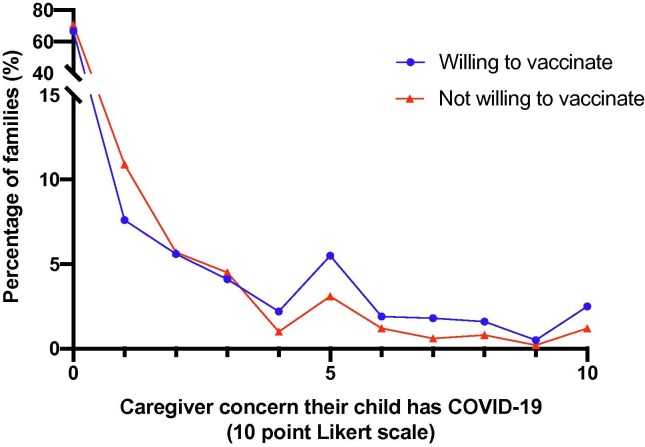
Results: 65% (n = 1005) of caregivers reported that they intend to vaccinate their child against COVID-19, once a vaccine is available. A univariate and subsequent multivariate analysis found that increased intended uptake was associated with children that were older, children with no chronic illness, when fathers completed the survey, children up-to-date on their vaccination schedule, recent history of vaccination against influenza, and caregivers concerned their child had COVID-19 at the time of survey completion in the ED. The most common reason reported by caregivers intending to vaccinate was to protect their child (62%), and the most common reason reported by caregivers refusing vaccination was the vaccine's novelty (52%).
Conclusions: The majority of caregivers intend to vaccinate their children against COVID-19, though uptake will likely be associated with specific factors such as child and caregiver demographics and vaccination history. Public health strategies need to address barriers to uptake by providing evidence about an upcoming COVID-19 vaccine's safety and efficacy, highlighting the risks and consequences of infection in children, and educating caregivers on the role of vaccination.
Keywords: COVID-19; Child; Coronavirus; Emergency Department; Pandemic; Vaccination.
Copyright © 2020 Elsevier Ltd. All rights reserved.
Conflict of interest statement
Declaration of Competing Interest The authors declare that they have no known competing financial interests or personal relationships that could have appeared to influence the work reported in this paper.
Figures
References
-
- Thanh Le T., Andreadakis Z., Kumar A., Gómez Román R., Tollefsen S., Saville M., Mayhew S. The COVID-19 vaccine development landscape. Nat Rev Drug Discov. 2020;19(5):305–306. - PubMed
-
- Lurie N., Saville M., Hatchett R., Halton J. Developing Covid-19 Vaccines at Pandemic Speed. N Engl J Med. 2020;382(21):1969–1973. - PubMed
-
- Mahase E. Covid-19: What do we know so far about a vaccine? BMJ. 2020;369 - PubMed
-
- Centers for Disease Control and Prevention. Final estimates for 2009-10 seasonal Influenza and Influenza A (H1N1) 2009 monovalent vaccination coverage - United States, August 2009 through May, 2010; May 13, 2011. https://www.cdc.gov/flu/fluvaxview/coverage_0910estimates.htm
Publication types
MeSH terms
Substances
LinkOut - more resources
Full Text Sources
Medical
Miscellaneous
