


Lie detection accuracy and beliefs about cues to deception in adult children of alcoholics
- PMID: 33071552
- PMCID: PMC7534363
- DOI: 10.1080/13218719.2020.1733697
Lie detection accuracy and beliefs about cues to deception in adult children of alcoholics
Abstract
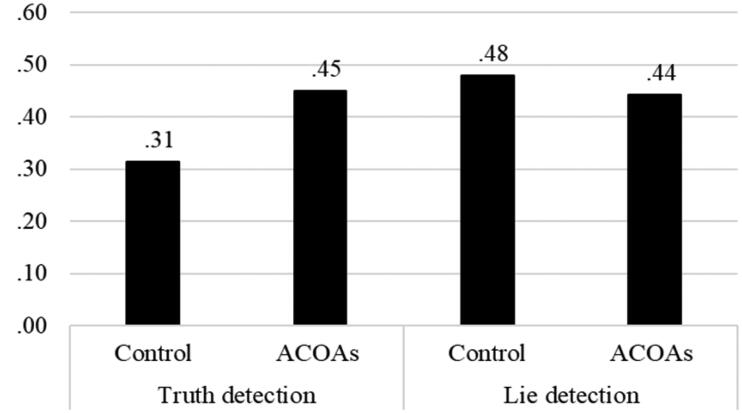
When one or both parents misuse alcohol, it can lead to the development of particular and varied traits in their children. The present study tested whether adult children of alcoholics (ACoAs) who participated in therapy had better veracity assessment skills and more reliable beliefs about cues to deception than the control group of non-ACoAs. The results revealed that individuals who grew up in a family with alcohol misuse problems detected truth - but not lies - significantly better than the control group. The groups did not differ in accuracy of their beliefs about cues to deception. It is possible that the ACoAs' higher truth detection accuracy is to some extent attributable to their participation in therapy, which increased their level of trust in others.
Keywords: ACoA; adult children of alcoholics; beliefs about cues to deception; cues to deception; deception detection; lie detection.
© 2020 The Australian and New Zealand Association of Psychiatry, Psychology and Law.
Figures
References
-
- Baron-Cohen, S., Wheelwright, S., Hill, J., Raste, Y., & Plumb, I. (2001). The “Reading the mind in the eyes” Test revised version: A study with normal adults, and adults with Asperger syndrome or high-functioning autism. Journal of Child Psychology and Psychiatry, 42(2), 241–251. doi: 10.1111/1469-7610.00715 - DOI - PubMed
-
- Baumann, E.C., & Hill, C.E. (2016). Client concealment and disclosure of secrets in outpatient psychotherapy. Counselling Psychology Quarterly, 29(1), 53–75. doi: 10.1080/09515070.2015.1023698 - DOI
-
- Blankenship, K.L., & Whitley, B.E. Jr. (2000). Relation of general deviance to academic dishonesty. Ethics & Behavior, 10(1), 1–12. doi: 10.1207/S15327019EB1001_1 - DOI
LinkOut - more resources
Full Text Sources