


When Pandemic Hits: Exercise Frequency and Subjective Well-Being During COVID-19 Pandemic
- PMID: 33071902
- PMCID: PMC7541696
- DOI: 10.3389/fpsyg.2020.570567
When Pandemic Hits: Exercise Frequency and Subjective Well-Being During COVID-19 Pandemic
Abstract
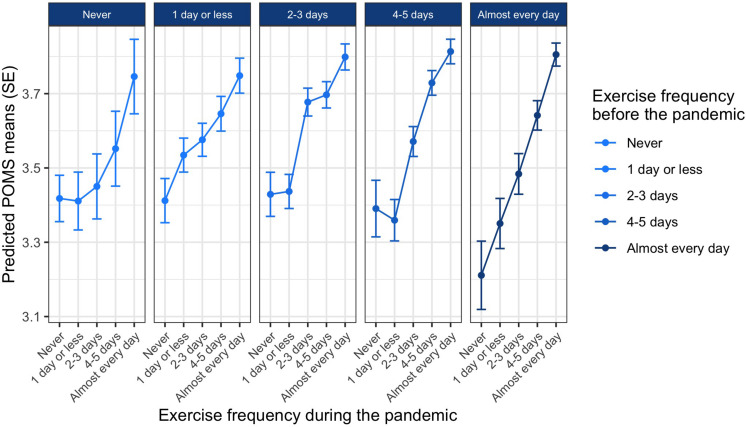
The governmental lockdowns related to the COVID-19 pandemic have forced people to change their behavior in many ways including changes in exercise. We used the brief window of global lockdown in the months of March/April/May 2020 as an opportunity to investigate the effects of externally imposed restrictions on exercise-related routines and related changes in subjective well-being. Statistical analyses are based on data from 13,696 respondents in 18 countries using a cross-sectional online survey. A mixed effects modeling approach was used to analyze data. We tested whether exercise frequency before and during the pandemic would influence mood during the pandemic. Additionally, we used the COVID-19 pandemic data to build a prediction model, while controlling for national differences, to estimate changes in exercise frequency during similar future lockdown conditions depending on prelockdown exercise frequency. According to the prediction model, those who rarely exercise before a lockdown tend to increase their exercise frequency during it, and those who are frequent exercisers before a lockdown tend to maintain it. With regards to subjective well-being, the data show that those who exercised almost every day during this pandemic had the best mood, regardless of whether or not they exercised prepandemic. Those who were inactive prepandemic and slightly increased their exercise frequency during the pandemic, reported no change in mood compared to those who remained inactive during the pandemic. Those who reduced their exercise frequency during the pandemic reported worse mood compared to those who maintained or increased their prepandemic exercise frequency. This study suggests that under similar lockdown conditions, about two thirds of those who never or rarely exercise before a lockdown might adopt an exercise behavior or increase their exercise frequency. However, such changes do not always immediately result in improvement in subjective well-being. These results may inform national policies, as well as health behavior and exercise psychology research on the importance of exercise promotion, and prediction of changes in exercise behavior during future pandemics.
Keywords: habit; health; mood; motivation; physical activity.
Copyright © 2020 Brand, Timme and Nosrat.
Figures

References
-
- Bandura A. (1989). “Self-efficacy mechanism in physiological activation and health-promoting behavior,” in Adaptation, Learning and Affect, eds Madden J., Matthysse S., Barchas J. (Raven: ), 1169–1188.
-
- Bates D., Mächler M., Bolker B. M., Walker S. C. (2015). Fitting Linear Mixed-Effects Models Using Lme4. J. Statist. Soft. 67 1–48. 10.18637/jss.v067.i01 - DOI
-
- Brand R., Ekkekakis P. (2018). Affective-Reflective Theory of Physical Inactivity and Exercise: Foundations and Preliminary Evidence. German J Exerc. Sport Res. 48 48–58. 10.1007/s12662-017-0477479 - DOI
LinkOut - more resources
Full Text Sources
Miscellaneous
