


Proteomics Insights Into the Molecular Basis of SARS-CoV-2 Infection: What We Can Learn From the Human Olfactory Axis
- PMID: 33071996
- PMCID: PMC7536310
- DOI: 10.3389/fmicb.2020.02101
Proteomics Insights Into the Molecular Basis of SARS-CoV-2 Infection: What We Can Learn From the Human Olfactory Axis
Abstract
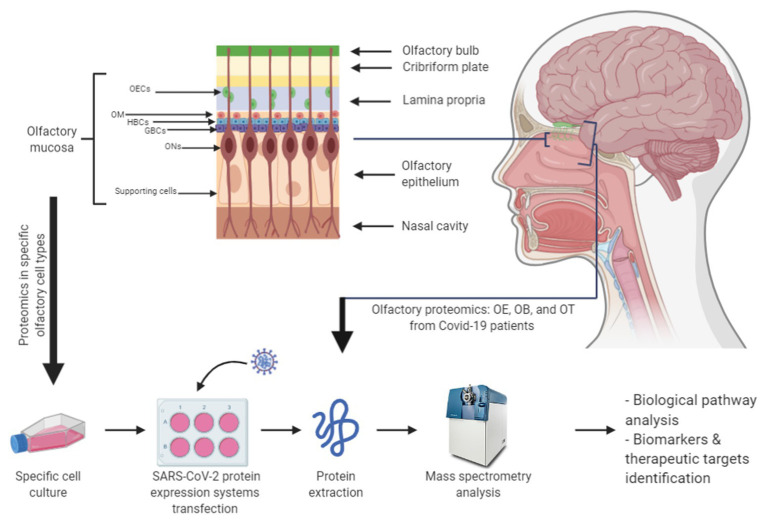
Like other RNA viruses, severe acute respiratory syndrome coronavirus 2 (SARS-CoV-2) replicates in host cells, continuously modulating the molecular environment. It encodes 28 multifunctional proteins that induce an imbalance in the metabolic and proteostatic homeostasis in infected cells. Recently, proteomic approaches have allowed the evaluation of the impact of SARS-CoV-2 infection in human cells. Here, we discuss the current use of proteomics in three major application areas: (i) virus-protein interactomics, (ii) differential proteotyping to map the virus-induced changes in different cell types, and (iii) diagnostic methods for coronavirus infectious disease 2019 (COVID-19). Since the nasal cavity is one of the entry sites for SARS-CoV-2, we will also discuss the potential application of olfactory proteomics to provide novel insights into the olfactory dysfunction triggered by SARS-CoV-2 in patients with COVID-19.
Keywords: coronavirus infectious disease 2019; mass-spectrometry; proteomics; severe acute respiratory syndrome coronavirus-2; smell.
Copyright © 2020 Lachén-Montes, Corrales, Fernández-Irigoyen and Santamaría.
Figures
References
-
- Akgun E., Tuzuner M. B., Sahin B., Kilercik M., Kulah C., Cakiroglu H. N., et al. (2020). Altered molecular pathways observed in naso-oropharyngeal samples of SARS-CoV-2 patients. medRxiv [Preprint]. 10.1101/2020.05.14.20102558 - DOI
-
- Bezstarosti K., Lamers M. M., Haagmans B. L., Demmers J. A. (2020). Targeted proteomics for the detection of SARS-CoV-2 proteins. bioRxiv [Preprint]. 10.1101/2020.04.23.057810 - DOI
Publication types
LinkOut - more resources
Full Text Sources
Miscellaneous
