Review
. 2020 Nov;13(11):100476.
doi: 10.1016/j.waojou.2020.100476. Epub 2020 Oct 9.

Enhancing innate immunity against virus in times of COVID-19: Trying to untangle facts from fictions

Affiliations
Review

Enhancing innate immunity against virus in times of COVID-19: Trying to untangle facts from fictions

Désirée Larenas-Linnemann et al. World Allergy Organ J. 2020 Nov.

Abstract

Introduction: In light of the current COVID-19 pandemic, during which the world is confronted with a new, highly contagious virus that suppresses innate immunity as one of its initial virulence mechanisms, thus escaping from first-line human defense mechanisms, enhancing innate immunity seems a good preventive strategy.

Methods: Without the intention to write an official systematic review, but more to give an overview of possible strategies, in this review article we discuss several interventions that might stimulate innate immunity and thus our defense against (viral) respiratory tract infections. Some of these interventions can also stimulate the adaptive T- and B-cell responses, but our main focus is on the innate part of immunity. We divide the reviewed interventions into: 1) lifestyle related (exercise, >7 h sleep, forest walking, meditation/mindfulness, vitamin supplementation); 2) Non-specific immune stimulants (letting fever advance, bacterial vaccines, probiotics, dialyzable leukocyte extract, pidotimod), and 3) specific vaccines with heterologous effect (BCG vaccine, mumps-measles-rubeola vaccine, etc).

Results: For each of these interventions we briefly comment on their definition, possible mechanisms and evidence of clinical efficacy or lack of it, especially focusing on respiratory tract infections, viral infections, and eventually a reduced mortality in severe respiratory infections in the intensive care unit. At the end, a summary table demonstrates the best trials supporting (or not) clinical evidence.

Conclusion: Several interventions have some degree of evidence for enhancing the innate immune response and thus conveying possible benefit, but specific trials in COVID-19 should be conducted to support solid recommendations.

Keywords: ACE2, Angiotensin converting enzime-2; APC, Antigen-presenting cell; BCG, Bacillus Calmette-Guérin; BV, Bacterial vaccine; Bacillus calmette-guérin; Bacterial vaccine; CCL-5, Chemokine (C–C motif) ligand 5; CI, Confidence interval; CNS, Central nervous system; COVID-19; COVID-19, Coronavirus disease-2019; CXCR3A, CXC chemokine receptor 3A; DAMPs, Damage-associated molecular patterns; DC, Dendritic cell; DLE, Dialyzable leukocyte extract; Exercise; Gαs: G protein coupled receptor alfa-subunits, HSP; Heat shock proteins, HLA-DR; Immune response; Immunoglobulin, IGFBP6; Innate; Insulin-like growth-factor-binding-protein 6, IL; Intercellular adhesion molecule type 1, IFN; Interferon, IG; Interleukin, MBSR; MCP-1, Monocyte chemoattractant protein-1; MMR; MODS, Multi-organ dysfunction syndrome; Major histocompatibility complex class II cell surface receptor, ICAM-1; Mindfulness; Mindfulness-based stress reduction, mCa++: Intramitochondrial calcium; MyD88, Myeloid differentiation primary response 88; NF-κB, Nuclear factor kappaB; NK, Natural killer; NK-Cell; NOD2, Nucleotide-binding oligomerization domain-containing protein 2; OR, Odds ratio; OxPhos: Oxidative phosphorylation, PAMPs; PKC, Protein kinase C; PPD, Purified protein derivative (tuberculin); PUFA, Polyunsaturated fatty acid; Pathogen-associated molecular patterns, PBMC; Peripheral blood mononuclear cell, PI3K/Akt: Phosphatidylinositol 3-kinase pathway; R0: Basic reproduction number, REM; Rapid eye movement, RIPK2; Reactive nitrogen species, ROS; Reactive oxygen species, SARS-CoV-2; Receptor iteracting serine/threonine kinase 2, RNA; Ribonucleic acid, RNS; Severe acute respiratory syndrome coronavirus 2, SIRS; Sleep; Systemic inflammatory response syndrome, TCR:T-cell receptor; TLR, Toll-like receptor; TNF-α, Tumor necrosis factor alpha; TRPV, Thermolabile calcium channels; Th, T helper-cell; Trained immunity; URTI, Upper-respiratory tract infection.


Conflict of interest statement

All authors declared or they have no potential conflicts of interest. The following authors, indicated relations with the pharmaceutical industry: Dr. Larenas Linnemann reports personal fees from Allakos, Amstrong, Astrazeneca, Boehringer Ingelheim, Chiesi, DBV Technologies, Grunenthal, GSK, MEDA, Menarini, MSD, Novartis, Pfizer, Novartis, Sanofi, Siegfried, UCB, Alakos, Gossamer, grants from Sanofi, Astrazeneca, Novartis, UCB, GSK, TEVA, Boehringer Ingelheim, Chiesi, Purina institute.

Figures

Fig. 1
Fig. 1
SARS-CoV-2 infects type 2 pneumocytes by entering the cells via the ACE2 receptor on their surfaces. Unlike the normal anti-viral response with increased IFN type I and III and with it the activation of genes stimulated by IFN in adjacent cells and thereby increasing its anti-viral defense, the coronavirus has mechanisms that lower this anti-viral innate defense mechanism by interfering with IFN production and its effects. In addition, chemotactic molecules are released in a viral infection that attract macrophages (M∅), natural killer (NK) cells, and neutrophils. This reaction is not fully achieved during early infection with coronavirus, so the initial innate immune response appears incomplete and slow. After this first innate response, adaptive immunity is triggered via activation of dendritic cells (DC) that stimulate specific Th1 lymphocytes, which in turn activate cytotoxic T cells (Tccell) to eliminate infected cells, in the more advanced stages of the infection, along with plasma cell development and the production of antiviral IgM and IgG antibodies (not shown). However, in some patients with COVID-19 at this stage a dysregulated activation of macrophages (ie, by IL6) is seen, causing the feared cytokine storm.
Fig. 2
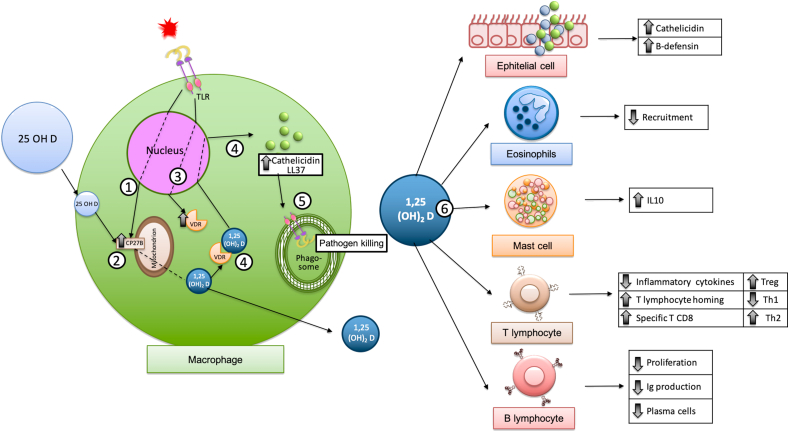
Fig. 2
The conversion of 25 OHD2 to 1,25-(OH)2 D3 can be done directly in some cells of the immune system such as macrophages. The macrophage, like kidney cells, contains the enzyme 1-alpha hydroxylase that is capable of transforming Vitamin D into its active form, calcitriol. Exposure of the macrophage to some pathogens induces the production of CP27B (step 1) (which allows 25 OHD to enter the mitochondria for transformation into its active form 1,25-(OH)2 D3), (step 2) as well as vitamin D receptor (VDR) (step 3), which by binding to 1,25-(OH)2 D3 increases the production of cathelicidin. (step 4). The antimicrobial activity of vitamin D appears to be primarily dependent on the induction of cathelicidins, which perform numerous functions that enhance both innate and adaptive immunity; help improve the digestion process within the phagolysosome through a non-oxygen dependent mechanism (step 5), that can promote pathogen clearance by inducing apoptosis of infected epithelial cells, and induce paracrine responses in monocytes and T and B lymphocytes, among others. Vitamin D also has direct effects on other cells, for example, epithelial cells, eosinophils, mast cells as well as T and B lymphocytes. (step 6)
Fig. 3
Fig. 3
In DCs, derived from human monocytes, subjected to temperatures >38 °C, a decrease in mitochondrial metabolism has been seen inducing a decrease in oxidative phosphorylation (OxPhos) and an increase in reactive oxygen and nitrogen species (ROS/RNS), intramitochondrial calcium and glycolysis. All this produces the release of proinflammatory cytokines that activate T lymphocytes. Fever favors the production of heat shock proteins (HSP) by all eukaryotic cells. DCs release insulin-growth-factor-binding-protein (IGFBP6) that has stimulating, but also self-regulating effects
Fig. 4
Fig. 4
The response to early damage has been clinically defined as systemic inflammatory response syndrome (SIRS) in which innate immune system cells and proinflammatory cytokines are involved; secondarily, the adaptive immune response also gets activated, allowing the host to heal, as long as a negative feedback is produced by regulatory cytokines to counteract the inflammation and limit the immune damage, generating a “temporary immunosuppression”. However, if at this moment an opportunistic infection occurs or the inflammatory stimulus persists, a second SIRS can be generated that favors the massive release of inflammatory cytokines (cytokine storm) that can cause death due to the development of the multi-organ dysfunction syndrome (MODS)
Fig. 5
Fig. 5
In murine and ex vivo human experiments monocyte-derived DCs, upon stimulation with MV130 (Bactek), produced IL-12p70 and TNF-a enhancing Th1 proliferation, and IL-6, IL-1β, IL-8 ie, stimulating the development of Th17 cells. MV130 effects were shown to be generated after TLR activation and the serine/threonine-protein kinase-2 receptor interaction (RIPK2) and myeloid-88 (MyD88) pathways under control of IL-10. Trained immunity effects have been shown to persist for months, as epigenetic changes also occur in the progenitor cells in the bone marrow

References

    1. Taubenberger J.K., Morens D.M. Influenza: the once and future pandemic. Publ Health Rep. 2010;125(Suppl 3):16–26. - PMC - PubMed
    1. He W., Yi G.Y., Zhu Y. Estimation of the basic reproduction number, average incubation time, asymptomatic infection rate, and case fatality rate for COVID-19: meta-analysis and sensitivity analysis. J Med Virol. 2020 doi: 10.1002/jmv.26041. - DOI - PMC - PubMed
    1. Zhou T., Liu Q., Yang Z. Preliminary prediction of the basic reproduction number of the Wuhan novel coronavirus 2019-nCoV. J Evid Base Med. 2020;13(1):3–7. - PMC - PubMed
    1. Totura A.L., Baric R.S. SARS coronavirus pathogenesis: host innate immune responses and viral antagonism of interferon. Curr Opin Virol. 2012;2(3):264–275. - PMC - PubMed
    1. Mehta P., McAuley D.F., Brown M. COVID-19: consider cytokine storm syndromes and immunosuppression. Lancet. 2020;395(10229):1033–1034. - PMC - PubMed