


Performance of the Four-Plex Tandem Mass Spectrometry Lysosomal Storage Disease Newborn Screening Test: The Necessity of Adding a 2nd Tier Test for Pompe Disease
- PMID: 33072961
- PMCID: PMC7548889
- DOI: 10.3390/ijns4040041
Performance of the Four-Plex Tandem Mass Spectrometry Lysosomal Storage Disease Newborn Screening Test: The Necessity of Adding a 2nd Tier Test for Pompe Disease
Abstract
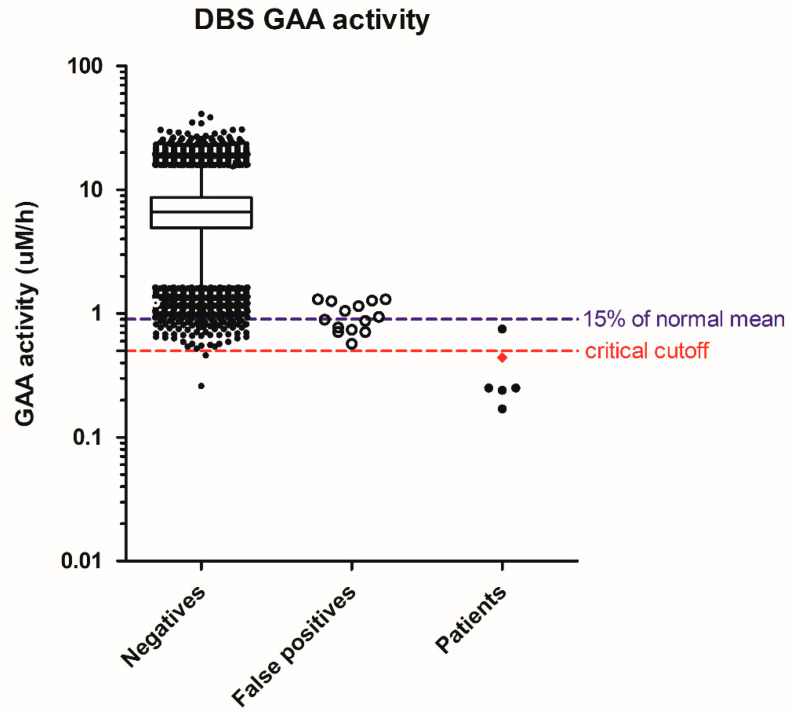
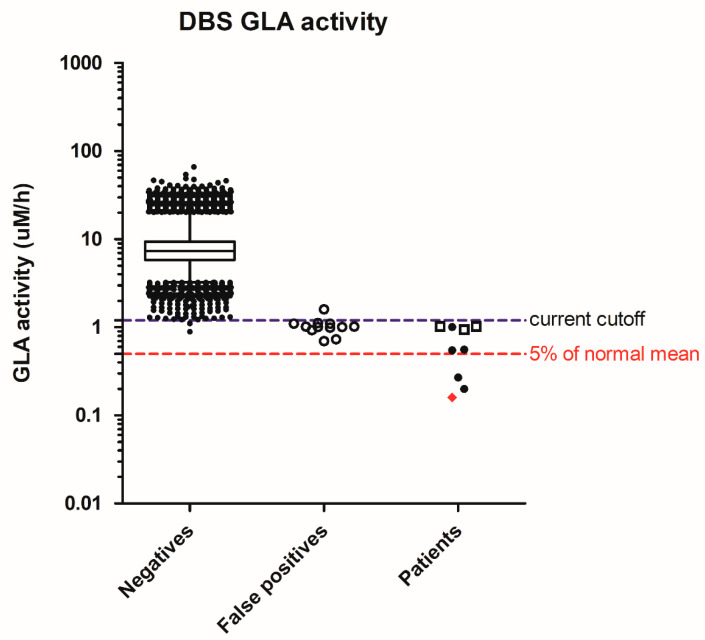
Early diagnosis of lysosomal storage diseases (LSDs) through newborn screening (NBS) has been adapted widely. The National Taiwan University Hospital Newborn Screening Center launched the four-plex tandem mass spectrometry LSD newborn screening test in 2015. The test determined activities of acid α-glucosidase (GAA; Pompe), acid α-galactosidase (GLA; Fabry), acid β-glucocerebrosidase (ABG; Gaucher), and acid α-l-iduronidase (IDUA; MPS-I) in dried blood spots (DBS). Through 2017, 64,148 newborns were screened for these four LSDs. The screening algorithm includes enzyme activity/ratio as the cutoffs for the first screening test and a second-tier test for Pompe disease screening. The second-tier Pompe disease screening test measured activity inhibition by acarbose. Twenty-nine newborns required a confirmatory test; six were confirmed to have Pompe disease, and nine were confirmed to have Fabry disease. The screen-positive rate for Pompe disease was 0.031%. Therefore, in Pompe disease newborn screening, a validated 2nd tier test is necessary to decrease false positives.
Keywords: Fabry newborn screening; Gaucher newborn screening; Pompe newborn screening; accuracy; tandem mass spectrometry.
© 2018 by the authors.
Conflict of interest statement
Conflicts of InterestThe authors declare no conflict of interest.
Figures
References
-
- Hirschhorn R., Reuser A. Glycogen storage disease type II: Acid α-glucosidase (acid maltase) deficiency. In: Scriver C., Beaudet A., Sly W., Valle D., editors. The Metabolic and Molecular Bases of Inherited Disease. McGraw-Hill; New York, NY, USA: 2001. pp. 3389–3420.
-
- Hwu W.L., Chien Y.H., Lee N.C., Chiang S.C., Dobrovolny R., Huang A.C., Yeh H.Y., Chao M.C., Lin S.J., Kitagawa T., et al. Newborn screening for fabry disease in taiwan reveals a high incidence of the later-onset GLA mutation c.936+919G>A (IVS4+919G>A) Hum. Mutat. 2009;30:1397–1405. doi: 10.1002/humu.21074. - DOI - PMC - PubMed
-
- Chien Y.H., Lee N.C., Chen C.A., Tsai F.J., Tsai W.H., Shieh J.Y., Huang H.J., Hsu W.C., Tsai T.H., Hwu W.L. Long-term prognosis of patients with infantile-onset pompe disease diagnosed by newborn screening and treated since birth. J. Pediatr. 2015;166:985–991. doi: 10.1016/j.jpeds.2014.10.068. - DOI - PubMed
-
- Chien Y.H., Chiang S.C., Zhang X.K., Keutzer J., Lee N.C., Huang A.C., Chen C.A., Wu M.H., Huang P.H., Tsai F.J., et al. Early detection of pompe disease by newborn screening is feasible: Results from the taiwan screening program. Pediatrics. 2008;122:e39–e45. doi: 10.1542/peds.2007-2222. - DOI - PubMed
LinkOut - more resources
Full Text Sources
Research Materials
Miscellaneous
