


Ciliary body length revisited by anterior segment optical coherence tomography: implications for safe access to the pars plana for intravitreal injections
- PMID: 33074373
- PMCID: PMC8166736
- DOI: 10.1007/s00417-020-04967-3
Ciliary body length revisited by anterior segment optical coherence tomography: implications for safe access to the pars plana for intravitreal injections
Abstract
Purpose: To investigate the dependence of the ciliary body length (CBL) on the axial length (AL) and to draw conclusions on implications regarding safe pars plana access for intravitreal injections and vitreoretinal surgery.
Methods: A total of 200 individuals (mean age 42 years, SD ± 15.4) were enrolled in the study. Objective refraction and AL were obtained. Spherical equivalent (SE) was calculated. Anterior segment optical coherence tomography (ASOCT) was used to image and measure the CBL.
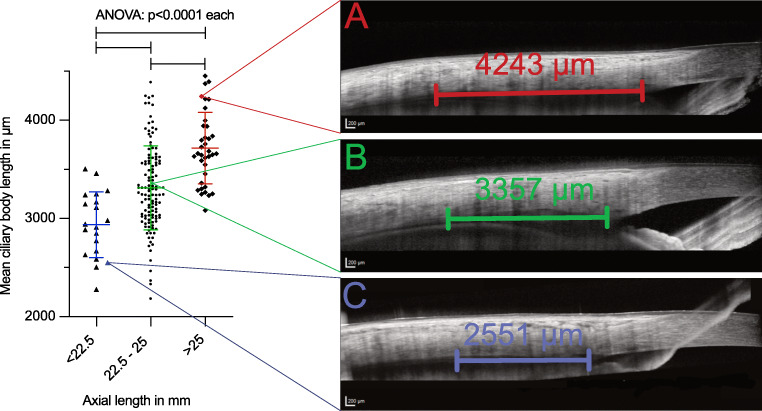
Results: The mean SE was - 1.64 diopters (SD ± 3.15, range - 14.5 to + 9 diopters) and the mean AL was 24.19 mm (SD ± 1.65, range 19.8-32.2 mm). There was a significant correlation between SE and AL (r2 = 0.62, p < 0.0001). Mean CBL correlated significantly with age (r2 = 0.11, p < 0.0001), AL (r2 = 0.23, p < 0.0001) and SE (r2 = 0.25, p < 0.0001). The mean CBL was 3351 μm (SD ± 459, range 2184-4451 μm). Three separate groups were defined by their AL with a normal AL group (AL 22.5 to 25 mm), a short AL group (AL < 22.5 mm) and a long AL group (AL > 25 mm). The mean CBL in the normal AL group was 3311 μm (SD ± 427), in the short AL group 2936 μm (SD ± 335) and in the long AL group 3715 μm (SD ± 365), and differed significantly (p < 0.0001) when compared.
Conclusion: For interventions requiring pars plana access (as an intravitreal injection or vitreoretinal surgery), an incision distance of 3.5-4.0 mm posterior to the limbus is recommended. In our research, however, a difference of 0.77 mm in mean CBL between the group with short AL and the group with long AL is demonstrated, implying that the mean CBL in very short and very long eyes differs significantly. These findings suggest that the AL should be taken into account for pars plana access and that it would be advisable to prefer the shorter or longer recommended distance (3.5 and 4.0 mm, respectively) from the limbus, which correlates with the AL. If AL is > 25 mm, a distance of 4.0 mm from the limbus should be chosen; and if AL is < 22.5 mm, a distance of 3.5 mm seems adequate.
Trial registration number and date: NCT00564291, 27 Nov 2007.
Keywords: Anterior segment optical coherence tomography; Axial length; Ciliary body; Intravitreal injection; Pars plana.
Conflict of interest statement
The authors declare that they have no conflict in interest.
Figures



References
-
- Giampani ASB, Giampani J. Glaucoma-basic and clinical aspects. London: IntechOpen; 2013. Anatomy of ciliary body, ciliary processes, anterior chamber angle and collector vessels; pp. 3–13.
MeSH terms
Associated data
LinkOut - more resources
Full Text Sources
Medical
Miscellaneous
