


Perioperative Morbidity and Mortality of Patients With COVID-19 Who Undergo Urgent and Emergent Surgical Procedures
- PMID: 33074900
- PMCID: PMC7737869
- DOI: 10.1097/SLA.0000000000004420
Perioperative Morbidity and Mortality of Patients With COVID-19 Who Undergo Urgent and Emergent Surgical Procedures
Abstract
Objective: To evaluate the perioperative morbidity and mortality of patients with COVID-19 who undergo urgent and emergent surgery.
Summary background data: Although COVID-19 infection is usually associated with mild disease, it can lead to severe respiratory complications. Little is known about the perioperative outcomes of patients with COVID-19.
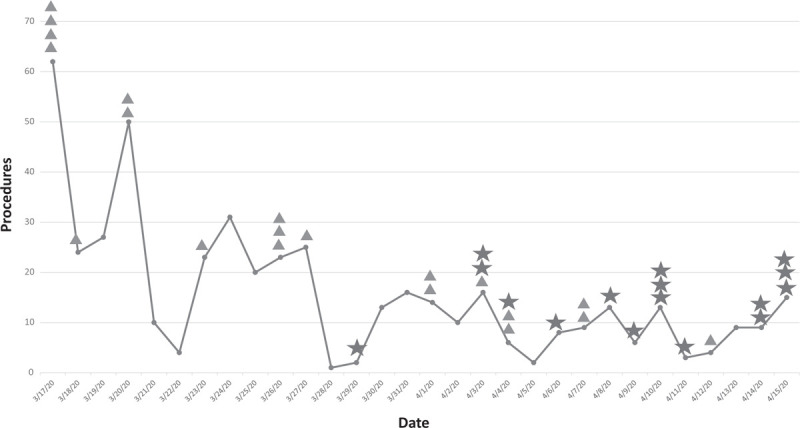
Methods: We examined patients who underwent urgent and emergent surgery at 2 hospitals in New York City from March 17 to April 15, 2020. Elective surgical procedures were cancelled throughout and routine, laboratory based COVID-19 screening was instituted on April 1. Mortality, complications, and admission to the intensive care unit were compared between patients with COVID-19 detected perioperatively and controls.
Results: Among 468 subjects, 36 (7.7%) had confirmed COVID-19. Among those with COVID-19, 55.6% were detected preoperatively and 44.4% postoperatively. Before the routine preoperative COVID-19 laboratory screening, 7.7% of cases were diagnosed preoperatively compared to 65.2% after institution of screening (P = 0.0008). The perioperative mortality rate was 16.7% in those with COVID-19 compared to 1.4% in COVID-19 negative subjects [aRR = 9.29; 95% confidence interval (CI), 5.68-15.21]. Serious complications were identified in 58.3% of COVID-19 subjects versus 6.0% of controls (aRR = 7.02; 95%CI, 4.96-9.92). Cardiac arrest, sepsis/shock, respiratory failure, pneumonia, acute respiratory distress syndrome, and acute kidney injury were more common in those with COVID-19. The intensive care unit admission rate was 36.1% in those with COVID-19 compared to 16.4% of controls (aRR = 1.34; 95%CI, 0.86-2.09).
Conclusions: COVID-19 is associated with an increased risk for serious perioperative morbidity and mortality. A substantial number of patients with COVID-19 are not identified until after surgery.
Copyright © 2020 Wolters Kluwer Health, Inc. All rights reserved.
Conflict of interest statement
The authors declare no conflict of interests.
Figures
Comment in
-
Socioeconomic Factors, Urological Epidemiology and Practice Patterns.J Urol. 2021 May;205(5):1505-1506. doi: 10.1097/JU.0000000000001668. Epub 2021 Feb 24. J Urol. 2021. PMID: 33625911 No abstract available.
References
-
- Wu Z, McGoogan JM. Characteristics of and important lessons from the coronavirus disease 2019 (COVID-19) outbreak in china: summary of a report of 72314 cases from the Chinese center for disease control and prevention. JAMA 2020; 323:1239–1242. - PubMed
-
- WHO Director-General's opening remarks at the media briefing on COVID-19-11 March 2020. Available at: https://www.who.int/dg/speeches/detail/who-director-general-s-opening-re.... Accessed April 10, 2020.
-
- American College of Surgeons. COVID-19: Guidance for Triage of Non-Emergent Surgical Procedures. Available at: https://www.facs.org/covid-19/clinical-guidance/triage. Accessed April 10, 2020.
Publication types
MeSH terms
LinkOut - more resources
Full Text Sources
Medical
Miscellaneous
