


Higher binding affinity of furin for SARS-CoV-2 spike (S) protein D614G mutant could be associated with higher SARS-CoV-2 infectivity
- PMID: 33075532
- PMCID: PMC7567667
- DOI: 10.1016/j.ijid.2020.10.033
Higher binding affinity of furin for SARS-CoV-2 spike (S) protein D614G mutant could be associated with higher SARS-CoV-2 infectivity
Abstract
Objective: The coronavirus disease 2019 (COVID-19) pandemic has caused an exponential rise in death rates and hospitalizations. The aim of this study was to characterize the D614G substitution in the severe acute respiratory syndome coronavirus 2 (SARS-CoV-2) spike glycoprotein (S protein), which may affect viral infectivity.
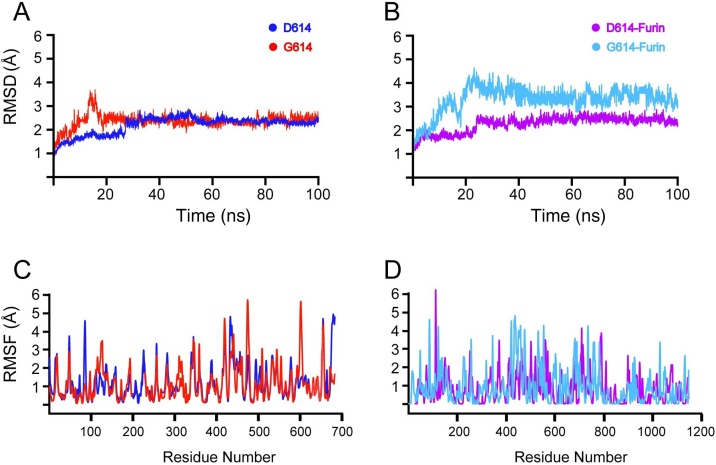
Methods: The effect of D614G substitution on the structure and thermodynamic stability of the S protein was analyzed with use of DynaMut and SCooP. HDOCK and PRODIGY were used to model furin protease binding to the S protein RRAR cleavage site and calculate binding affinities. Molecular dynamics simulations were used to predict the S protein apo structure, the S protein-furin complex structure, and the free binding energy of the complex.
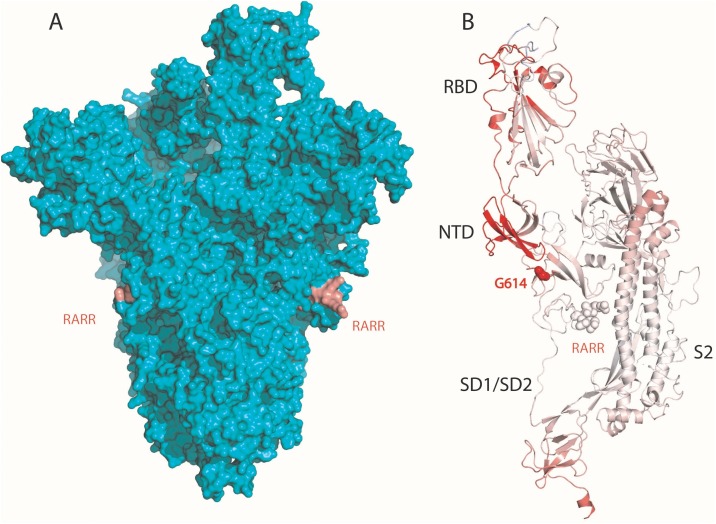
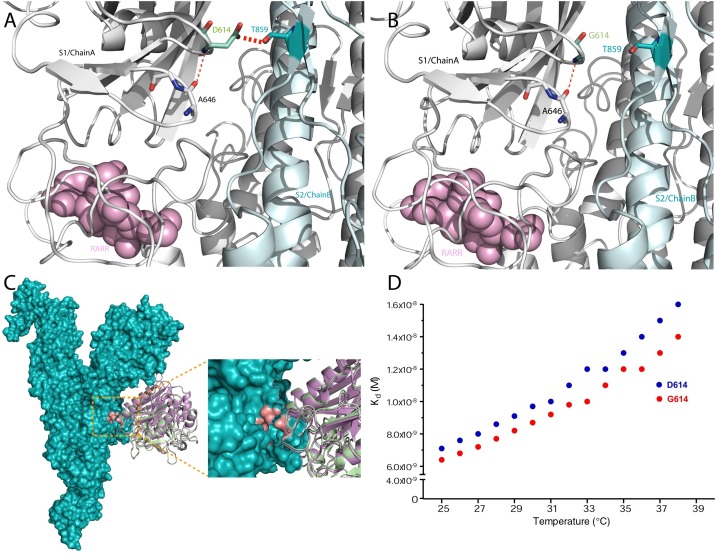
Results: The D614G substitution in the G clade of SARS-CoV-2 strains introduced structural mobility and decreased the thermal stability of the S protein (ΔΔG = -0.086 kcal mol-1). The substitution resulted in stronger binding affinity (Kd = 1.6 × 10⁻⁸) for furin, which may enhance S protein cleavage. The results were corroborated by molecular dynamics simulations demonstrating higher binding energy of furin and the S protein D614G mutant (-61.9 kcal mol-1 compared with -56.78 kcal mol-1 for wild-type S protein).
Conclusions: The D614G substitution in the G clade induced flexibility of the S protein, resulting in increased furin binding, which may enhance S protein cleavage and infiltration of host cells. Therefore, the SARS-CoV-2 D614G substitution may result in a more virulent strain.
Keywords: COVID-19; Furin; G clade; Interatomic binding; Molecular dynamics simulations; S protein; SARS-CoV-2; Thermodynamic stability.
Copyright © 2020 The Authors. Published by Elsevier Ltd.. All rights reserved.
Figures
References
-
- Abraham M.J., Murtola T., Schulz R., Páll S., Smith J.C., Hess B., et al. GROMACS: high performance molecular simulations through multi-level parallelism from laptops to supercomputers. SoftwareX. 2015;1:19–25.
MeSH terms
Substances
LinkOut - more resources
Full Text Sources
Other Literature Sources
Medical
Miscellaneous
