Review
. 2020 Oct 15;25(20):4723.
doi: 10.3390/molecules25204723.

Merging Ligand-Based and Structure-Based Methods in Drug Discovery: An Overview of Combined Virtual Screening Approaches

Affiliations
Review

Merging Ligand-Based and Structure-Based Methods in Drug Discovery: An Overview of Combined Virtual Screening Approaches

Javier Vázquez et al. Molecules. .

Abstract

Virtual screening (VS) is an outstanding cornerstone in the drug discovery pipeline. A variety of computational approaches, which are generally classified as ligand-based (LB) and structure-based (SB) techniques, exploit key structural and physicochemical properties of ligands and targets to enable the screening of virtual libraries in the search of active compounds. Though LB and SB methods have found widespread application in the discovery of novel drug-like candidates, their complementary natures have stimulated continued efforts toward the development of hybrid strategies that combine LB and SB techniques, integrating them in a holistic computational framework that exploits the available information of both ligand and target to enhance the success of drug discovery projects. In this review, we analyze the main strategies and concepts that have emerged in the last years for defining hybrid LB + SB computational schemes in VS studies. Particularly, attention is focused on the combination of molecular similarity and docking, illustrating them with selected applications taken from the literature.

Keywords: combined strategies; drug discovery; ligand-based techniques; structure-based methods; virtual screening.


Conflict of interest statement

The authors declare no conflict of interest.

Figures
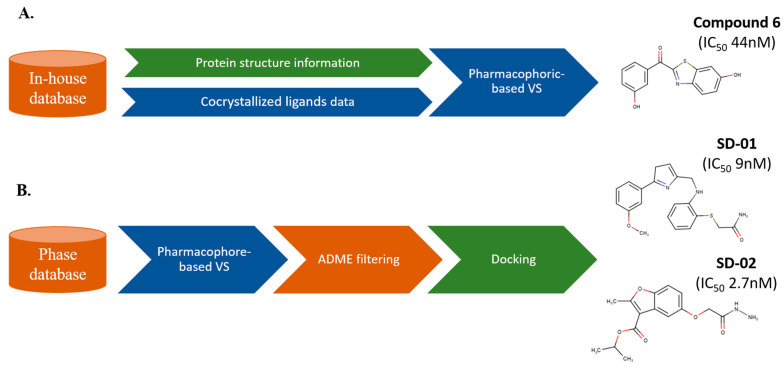
Figure 1
Figure 1
Representative cases of two combined ligand-based (LB) and structure-based (SB) strategies leading to the discovery of potent inhibitors of (A) 17β-hydroxysteroid dehydrogenase type 1 (17β-HSD1) and (B) histone deacetylase 8 (HDAC8) enzymes. LB and SB methods are highlighted in blue and green, respectively. VS: virtual screening.
Figure 2
Figure 2
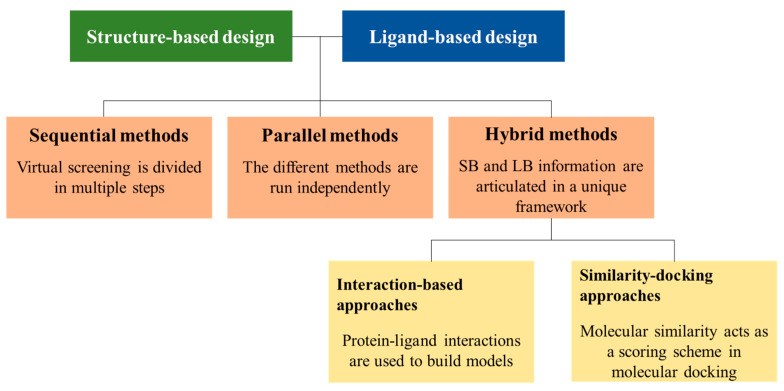
Schematic representation of the three main strategies adopted for combining LB and SB methods.
Figure 3
Figure 3
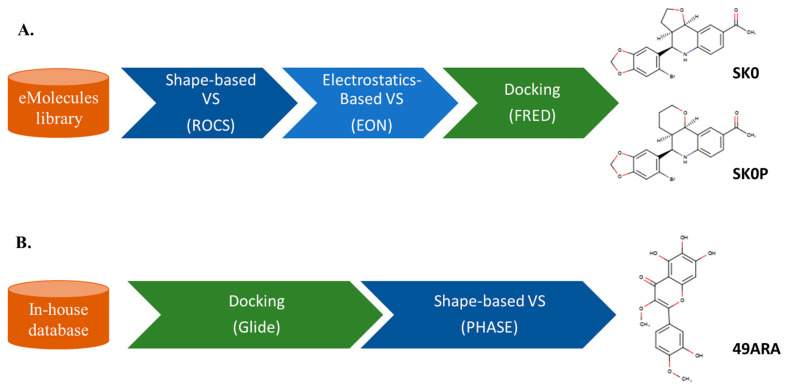
Schematic representation of two sequential VS processes (LB and SB methods are highlighted in blue and green, respectively). (A) Sequential application of LB (shape-based and electrostatic-based similarity search) followed by SB (docking). The two most active compounds found, SK0 and SK0P, exhibited antiproliferative activities against SK-BR-3 and MCF7 cell lines in the micromolar range. (B) Sequential VS of SB followed by LB over an in-house database. The compound 49ARA was detected among the top-ranked compounds included in the methylene chloride extract of Artemisia annua (IC50 of 2.2 μg/mL). ROCS: Rapid Overlay of Chemical Structures.
Figure 4
Figure 4
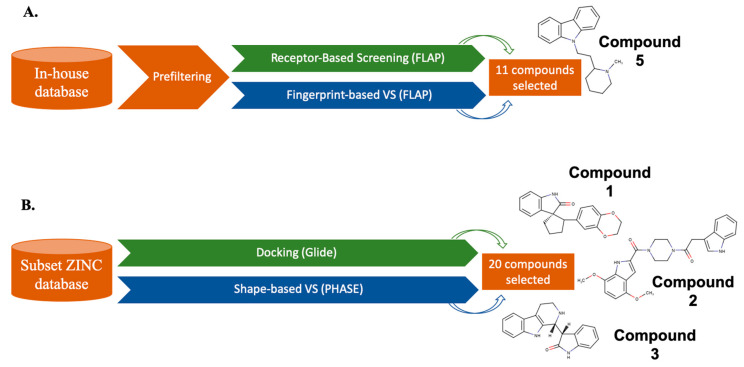
Schematic representation of two parallel VS processes (LB and SB methods are highlighted in blue and green, respectively). (A) Parallel application of LB (fingerprint similarity search) followed by SB (pharmacophoric receptor-based screening). FLAP, which allows ligand-ligand and ligand-protein similarity assays, was used for both approaches. The most active compound exhibited an IC50 in the micromolar range. (B) Parallel VS over a ZINC database subset. Glide was run for SB and PHASE for LB. Among the 20 hits selected, three compounds showed activity in the micromolar range.
Figure 5
Figure 5
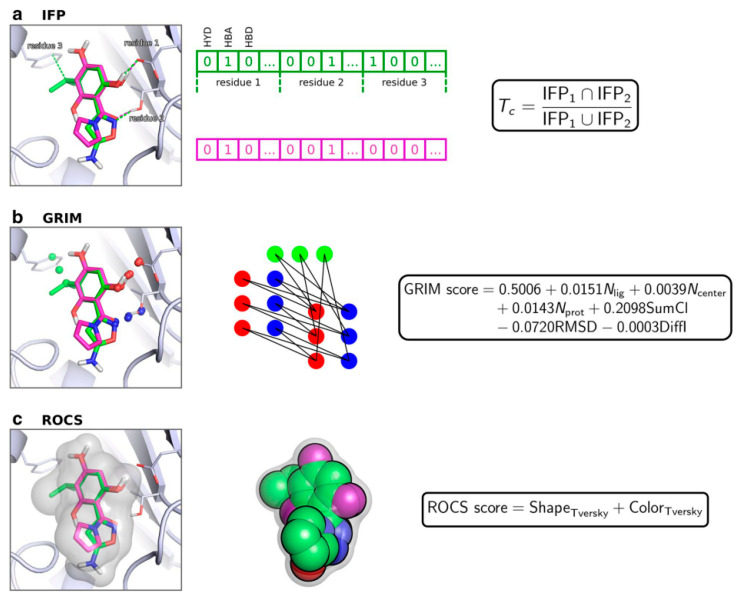
Overview of rescoring methods coupled to interaction fingerprints (IFP), graph matching (GRIM), and ROCS. (a) In the IFP score Tc denotes the Tanimoto coefficient. (b) In the GRIM score, Nlig is the number of aligned ligand points, Ncenter stands for the number of aligned centered points, Nprot is the number of aligned protein points, SumCl is the sum of clique weights over all weights, RMSD is the root mean square deviation of the matched cliques, and DiffI stands for the difference between the number of interaction points in the query and the template compound. (c) The ROCS score is based on the Tversky coefficient. Reprinted with permission from Springer Nature [79].
Figure 6
Figure 6
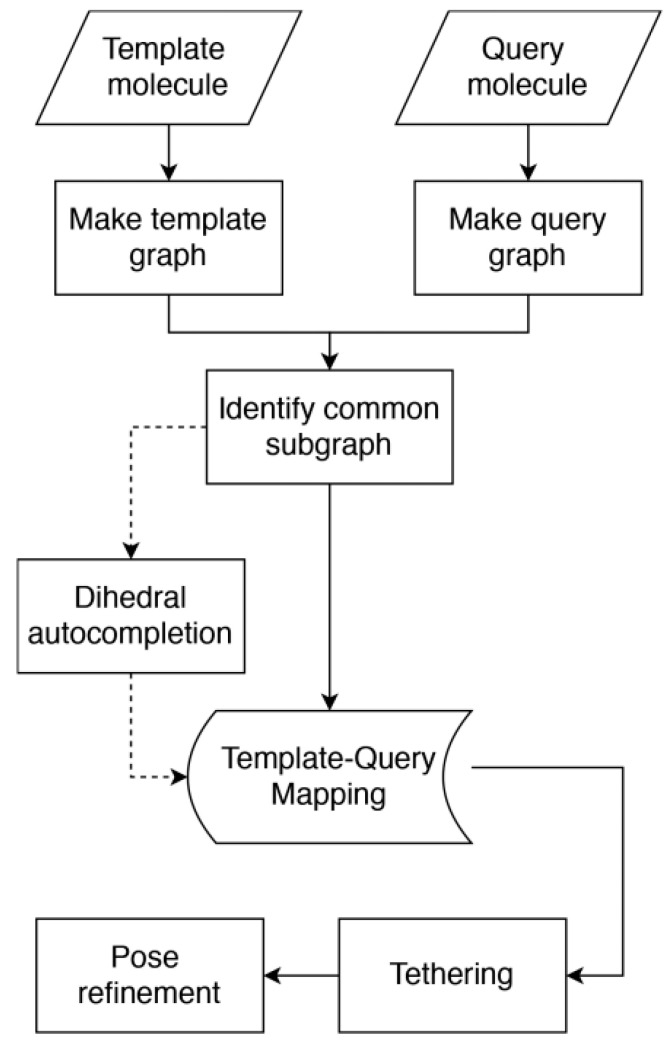
Schematic representation of the flowchart implemented in the SkeleDock algorithm. Reprinted with permission from the American Chemical Society [164].
Figure 7
Figure 7
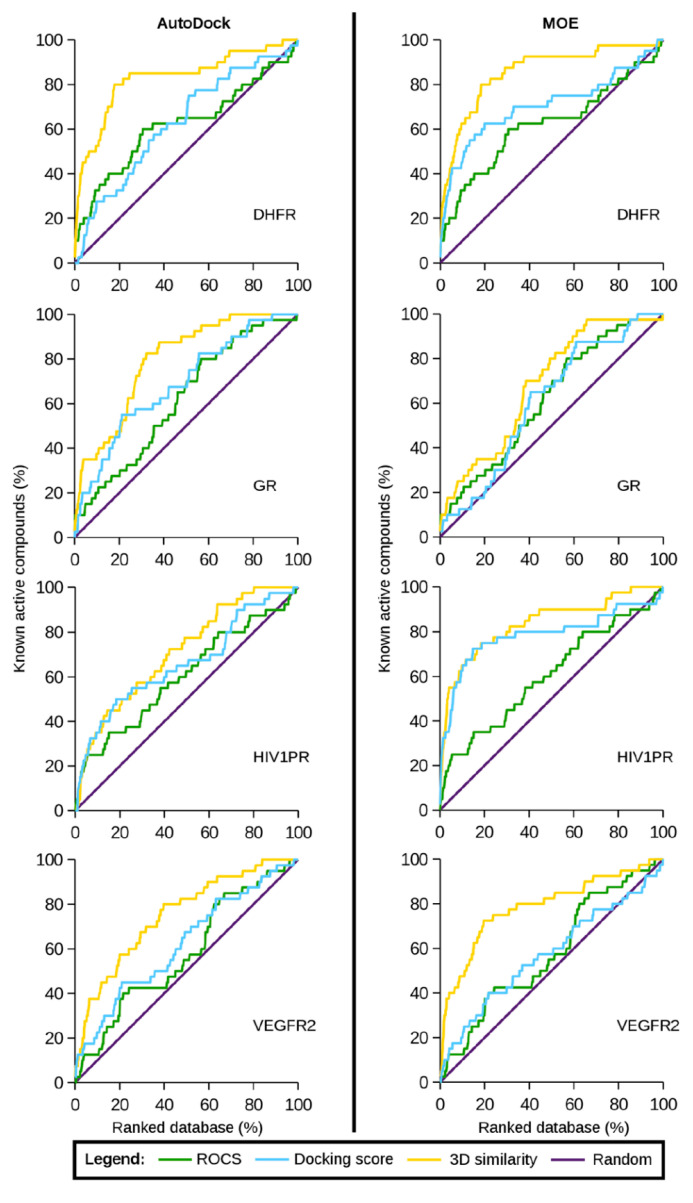
ROC plots obtained for four validation targets (DHFR: dihydrofolate reductase, GR: glucocorticoid receptor, HIV1PR: HIV-1 protease, and VEGFR2: vascular endothelial growth factor receptor-2) using shape-based similarity (ROCS; green), docking (AutoDock [166] and MOE [167]; cyan), and the hybridized method (yellow). Reprinted with permission from the American Chemical Society [76].
Figure 8
Figure 8
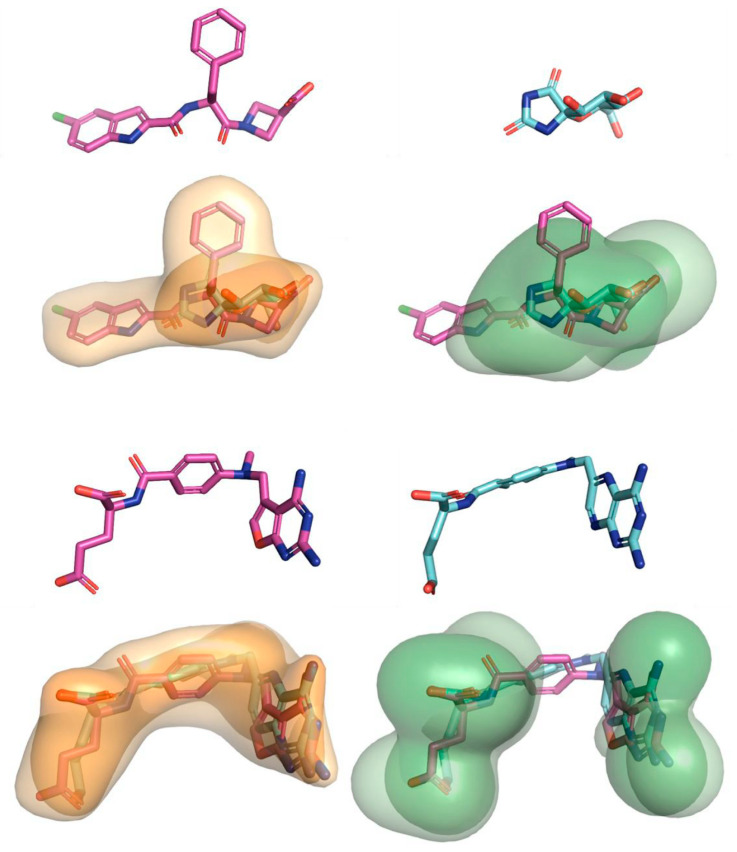
Representation of the hydrophobic molecular overlay exploited by PharmScreen. (Top) Overlay of ZINC02046793 (template) and ZINC1489956 (active) pertaining to glycogen phosphorylase®. (Bottom) Molecular alignment of ZINC0384989 (template) and ZINC1529323 (active) pertaining to the dihydrofolate reductase. Orange and green contours denote the fields originated from the cavitation and electrostatic components of the molecular lipophilicity. Reprinted with permission from the American Chemical Society [80].
Figure 9
Figure 9
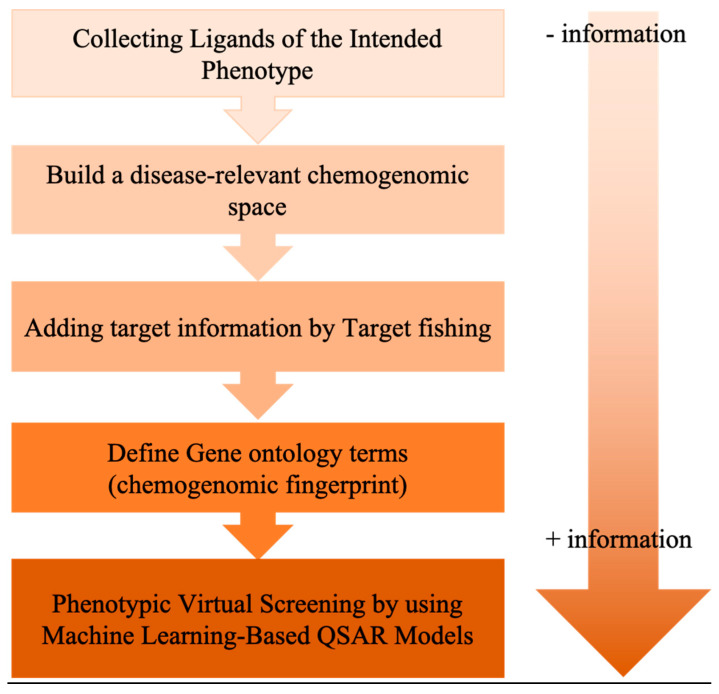
Schematic representation of systemic chemogenomics/quantitative structure-activity relationships (QSARs) for phenotypic VS.

References

    1. Free Energy Calculations . In: Theory and Applications in Chemistry and Biology. Chipot C., Pohorille A., editors. Springer; Berlin/Heidelberg, Germany: 2007.
    1. Abel R., Wang L., Harder E.D., Berne B.J., Friesner R.A. Advancing drug discovery through enhanced free energy calculations. Acc. Chem. Res. 2017;50:1625–1632. doi: 10.1021/acs.accounts.7b00083. - DOI - PubMed
    1. Williams-Noonan B.J., Yuriev E., Chalmers D.K. Free energy methods in drug design: Prospects of “alchemical perturbation” in medicinal chemistry. J. Med. Chem. 2018;61:638–649. doi: 10.1021/acs.jmedchem.7b00681. - DOI - PubMed
    1. Christ C.D., Fox T. Accuracy assessment and automation of free energy calculations for drug design. J. Chem. Inf. Model. 2013;54:108–120. doi: 10.1021/ci4004199. - DOI - PubMed
    1. Mondal D., Florian J., Warshel A. Exploring the effectiveness of binding free energy calculations. J. Phys. Chem. B. 2019;123:8910–8915. doi: 10.1021/acs.jpcb.9b07593. - DOI - PMC - PubMed