Review
. 2020 Oct 15;12(10):2984.
doi: 10.3390/cancers12102984.

Inflammation as a Driver of Prostate Cancer Metastasis and Therapeutic Resistance

Affiliations
Review

Inflammation as a Driver of Prostate Cancer Metastasis and Therapeutic Resistance

Maddison Archer et al. Cancers (Basel). .

Abstract

Prostate cancer is the most common malignancy among men, and progression to metastasis and the emergence of therapeutically resistant disease confers a high mortality rate. Growing evidence implicates inflammation as a driver of prostate cancer development and progression, resulting in increased cancer risk for prostate cancer. Population-based studies revealed that the use of antinflammatory drugs led to a 23% risk reduction prostate cancer occurrence, a negative association that was stronger in men who specifically used COX-2 inhibitors. Furthermore, patients that were taking aspirin had a 21% reduction in prostate cancer risk, and further, long-term users of daily low dose aspirin had a 29% prostate cancer risk reduction as compared to the controls. Environmental exposure to bacterial and viral infections, exposure to mutagenic agents, and genetic variations predispose the prostate gland to inflammation, with a coordinated elevated expression of inflammatory cytokines (IL-6, TGF-β). It is the dynamics within the tumor microenvironment that empower these cytokines to promote survival and growth of the primary tumor and facilitate disease progression by navigating the immunoregulatory network, phenotypic epithelial-mesenchymal transition (EMT), angiogenesis, anoikis resistance, and metastasis. In this review, we discuss the sources of inflammation in the prostate, the functional contribution of the critical inflammatory effectors to prostate cancer initiation and metastatic progression, and the therapeutic challenges that they impose on treatment of advanced disease and overcoming therapeutic resistance. Growing mechanistic evidence supports the significance of inflammation in localized prostate cancer, and the systemic impact of the process within the tumor microenvironment on disease progression to advanced therapeutically-resistant prostate cancer. Rigorous exploitation of the role of inflammation in prostate cancer progression to metastasis and therapeutic resistance will empower the development of precise biomarker signatures and effective targeted therapeutics to reduce the clinical burden and lethal disease in the future.

Keywords: EMT phenotype; anoikis; macrophages; metastasis; survival signaling; treatment resistance; tumor microenvironment; vascularity.


Conflict of interest statement

The authors declare no conflict of interest. The funders had no role in the design of the study, in the collection, analysis or interpretation of the data; in the writing of the manuscript or in the decision to publish the results.

Figures
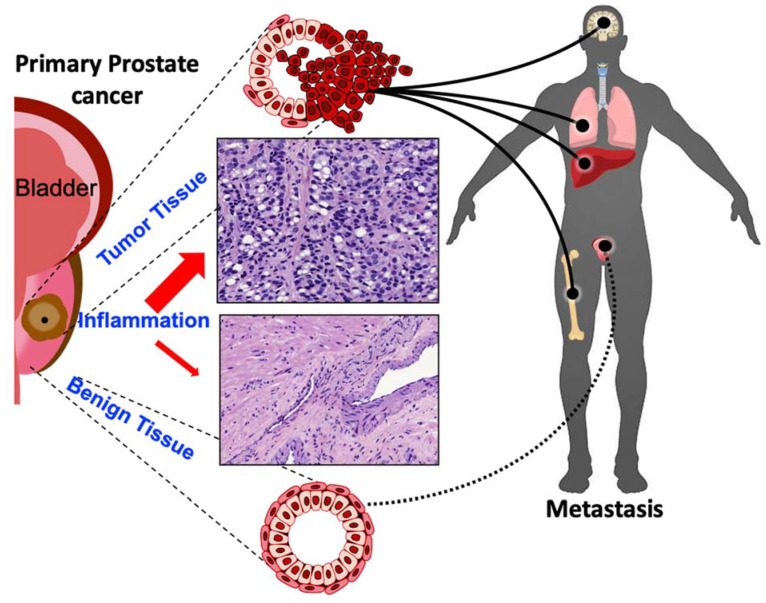
Figure 1
Figure 1
The Case of Inflammation within the Primary Prostate Tumors. Schema of normal prostate and corresponding/adjacent prostate tumor from biopsies in the patient. H&E staining indicating areas of inflammatory cell infiltration from the primary prostate cancer. Inflammation as a histopathological feature on the local prostate adenocarcinoma that remains organ-confined is not explicitly defined and its contribution in the context of navigating the aggressive behavior of prostate cancer to bone metastasis is even more poorly understood. We propose that inflammation in the primary tumor microenvironment can navigate the metastatic journey beyond the prostate including the liver, brain, lung, and bone. Differentiating prostate inflammation from cancer development early is critical to reducing overtreatment and overcoming therapeutic resistance.
Figure 2
Figure 2
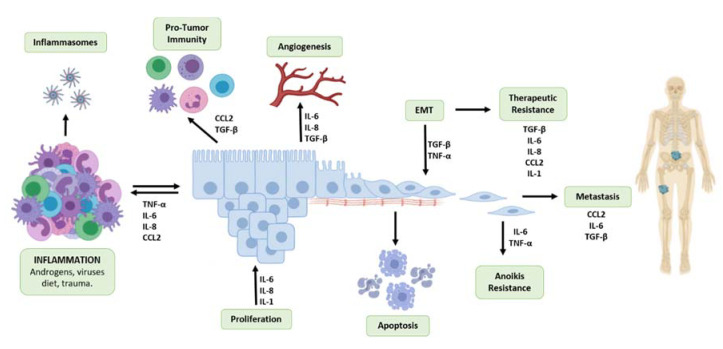
Overlapping functions of Inflammatory Cytokines Determine the Prostate Tumor Microenvironment Landscape and Metastatic Progression. Systemic and local inflammation in the prostate as a result of androgens, viral infections, trauma and diet is characterized by production of pro-inflammatory cytokines. In the microenvironment of primary prostate tumors, inflammation is sustained by production of pro-inflammatory cytokines by caner epithelial cells. These cytokines promote tumor cell proliferation, act as chemoattractants for tumor-associated macrophages (TAMs) and other immune cells to promote immune evasion, angiogenesis and ultimately tumor cell invasion and progression to metastasis to the bone. transforming growth factor beta (TGF-β) and tumor necrosis-factor-α (TNF-α) mediate the phenotypic reprogramming of tumor cells via Epithelial–Mesenchymal Transition (EMT) allowing the cells to lose their tight junctions and promote anoikis with consequential loss of attachment to basement membrane. This phenotypic reprogramming, along with influence of inflammatory cytokines confers resistance to therapeutics, via impacting cell survival as tumor cells are subjected to apoptosis; NF-κB signaling facilitates resistance to anoikis in tumor cells empowering migration, invasion and development of metastatic lesions primarily in the bone with the functional contributions by chemokine ligand 2 (CCL2), IL-6, and TGF-β within the bone microenvironment.

References

    1. Siegel R.L., Miller K.D., Jemal A. Cancer statistics, 2020. CA Cancer J. Clin. 2020;70:7–30. doi: 10.3322/caac.21590. - DOI - PubMed
    1. De Marzo A.M., Platz E.A., Sutcliffe S., Xu J., Grönberg H., Drake C.G., Nakai Y., Isaacs W.B., Nelson W.G. Inflammation in prostate carcinogenesis. Nat. Rev. Cancer. 2007;7:256–269. doi: 10.1038/nrc2090. - DOI - PMC - PubMed
    1. Lu H., Ouyang W., Huang C. Inflammation, a key event in cancer development. Mol. Cancer Res. 2006;4:221–233. doi: 10.1158/1541-7786.MCR-05-0261. - DOI - PubMed
    1. Medzhitov R. Inflammation 2010: New adventures of an old flame. Cell. 2010;140:771–776. doi: 10.1016/j.cell.2010.03.006. - DOI - PubMed
    1. Staal J., Beyaert R. Inflammation and NF-kappaB signaling in prostate cancer: Mechanisms and clinical implications. Cells. 2018;7:122. doi: 10.3390/cells7090122. - DOI - PMC - PubMed