


Role of clinical, functional and social factors in the association between multimorbidity and quality of life: Findings from the Survey of Health, Ageing and Retirement in Europe (SHARE)
- PMID: 33079931
- PMCID: PMC7575102
- DOI: 10.1371/journal.pone.0240024
Role of clinical, functional and social factors in the association between multimorbidity and quality of life: Findings from the Survey of Health, Ageing and Retirement in Europe (SHARE)
Abstract
Objective: An increasing number of diseases is linked to deterioration of quality of life (QoL). Part of this association can be explained by socio-economic factors, which are most commonly accounted for. Our aim was to explore the potential contribution of other factors related to clinical burden, social interaction and functioning.
Methods: A cross-sectional analysis was conducted on wave 6 of the population-based Survey of Health, Ageing and Retirement in Europe (SHARE), among participants aged 50+ (n = 67 179). The Control, Autonomy, Self-Realization and Pleasure (CASP-12v1) questionnaire measured QoL. The association between number of diseases and QoL was tested in a mixed-effects linear regression model. The base model controlled for socio-economic characteristics. Factors of interest (symptoms, polypharmacy, unmet care needs, utilisation of care, social network, personal and financial help, loneliness and activities of daily living (ADL) with instrumental activities (IADL)) were added to the base model one at a time and tested for relevance (i.e. change in the β-coefficient of the number of conditions of 15% or more).
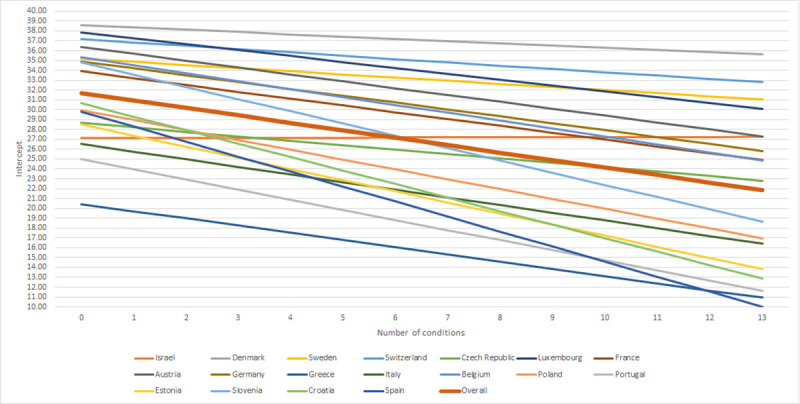
Results: Symptoms, polypharmacy, loneliness and ADL/IADL appeared relevant and were retained in the final model. The association between number of conditions and QoL in the base model was -2.44 [95% CI: -2.72; -2.16], while this association was -0.76 [95%CI: -0.97; -0.54] after all relevant factors were included.
Conclusion: Factors beyond the socio-economic circumstances play an important role in explaining the association between number of conditions and QoL. These factors should be considered to better estimate the impact of chronic diseases on QoL, and for improving patient care.
Conflict of interest statement
The authors have declared that no competing interests exist.
Figures

References
-
- United Nations. Department of Economic and Social Affairs, Population Division (2020), World Population Ageing 2019(ST/ESA/SER.A/444).
-
- van den Akker M, Buntinx F, Knottnerus JA. Comorbidity or multimorbidity: what's in a name? A review of literature. Eur J Gen Pract. 1996;2(2):65–70. 10.3109/13814789609162146 - DOI
MeSH terms
LinkOut - more resources
Full Text Sources
Medical
