


Cesarean delivery and infant cortisol regulation
- PMID: 33080520
- PMCID: PMC7818649
- DOI: 10.1016/j.psyneuen.2020.104862
Cesarean delivery and infant cortisol regulation
Abstract
Background: Cesarean delivery reduces the risk of infant and maternal morbidity and mortality when medically indicated, however, the cesarean delivery rate is estimated to be two to three times higher than medically necessary. The World Health Organization and American College of Obstetricians and Gynecologists have expressed concern over the high rates of cesarean delivery, citing evidence that cesarean delivery has negative short- and long-term consequences for the health of the infant, mother, and for future pregnancies. Infants delivered by cesarean are at an increased risk of metabolic disease and immune dysfunction throughout the lifespan. Preliminary research suggests that the hypothalamic pituitary adrenal (HPA) axis is a plausible pathway linking cesarean delivery to poor health later in life. The present study examines the relation between mode of delivery and HPA axis function in six-month-old infants. We also examine whether the cesarean delivery was elective or indicated altered to the relation between mode of delivery and infant cortisol profiles.
Methods: The sample included 136 mother/infant pairs. Thirty-nine women delivered by cesarean and 97 delivered vaginally. Maternal and infant medical records were reviewed for prenatal medical history and birth outcomes. Infant saliva was collected for cortisol analysis at a 6-month well-baby checkup. Samples were collected upon arrival to the appointment (baseline) and 20 min after exposure to a painful stressor, the inoculation procedure (response). A mixed model ANCOVA was conducted to determine whether salivary cortisol concentrations differed between the two delivery groups. To examine whether complications related to having an indicated cesarean delivery contributed to any association between mode of delivery and cortisol production, cortisol concentrations were compared between the subgroup of infants whose cesarean deliveries were elective (e.g. maternal request or previous cesarean delivery) to infants delivered vaginally.
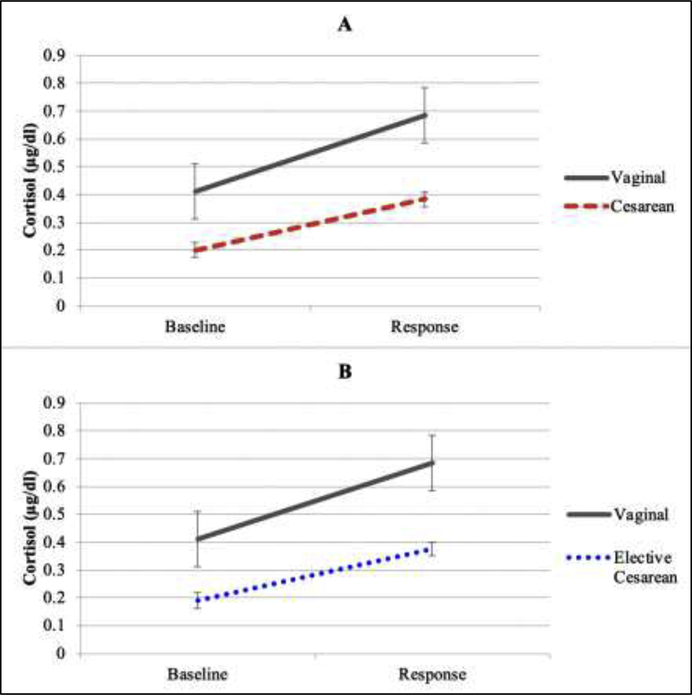
Results: Infants delivered by cesarean had lower cortisol concentrations at baseline and after the inoculation procedure compared to those delivered vaginally. Further, the relation between mode of delivery and cortisol levels persisted even when the analyses were restricted to compare only the elective cesarean deliveries (e.g. maternal request or previous cesarean delivery) to those delivered vaginally.
Discussion: This study provides evidence for an association between cesarean delivery and infant HPA axis function in infancy. Findings are consistent with the hypothesis that the HPA axis is a plausible pathway that links cesarean delivery with long-term health outcomes.
Keywords: Cesarean delivery; Cortisol; Delivery mode; HPA axis; Stress.
Copyright © 2020 Elsevier Ltd. All rights reserved.
Conflict of interest statement
Conflict of interest
The authors report no conflict of interest.
Figures
References
-
- American College of Obstetricians and Gynecologists, 2019. Cesarean delivery on maternal request. Obstet. Gynecol. 133, 73–77.
