


Tailored Exercise during Hematopoietic Stem Cell Transplantation Hospitalization in Children with Cancer: A Prospective Cohort Study
- PMID: 33080908
- PMCID: PMC7650695
- DOI: 10.3390/cancers12103020
Tailored Exercise during Hematopoietic Stem Cell Transplantation Hospitalization in Children with Cancer: A Prospective Cohort Study
Abstract
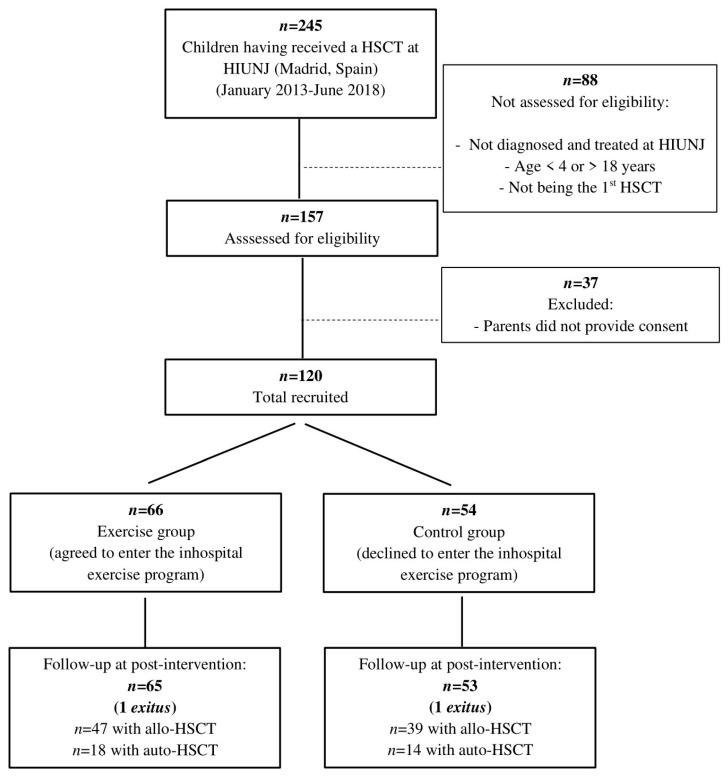
We assessed the clinical effects of a supervised exercise (aerobic + resistance) intervention performed during inpatient hospitalization for pediatric hematopoietic stem cell transplantation (HSCT). Patients were placed in an exercise (n = 65 (47 and 18 with allogeneic (allo-) and autologous (auto-) HSCT, respectively)) or a control (n = 53 (39 and 14)) group. Exercise interventions were performed in isolated hospital patient rooms. Patients were followed-up from the beginning of the conditioning phase up to 6 years. We assessed survival, risk of graft-versus-host disease (GvHD) or graft failure (primary outcomes), and engraftment kinetics, supportive care, toxicity profile, and immune reconstitution for auto-HSCT and allo-HSCT. The exercise intervention was safe and did not affect the risk of mortality, acute/chronic GvHD, or graft failure (all p > 0.05). No between-group differences (p > 0.05) were found for the remainder of clinical endpoints, except for a reduced number of total and viral infections in the exercise group after allo-HSCT (unadjusted p = 0.005 for both total and viral infections, and adjusted p = 0.023 and 0.083, respectively). In conclusion, exercise performed during inpatient hospitalization for pediatric HSCT is safe and well tolerated during both auto and allo-HSCT and tends to decrease the risk of infection after allo-HSCT. These findings provide additional support to the notion that a multidisciplinary approach (i.e., including the work of exercise specialists) is suitable in the management of children undergoing HSCT. Further studies are needed to determine whether applying a different training stimulus (notably, higher exercise intensities) exerts positive effects on HSCT prognosis in these patients.
Keywords: childhood cancer; exercise is medicine; graft-versus-host disease; immune reconstitution; infection.
Conflict of interest statement
The authors declare no conflict of interest.
Figures
References
-
- Miano M., Labopin M., Hartmann O., Angelucci E., Cornish J., Gluckman E., Locatelli F., Fischer A., Egeler R.M., Or R., et al. Haematopoietic stem cell transplantation trends in children over the last three decades: A survey by the paediatric diseases working party of the European Group for Blood and Marrow Transplantation. Bone Marrow Transpl. 2007;39:89–99. doi: 10.1038/sj.bmt.1705550. - DOI - PubMed
-
- Chow E.J., Cushing-Haugen K.L., Cheng G.S., Boeckh M., Khera N., Lee S.J., Leisenring W.M., Martin P.J., Mueller B.A., Schwartz S.M., et al. Morbidity and Mortality Differences Between Hematopoietic Cell Transplantation Survivors and Other Cancer Survivors. J. Clin. Oncol. 2017;35:306–313. doi: 10.1200/JCO.2016.68.8457. - DOI - PMC - PubMed
-
- Morales J.S., Valenzuela P.L., Rincón-Castanedo C., Takken T., Fiuza-Luces C., Santos-Lozano A., Lucia A. Exerc.ise training in childhood cancer: A systematic review and meta-analysis of randomized controlled trials. Cancer Treat. Rev. 2018;70:154–167. doi: 10.1016/j.ctrv.2018.08.012. - DOI - PubMed
-
- Martha B.A., Vacchi C.O., Fattori R.A., Macagnan F.E. Effect of physical Exerc.ise on the functional capacity of children and adolescents submitted to transplantation of hematopoietic stem cells-A systematic review with meta-analysis. J. Child. Health Care. 2020 doi: 10.1177/1367493520903626. - DOI - PubMed
Grants and funding
LinkOut - more resources
Full Text Sources
Medical
