. 2020 Oct 16;9(10):708.
doi: 10.3390/antibiotics9100708.

Prevalence and Epidemiology of Multidrug-Resistant Pathogens in the Food Chain and the Urban Environment in Northwestern Germany

Affiliations

Prevalence and Epidemiology of Multidrug-Resistant Pathogens in the Food Chain and the Urban Environment in Northwestern Germany

Sylvia Klees et al. Antibiotics (Basel). .

Abstract

The surveillance of antimicrobial resistance among humans and food-producing animals is important to monitor the zoonotic transmission of multidrug-resistant bacteria (MDRB). We assessed the prevalence of four MDRB within the meat production chain, including extended-spectrum β-lactamase (ESBL)-producing, carbapenemase-producing Enterobacterales (CPE) and colistin-resistant Enterobacterales (Col-E), as well as vancomycin-resistant enterococci (VRE). In total, 505 samples from four stages of meat production, i.e., slaughterhouses, meat-processing plants, fresh food products and the urban environment, were collected in northwestern Germany in 2018/2019 and screened for the presence of MDRB using both culture-based and PCR-based techniques. We detected genes encoding for carbapenemases in 9-56% (blaOXA-48, blaKPC, blaNDM, blaVIM) and colistin resistance-encoding mcr genes in 9-26% of the samples from all stages. Culture-based analysis found CPE and VRE only in environmental samples (11% and 7%, respectively), but Col-E and ESBL-producers in 1-7% and 12-46% of samples from all stages, respectively. Overall, our results showed that ESBL-producers and mcr-carrying Col-E were common in food-producing animals at slaughterhouses, in meat-processing plants and in food items at retail, while CPE and VRE were only found in the environment. The discrepancy between detected carbapenemase genes and isolated CPE emphasizes the need for more sensitive detection methods for CPE monitoring.

Keywords: antimicrobial resistance; food safety; one health; zoonosis.


Conflict of interest statement

The authors declare no conflict of interest.

Figures
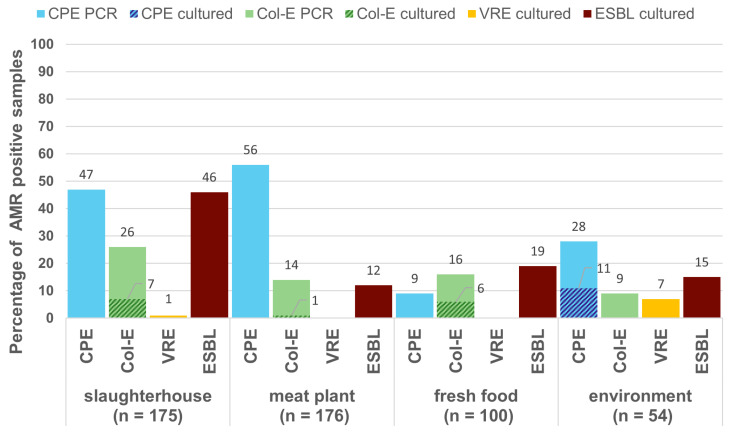
Figure 1
Figure 1
Overview of carbapenemase-producing Enterobacterales (CPE), colistin-resistant Enterobacterales (Col-E), vancomycin-resistant enterococci (VRE), and extended-spectrum β-lactamase (ESBL)-producing Escherichia coli prevalence in different stages of the meat production chain. For CPE and Col-E, stippled areas indicate from how many samples’ isolates were successfully cultured in comparison to the relative amount of samples that were positive for antimicrobial resistance (AMR) genes in the PCR screening.
Figure 2
Figure 2
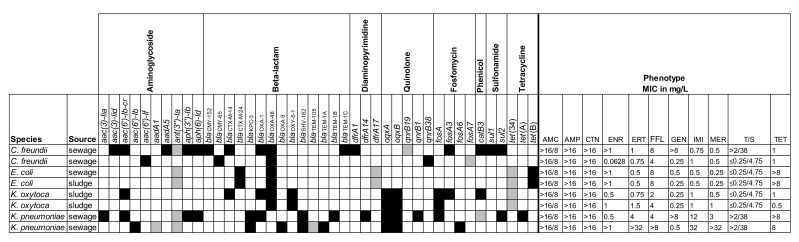
Resistance profiles for eight carbapenemase-producing Enterobacterales. Overview of the presence/absence of the resistance genes and minimum inhibitory concentrations (MICs) for the selected antimicrobial agents. AMC = amoxicillin/clavulanic acid; AMP = ampicillin; CTN = cephalothin; ENR = enrofloxacin; ERT = ertapenem; FFL = florfenicol; GEN = gentamicin; IMI = imipenem; MER = meropenem; T/S = trimethoprim/sulfamethoxazole; TET = tetracycline. Black = presence (>80% coverage, 95% identity); grey = partial presence (<80% coverage); white = absence.
Figure 3
Figure 3
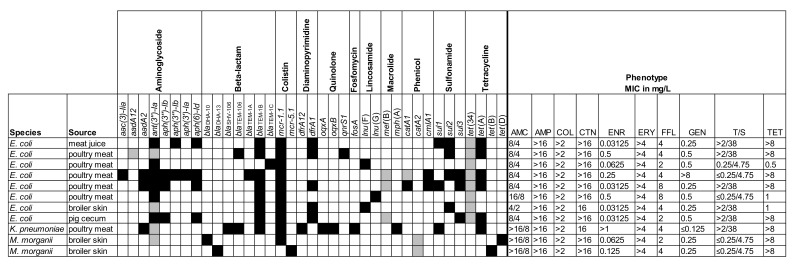
Resistance profiles for eleven colistin-resistant Enterobacterales. Overview of the presence/absence of the resistance marker genes and minimum inhibitory concentrations (MICs) for the selected antimicrobial agents. AMC = amoxicillin/clavulanic acid; AMP = ampicillin; COL = colistin; CTN = cephalothin; ENR = enrofloxacin; ERY = erythromycin; FFL = florfenicol; GEN = gentamicin; T/S = trimethoprim/sulfamethoxazole; TET = tetracycline. Black = presence (>80% coverage, 95% identity); grey = partial presence (<80% coverage); white = absence.
Figure 4
Figure 4
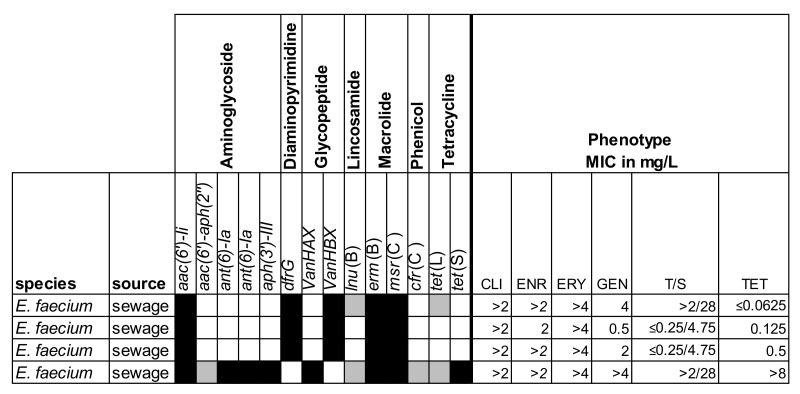
Resistance profiles for four vancomycin-resistant enterococci. Overview of the presence/absence of the resistance marker genes and minimum inhibitory concentrations (MICs) for the selected antibiotics. CLI = clindamycin; CMP = chloramphenicol; ENR = enrofloxacin; ERY = erythromycin; GEN = gentamicin; T/S = trimethoprim/sulfamethoxazole; TET = tetracycline. Black = presence (>80% coverage, 95% identity); grey = partial presence (<80% coverage); white = absence.
Figure 5
Figure 5
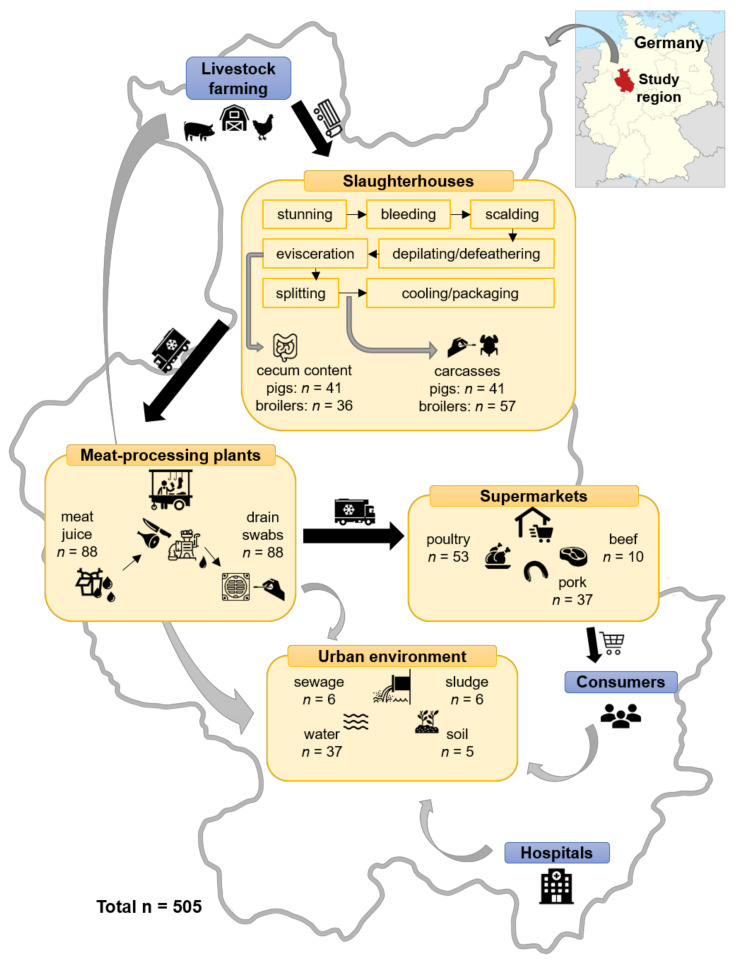
Overview of samples taken at different stages of the meat production chain. Locator map of the study region by TUBS, available from https://commons.wikimedia.org/wiki/File:Locator_map_RB_DT_in_Germany.svg, is licensed under CC BY-SA 3.0.

References

    1. Schwarz S., Silley P., Simjee S., Woodford N., van Duijkeren E., Johnson A.P., Gaastra W. Assessing the antimicrobial susceptibility of bacteria obtained from animals. Vet. Microbiol. 2010;141:1–4. doi: 10.1016/j.vetmic.2009.12.013. - DOI - PubMed
    1. Da Costa P.M., Loureiro L., Matos A.J.F. Transfer of multidrug-resistant bacteria between intermingled ecological niches: The interface between humans, animals and the environment. Int. J. Environ. Res. Public Health. 2013;10:278–294. doi: 10.3390/ijerph10010278. - DOI - PMC - PubMed
    1. Fischer J., Hille K., Ruddat I., Mellmann A., Köck R., Kreienbrock L. Simultaneous occurrence of MRSA and ESBL-producing Enterobacteriaceae on pig farms and in nasal and stool samples from farmers. Vet. Microbiol. 2017;200:107–113. doi: 10.1016/j.vetmic.2016.05.021. - DOI - PubMed
    1. Friese A., Schulz J., Laube H., von Salviati C., Hartung J., Roesler U. Faecal occurrence and emissions of livestock-associated methicillin-resistant Staphylococcus aureus (laMRSA) and ESBL/AmpC-producing E. coli from animal farms in Germany. Berl. Münch. Tierärztl. Wochenschr. 2013;126:175–180. - PubMed
    1. Beneke B., Klees S., Stührenberg B., Fetsch A., Kraushaar B., Tenhagen B.A. Prevalence of methicillin-resistant Staphylococcus aureus in a fresh meat pork production chain. J. Food Prot. 2011;74:126–129. doi: 10.4315/0362-028X.JFP-10-250. - DOI - PubMed