Review
. 2020 Oct 16;12(10):3011.
doi: 10.3390/cancers12103011.

Intestinal Microbiota in Colorectal Cancer Surgery

Affiliations
Review

Intestinal Microbiota in Colorectal Cancer Surgery

Ioannis Koliarakis et al. Cancers (Basel). .

Abstract

The intestinal microbiota consists of numerous microbial species that collectively interact with the host, playing a crucial role in health and disease. Colorectal cancer is well-known to be related to dysbiotic alterations in intestinal microbiota. It is evident that the microbiota is significantly affected by colorectal surgery in combination with the various perioperative interventions, mainly mechanical bowel preparation and antibiotic prophylaxis. The altered postoperative composition of intestinal microbiota could lead to an enhanced virulence, proliferation of pathogens, and diminishment of beneficial microorganisms resulting in severe complications including anastomotic leakage and surgical site infections. Moreover, the intestinal microbiota could be utilized as a possible biomarker in predicting long-term outcomes after surgical CRC treatment. Understanding the underlying mechanisms of these interactions will further support the establishment of genomic mapping of intestinal microbiota in the management of patients undergoing CRC surgery.

Keywords: anastomotic leakage; antibiotics; bowel preparation; colorectal cancer; dysbiosis; intestinal microbiota; outcomes; surgery; surgical site infection.


Conflict of interest statement

The authors declare no conflict of interest.

Figures
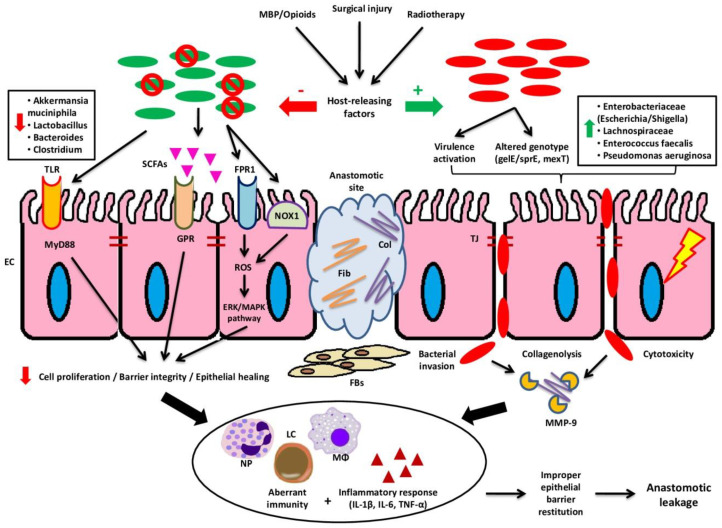
Figure 1
Figure 1
Events after colorectal surgery leading to AL. Surgical injury following colorectal resection in combination with perioperative interventions (MBP, opioids, and radiotherapy) trigger the release of various host-derived factors. These factors interfere with the intestinal microbiota at the anastomotic site causing shifts. Physiologically, microbiota promotes colonic cell proliferation and epithelial healing and enhances the integrity of the intestinal barrier, mainly through the stimulation of TLRs, release of SCFAs (e.g. butyrate), and interaction with FPR1 and NOX1 causing the release of ROS and upregulation of the ERK/MAPK pathway. However, the deleterious effects of the aforementioned factors result in reduction of beneficial members of microbiota, thus suppressing normal wound healing. Moreover, several pathogens are increased demonstrating virulence activation and altered genotype. These effects lead to bacterial invasion through failure of epithelial tight junctions, collagenolysis through the activation of MMP-9, and cytotoxicity. The transformation of the intestinal microbiota into a “pathobiome” results in aberrant immunity and inflammatory response, which impair the proper epithelial restitution, eventually leading to the pathogenesis of AL. AL: anastomotic leakage; Col: collagen; EC: epithelial cell; ERK: extracellular signal-regulated kinase; FBs: fibroblasts; Fib: fibrin/fibronectin; FPR: formyl peptide receptor; GPR: G-protein coupled receptor; IL: interleukin; LC: lymphocyte; MAPK: mitogen-activated protein kinase; MBP: mechanical bowel preparation; MMP: matrix metalloproteinase; MΦ: macrophage; NOX: NADPH oxidase; NP: neutrophil; ROS: reactive oxygen species; SCFAs: short-chain fatty acids; TLR: toll-like receptors; TNF: tumor necrosis factor.
Figure 2
Figure 2
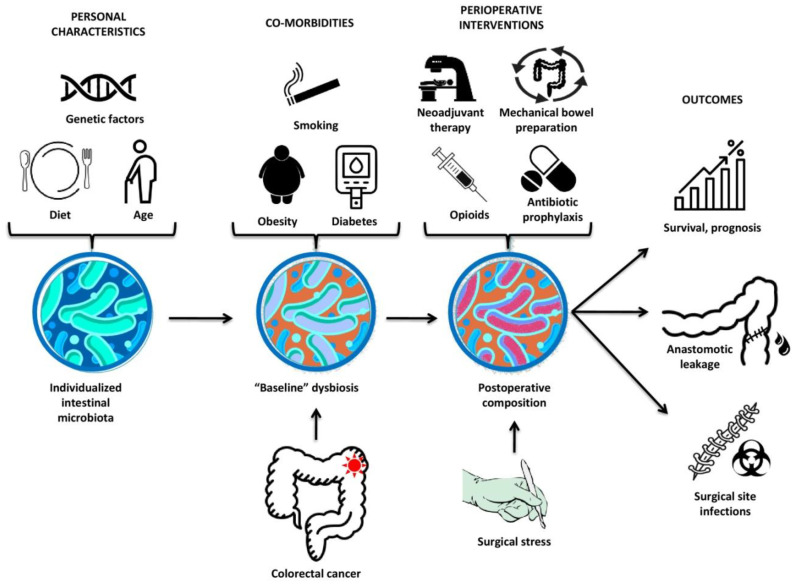
Factors influencing intestinal microbiota composition and outcomes after CRC surgery. Each individual has a distinct intestinal microbiota composition, which is mainly shaped by their age, genetic factors, and dietary preferences. Colorectal cancer, as the primary disease along with common co-morbidities including excessive tobacco usage, obesity, and diabetes further shifts the intestinal microbiota leading to a “baseline” dysbiotic state. The surgical stress combined with various perioperative interventions (neoadjuvant therapy, mechanical bowel preparation, opioids, and antibiotic prophylaxis) result in an altered postoperative microbial composition that ultimately determines the rates of postoperative complications (anastomotic leakage, surgical site infections) and long-term outcomes (survival, prognosis).

References

    1. Tremaroli V., Bäckhed F. Functional interactions between the gut microbiota and host metabolism. Nature. 2012;489:242–249. doi: 10.1038/nature11552. - DOI - PubMed
    1. Morowitz M.J., Babrowski T., Carlisle E.M., Olivas A., Romanowski K.S., Seal J.B., Liu D.C., Alverdy J.C. The human microbiome and surgical disease. Ann. Surg. 2011;253:1094–1101. doi: 10.1097/SLA.0b013e31821175d7. - DOI - PMC - PubMed
    1. Ferlay J., Soerjomataram I., Dikshit R., Eser S., Mathers C., Rebelo M., Parkin D.M., Forman D., Bray F. Cancer incidence and mortality worldwide: Sources, methods and major patterns in GLOBOCAN 2012. Int. J. Cancer. 2015;136:E359–E386. doi: 10.1002/ijc.29210. - DOI - PubMed
    1. Arthur J.C., Jobin C. The struggle within: Microbial influences on colorectal cancer. Inflamm. Bowel. Dis. 2011;17:396–409. doi: 10.1002/ibd.21354. - DOI - PMC - PubMed
    1. Ralls M.W., Miyasaka E., Teitelbaum D.H. Intestinal microbial diversity and perioperative complications. JPEN. 2014;38:392–399. doi: 10.1177/0148607113486482. - DOI - PMC - PubMed

LinkOut - more resources