


Identifying interventions with Gypsies, Roma and Travellers to promote immunisation uptake: methodological approach and findings
- PMID: 33081730
- PMCID: PMC7574499
- DOI: 10.1186/s12889-020-09614-4
Identifying interventions with Gypsies, Roma and Travellers to promote immunisation uptake: methodological approach and findings
Abstract
Background: In the UK, Gypsy, Roma and Traveller (GRT) communities are generally considered to be at risk of low or variable immunisation uptake. Many strategies to increase uptake for the general population are relevant for GRT communities, however additional approaches may also be required, and importantly one cannot assume that "one size fits all". Robust methods are needed to identify content and methods of delivery that are likely to be acceptable, feasible, effective and cost effective. In this paper, we describe the approach taken to identify potential interventions to increase uptake of immunisations in six GRT communities in four UK cities; and present the list of prioritised interventions that emerged.
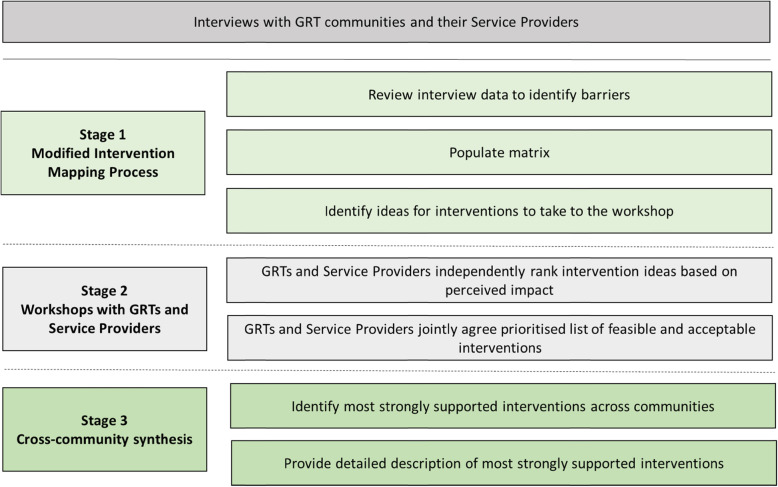
Methods: This work was conducted in three stages: (1) a modified intervention mapping process to identify ideas for potential interventions; (2) a two-step prioritisation activity at workshops with 51 GRTs and 25 Service Providers to agree a prioritised list of potentially feasible and acceptable interventions for each community; (3) cross-community synthesis to produce a final list of interventions. The theoretical framework underpinning the study was the Social Ecological Model.
Results: Five priority interventions were agreed across communities and Service Providers to improve the uptake of immunisation amongst GRTs who are housed or settled on an authorised site. These interventions are all at the Institutional (e.g. cultural competence training) and Policy (e.g. protected funding) levels of the Social Ecological Model.
Conclusions: The "upstream" nature of the five interventions reinforces the key role of GP practices, frontline workers and wider NHS systems on improving immunisation uptake. All five interventions have potentially broader applicability than GRTs. We believe that their impact would be enhanced if delivered as a combined package. The robust intervention development and co-production methods described could usefully be applied to other communities where poor uptake of immunisation is a concern.
Study registration: Current Controlled Trials ISRCTN20019630, Date of registration 01-08-2013, Prospectively registered.
Keywords: Co-production, Gypsy; Immunisation, intervention development; Roma; Traveller.
Conflict of interest statement
HB sits on the National Institute for Health and Care Excellence (NICE) Committee that is developing guidance on vaccine uptake in the general population. The other authors declare that they have no competing interests.
Figures

References
-
- Jenkins L. Preparation study of gypsy/traveller needs. Canterbury: University of Kent; 2010.
-
- Aspinall P. Hidden needs identifying key vulnerable groups in data collections: vulnerable migrants, gypsies and travellers, homeless people, and sex workers. Canterbury: University of Kent; 2014.
-
- All Ireland Traveller Health Study Team . All Ireland traveller health study our Geels. Dublin: University College Dublin; 2010.
Publication types
MeSH terms
Grants and funding
LinkOut - more resources
Full Text Sources
Medical
