Review
. 2020 Oct 20;18(1):400.
doi: 10.1186/s12967-020-02574-8.

Contrast-induced nephropathy and oxidative stress: mechanistic insights for better interventional approaches

Affiliations
Review

Contrast-induced nephropathy and oxidative stress: mechanistic insights for better interventional approaches

Prit Kusirisin et al. J Transl Med. .

Abstract

Contrast-induced nephropathy (CIN) or contrast-induced acute kidney injury (CI-AKI) is an iatrogenic acute kidney injury observed after intravascular administration of contrast media for intravascular diagnostic procedures or therapeutic angiographic intervention. High risk patients including those with chronic kidney disease (CKD), diabetes mellitus with impaired renal function, congestive heart failure, intraarterial intervention, higher volume of contrast, volume depletion, old age, multiple myeloma, hypertension, and hyperuricemia had increased prevalence of CIN. Although CIN is reversible by itself, some patients suffer this condition without renal recovery leading to CKD or even end-stage renal disease which required long term renal replacement therapy. In addition, both CIN and CKD have been associated with increasing of mortality. Three pathophysiological mechanisms have been proposed including direct tubular toxicity, intrarenal vasoconstriction, and excessive production of reactive oxygen species (ROS), all of which lead to impaired renal function. Reports from basic and clinical studies showing potential preventive strategies for CIN pathophysiology including low- or iso-osmolar contrast media are summarized and discussed. In addition, reports on pharmacological interventions to reduce ROS and attenuate CIN are summarized, highlighting potential for use in clinical practice. Understanding this contributory mechanism could pave ways to improve therapeutic strategies in combating CIN.

Keywords: Contrast-induced nephropathy; Mitochondria; Oxidative stress; Prevention; Statin.


Conflict of interest statement

The authors declare that they have no competing interests.

Figures
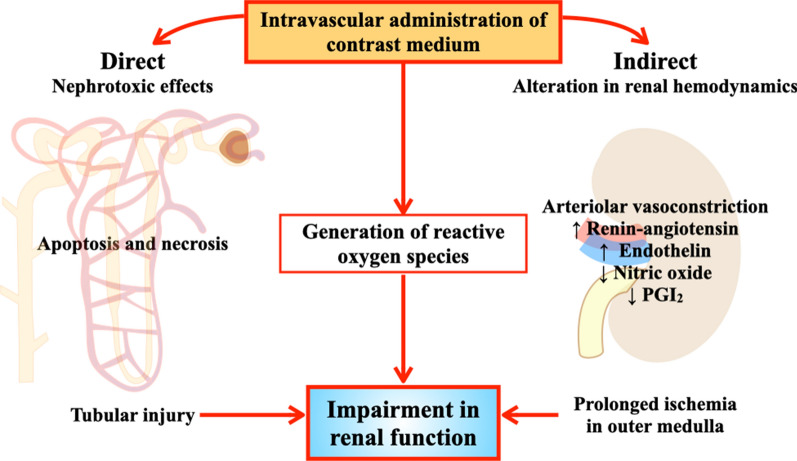
Fig. 1
Fig. 1
Pathophysiology of CIN. Pathogenesis of CIN consists of 3 mechanisms; direct effect, indirect effect, and generation of ROS. Direct effects include, direct cytotoxicity of CM to nephron leading to cellular apoptosis or necrosis and tubular injury. Indirect effects are that CM could alter renal hemodynamics, leading to intrarenal vasoconstriction, contributing to medullary hypoxia. This mechanism is mediated by the increase in vasoconstrictive mediators including renin, angiotensin II, and endothelin along with the decreasing of vasodilatory mediators including nitric oxide and PGI2. Lastly, CM can generate ROS and also reduce antioxidant enzyme activity as a result of various complex mechanisms which result in oxidative stress, leading to progression of impaired renal function. CIN, contrast-induced nephropathy; CM, contrast media; PGI2, prostaglandin I2; ROS, reactive oxygen species
Fig. 2
Fig. 2
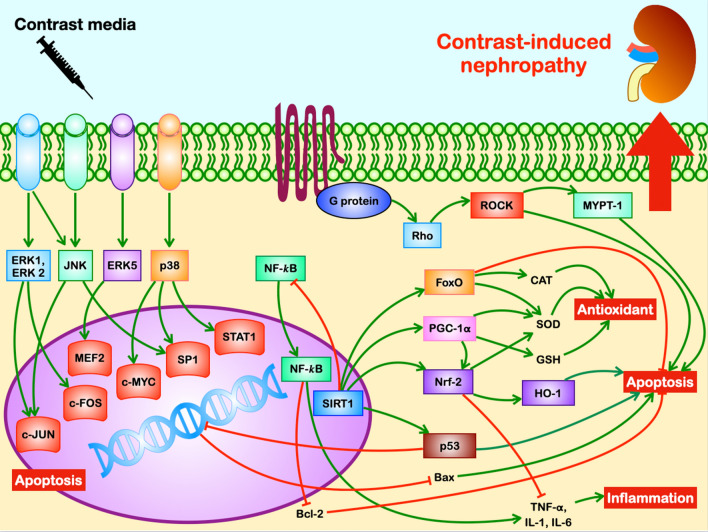
Mechanism of CIN via complex pathways of ROS from in vitro and in vivo studies. Contrast media can generate ROS especially in high risk patients such as DM and CKD through 4 major pathways: (1) MAPK pathway including ERK, JNK and p38; (2) SIRT1 pathway including SIRT1, FoxO, NF-kB, PGC-1 and p53; (3) Rho/ROCK pathway including MYPT-1 and NF-kB; (4) Nrf-2/HO-1 pathway including Nrf-2, NQO1, GSH and HO-1. CIN, contrast-induced nephropathy; CKD, chronic kidney disease; DM, diabetes mellitus; ERK, extracellular signal-related kinases; FoxO, Forkhead-box transcription factor; GSH, glutathione; JNK, c-JUN N-terminal kinase; MAPK, mitogen-activated protein kinase; MYPT-1, myosin-phosphatase target unit; NF-kB, nuclear factor-kB; NQO1, nicotinamide adenine dinucleotide phosphate quinone oxidoreductase 1; Nrf-2/HO-1, nuclear factor erythroid 2-related factor 2/heme oxygenase 1; PGC-1, peroxisome proliferator-activated receptor gamma-assisted activating factor-1; ROCK, rho-kinase; ROS, reactive oxygen species; SIRT1, silent information regulator 1
Fig. 3
Fig. 3
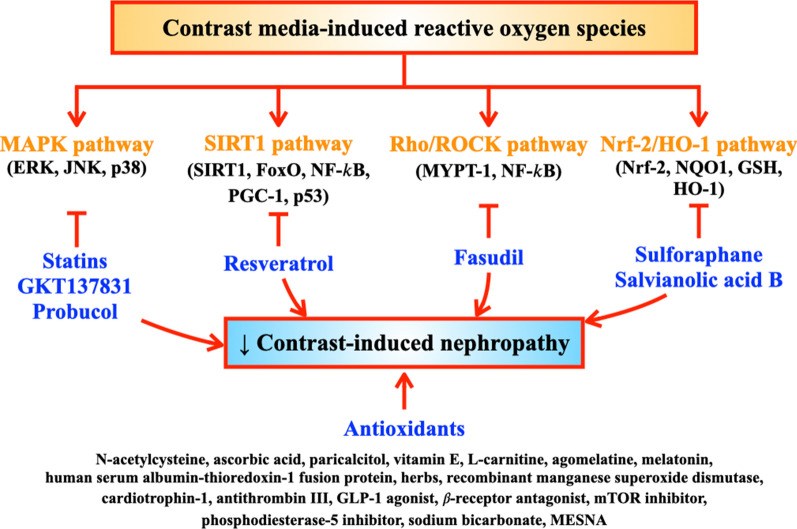
Intervention to reduce ROS for the prevention of CIN: evidence from in vitro, in vivo and clinical studies. In response to the mechanisms involved in ROS production in CIN, interventions to reduce ROS via complex pathways are illustrated. The MAPK pathway was inhibited by statins, GKT137831 and probucol. The SIRT1 pathway was inhibited by resveratrol. Rho/ROCK pathway was inhibited by fasudil. The Nrf-2/HO-1 pathway was inhibited by sulforaphane and salvianolic acid B. Antioxidant agents reported to exert benefits in CIN prevention have also been shown in this figure. CIN, contrast-induced nephropathy; GLP-1, glucagon-like peptide-1; MAPK, mitogen-activated protein kinase; MESNA, sodium-2-mercaptoethane sulphonate; mTOR, mammalian target of rapamycin; Nrf-2/HO-1, nuclear factor erythroid 2-related factor 2/heme oxygenase 1; ROCK, rho-kinase; ROS, reactive oxygen species; SIRT1, silent information regulator

References

    1. Pattharanitima P, Tasanarong A. Pharmacological strategies to prevent contrast-induced acute kidney injury. Biomed Res Int. 2014;2014:236930. doi: 10.1155/2014/236930. - DOI - PMC - PubMed
    1. Lopez-Ruiz A, Chandrashekar K, Juncos LA. Changing paradigms in contrast nephropathy. J Am Soc Nephrol. 2017;28(2):397–399. doi: 10.1681/ASN.2016121369. - DOI - PMC - PubMed
    1. Ehrmann S, Aronson D, Hinson JS. Contrast-associated acute kidney injury is a myth: yes. Intensive Care Med. 2018;44(1):104–106. doi: 10.1007/s00134-017-4950-6. - DOI - PubMed
    1. Haq MFU, Yip CS, Arora P. The conundrum of contrast-induced acute kidney injury. J Thorac Dis. 2020;12(4):1721–1727. doi: 10.21037/jtd.2019.12.88. - DOI - PMC - PubMed
    1. Iordache AM, Docea AO, Buga AM, Mitrut R, Albulescu D, Zlatian O, et al. The incidence of skin lesions in contrast media-induced chemical hypersensitivity. Exp Ther Med. 2019;17(2):1113–1124. - PMC - PubMed

Publication types