


Localization and restaging of carcinoma prostate by 68Gallium prostate-specific membrane antigen positron emission tomography computed tomography in patients with biochemical recurrence
- PMID: 33082634
- PMCID: PMC7531378
- DOI: 10.4103/iju.IJU_275_19
Localization and restaging of carcinoma prostate by 68Gallium prostate-specific membrane antigen positron emission tomography computed tomography in patients with biochemical recurrence
Abstract
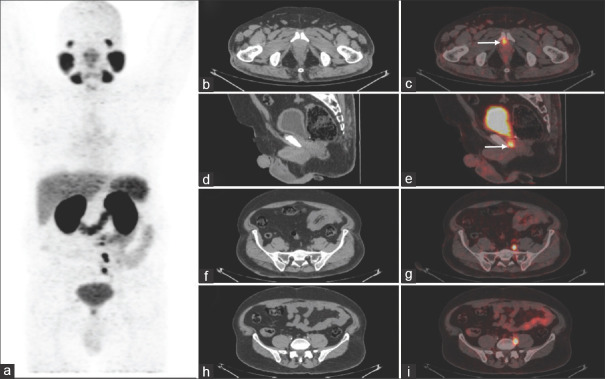
Introduction: Radical prostatectomy (RP) and radical radiotherapy (RT) are well established primary curative options for localized prostate cancer. Despite technical improvements, prostate-specific antigen (PSA)-recurrence after RP and RT is a common clinical scenario. We aimed to assess the role of 68Gallium (68Ga) prostate-specific membrane antigen positron emission tomography computed tomography (PSMA PET/CT) in patients with biochemical recurrence of prostate cancer after RP or RT for the detection and localization recurrent and metastatic disease.
Materials and methods: We ambispectively (70 retrospective and 100 prospective) analyzed the data of men with biochemical recurrence post-RP and post-RT who were evaluated by 68Ga PSMA PET/CT at our institute. We aimed to assess the relationship between serum PSA levels and the probability of having a positive scan in patients with recurrent prostate cancer.
Results: The study included 170 men, all had adenocarcinoma of the prostate, 124/170 had previous RP and 46/170 had prior RT. The median serum PSA in the RP group was 1.8 ng/ml and 5.2 ng/ml in the RT group. In the post-RP cohort, the detection rate of 68Ga PSMA PET/CT was 39.3% for PSA 0.2 to <0.5 ng/ml, 47.3% for PSA 0.5 to <1 ng/ml, 68.4% for PSA 1 to <2 ng/ml and 93.1% for PSA ≥2 ng/ml. In the post-RT group, the detection rate was 88.8% for PSA 2 to <4 ng/ml and 100% for PSA ≥4 ng/ml.
Conclusions: 68Ga PSMA PET/CT provides a novel imaging modality for the detection of prostate cancer recurrence and metastases at low posttreatment PSA levels, which may help in directing appropriate salvage treatments.
Copyright: © 2020 Indian Journal of Urology.
Conflict of interest statement
Conflicts of Interest: There are no conflicts of interest.
Figures


Comment in
-
Re; Seniaray N, Verma R, Khanna S, Belho E, Pruthi A, Mahajan H. Localization and restaging of carcinoma prostate by 68Gallium prostate-specific membrane antigen positron emission tomography computed tomography in patients with biochemical recurrence. Indian J Urol 2020;36:191-9.Indian J Urol. 2020 Oct-Dec;36(4):337-338. doi: 10.4103/iju.IJU_428_20. Epub 2020 Oct 1. Indian J Urol. 2020. PMID: 33376282 Free PMC article. No abstract available.
References
-
- Seigel RL, Miller KD, Jemal J. Cancer statistics 2016. CA Cancer J Clin. 2016;66:7–30. - PubMed
-
- Heidenreich A, Bastian PJ, Bellmunt J, Bolla M, Joniau S, van der Kwast T, et al. EAU Guidelines on Prostate Cancer Part1: Screening, diagnosis, and local treatment with curative intent-update 2013. Eur Urol. 2014;65:124–37. - PubMed
-
- Pound CR, Partin AW, Eisenberger MA, Chan DW, Pearson JD, Walsh PC. Natural history of progression after PSA elevation following radical prostatectomy. JAMA. 1999;281:1591–7. - PubMed
-
- Van Poppel H, Vekemans K, Da Pozzo L, Bono A, Kliment J, Montironi R, et al. Radical prostatectomy for locally advanced prostate cancer: Results of a feasibility study (EORTC 30001) Eur J Cancer. 2006;42:1062–7. - PubMed
LinkOut - more resources
Full Text Sources
Research Materials
Miscellaneous