. 2020 Oct 5:2020:2807946.
doi: 10.1155/2020/2807946. eCollection 2020.

Atypical EEG Responses to Nonverbal Emotionally Charged Stimuli in Children with ASD

Affiliations

Atypical EEG Responses to Nonverbal Emotionally Charged Stimuli in Children with ASD

Galina V Portnova et al. Behav Neurol. .

Abstract

This study focused on auditory emotional perception in children with low-functioning autism and investigated the children's response to emotionally charged nonverbal sounds which regularly induced emotional response in typically developing (TD) peers. An EEG was conducted, and emotional reactions were assessed using analog scales and images of presented sounds with additional images during the presentation of emotional stimuli. The results showed that EEG and emotional responses to the fearful sounds were similar in TD children and children with autism spectrum disorders (ASD). Both groups of children showed an increase in peak alpha frequency and power of alpha2-band and a decrease in low-frequency bands. Sounds of crying and laughter induced an atypical EEG response in children with ASD, with no change in alpha-band's power and frequency observed in them; this was contrary to the observation in TD children. The decrease in the fractal dimension detected in children with ASD only for sounds of crying and laughter correlated with the accuracy of assessment of these stimuli.


Conflict of interest statement

The authors have no conflicts of interest to disclose.

Figures
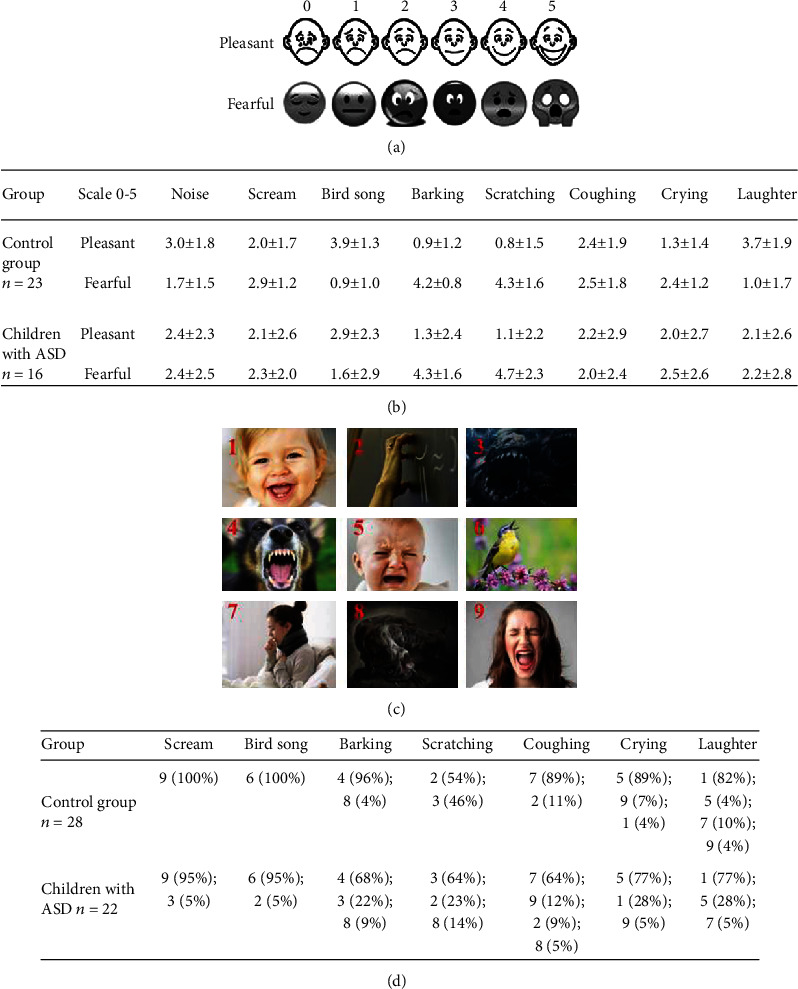
Figure 1
Figure 1
(a) Schematic example of the analog scales of pleasantness and fear (0–5). (b) Stimulus assessments using analog scales by both groups of participants. (c) Images used to identify sounds. (d) Recognition of stimuli using images in both groups.
Figure 2
Figure 2
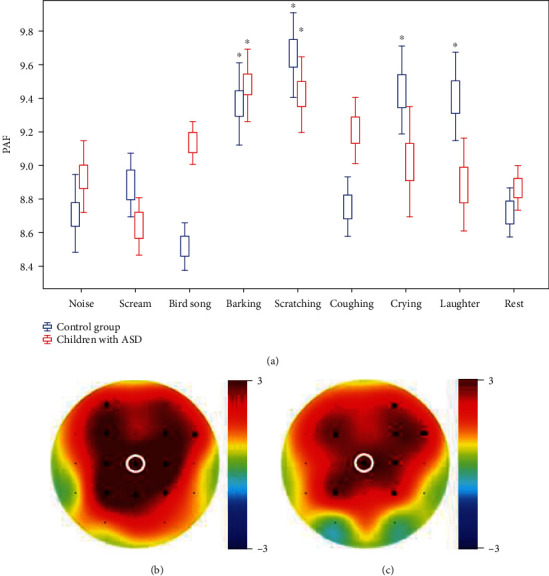
(a) Plots of PAF when listening to stimuli and rest. Significant differences between stimuli. x (abscissa): the types of stimuli presented to participants; y (ordinate): PAF averaged for participants of each group. (b, c) The topography was depicted for sound “barking” averaged for all participants separately for each group ((b) control group, (c) children with ASD). White circle: Cz—electrode in which PAF values were depicted.
Figure 3
Figure 3
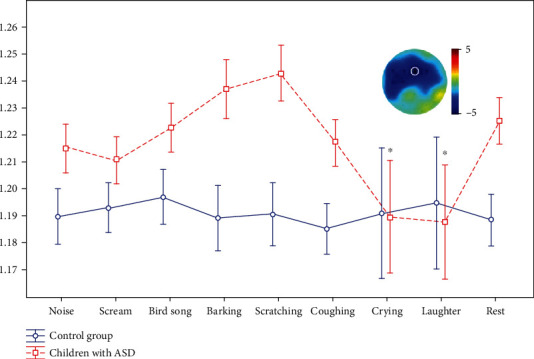
The dynamic of FD when listening to stimuli and rest. x (abscissa): the types of stimuli presented to participants; y (ordinate): FD averaged for participants of each group. Significant differences between stimuli and rest with topography of these differences (averaged for crying and laughter) in children with ASD. White circle: Fz—electrode in which FD values were depicted.
Figure 4
Figure 4
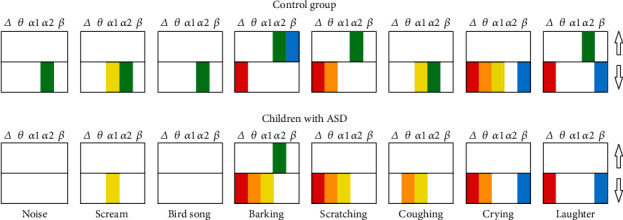
The PSD differences between stimuli and rest for delta (2-4 Hz), theta (4-8 Hz), alpha1 (8-10 Hz), alpha2 (10-12 Hz), and beta (12-20 Hz) bands. The colored columns depict significant differences which were supported by the clustering permutation test and passed Bonferroni correction. Arrows (up and down) indicate an increase and decrease compared to the background.
Figure 5
Figure 5
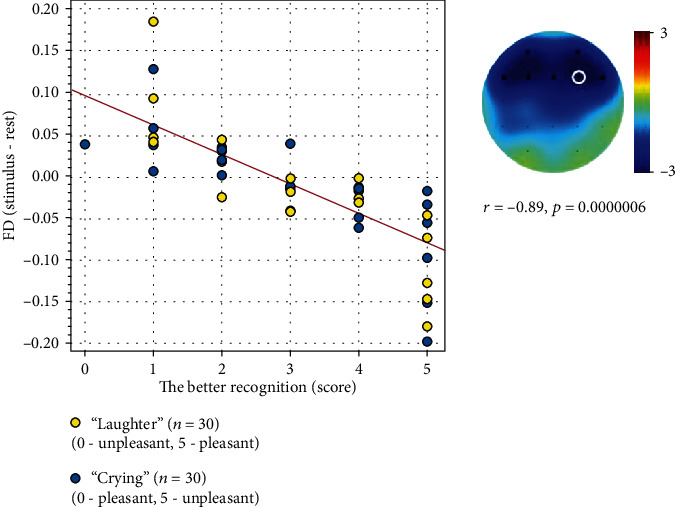
Results of the permutation test's correlation analysis between differences of FD values (the FD during rest was subtracted from crying and laughter) and assessments of these stimuli by scale (unpleasant-pleasant) unified in such a way that 0 is the incorrect recognition of the emotion, and 5 is the correct recognition of the emotion.

References

    1. Rosenblau G., Kliemann D., Dziobek I., Heekeren H. R. Emotional prosody processing in autism spectrum disorder. Social Cognitive and Affective Neuroscience. 2017;12(2):224–239. doi: 10.1093/scan/nsw118. - DOI - PMC - PubMed
    1. Schelinski S., Borowiak K., von Kriegstein K. Temporal voice areas exist in autism spectrum disorder but are dysfunctional for voice identity recognition. Social Cognitive and Affective Neuroscience. 2016;11(11):1812–1822. doi: 10.1093/scan/nsw089. - DOI - PMC - PubMed
    1. Brewer R., Biotti F., Catmur C., et al. Can neurotypical individuals read autistic facial expressions? Atypical production of emotional facial expressions in autism spectrum disorders. Autism Research. 2016;9(2):262–271. doi: 10.1002/aur.1508. - DOI - PMC - PubMed
    1. Downs A., Smith T. Emotional understanding, cooperation, and social behavior in high-functioning children with autism. Journal of Autism and Developmental Disorders. 2004;34(6):625–635. doi: 10.1007/s10803-004-5284-0. - DOI - PubMed
    1. Gross J. For siblings of the autistic, a burdened youth. New York Times. 2004;154(53059):A1–A28.