


Minimal change disease in a patient receiving checkpoint inhibition: Another possible manifestation of kidney autoimmunity?
- PMID: 33085845
- PMCID: PMC7941578
- DOI: 10.1002/cnr2.1250
Minimal change disease in a patient receiving checkpoint inhibition: Another possible manifestation of kidney autoimmunity?
Abstract
Background: Nivolumab has been associated with immune-related adverse events, including nephritis, with acute interstitial nephritis being the most commonly reported renal manifestation.
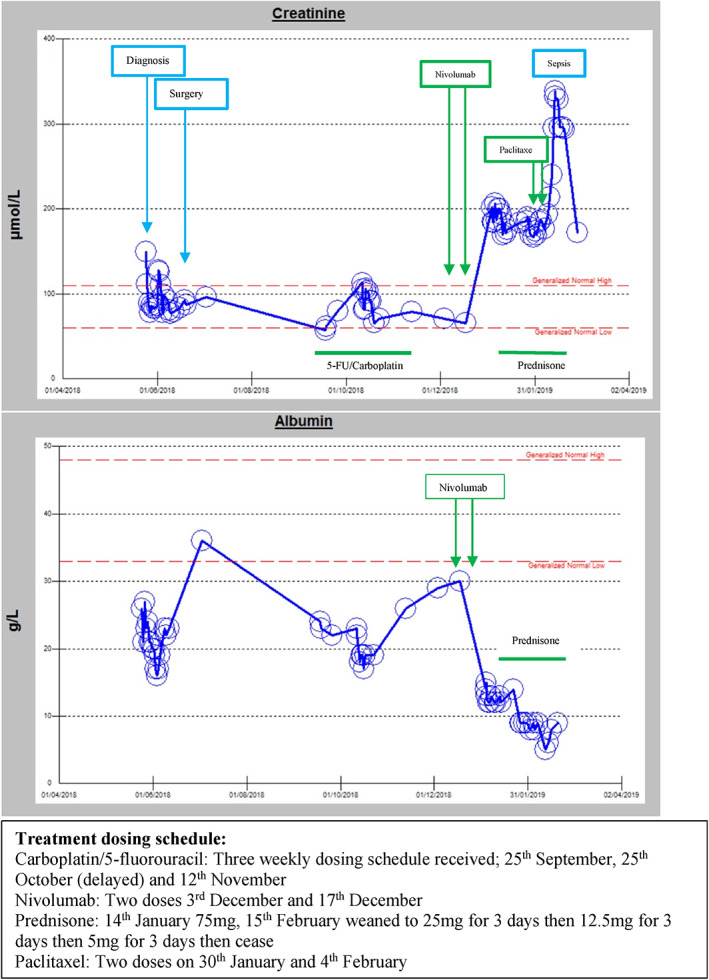
Case: We describe the first case to our knowledge of minimal change disease with nephrotic syndrome associated with the PD-1 checkpoint inhibitor, Nivolumab. Minimal change disease has been reported with other immune checkpoint inhibitors; however, this is the first reported case with Nivolumab. We report development of nephrotic syndrome with acute kidney injury in a 57-year-old man, 1 month after commencement of Nivolumab for metastatic squamous cell carcinoma of the tongue. Minimal change disease was confirmed by renal biopsy. Management with corticosteroids and cessation of Nivolumab failed to improve kidney function or nephrosis.
Conclusion: This case adds to current literature identifying minimal change as an additional complication of immune checkpoint inhibitor-associated acute kidney injury. Given the increasing use of immune checkpoint inhibitors for a range of malignancies, nephrologists, oncologist and generalists should be aware of the spectrum of kidney pathologies associated with their use.
Keywords: Nivolumab; immune related adverse event; immune-mediated nephritis; nephrotic syndrome; onconephrology.
© 2020 Wiley Periodicals LLC.
Conflict of interest statement
The authors have not received financial or nonfinancial support for the preparation of this manuscript. The authors have stated explicitly that there are no conflicts of interest in connection with this article.
Figures
References
-
- Manohar S, Kompotiatis P, Thongprayoon C, Cheungpasitporn W, Herrmann J, Herrmann SM. Programmed cell death protein 1 inhibitor treatment is associated with acute kidney injury and hypocalcemia: meta‐analysis. Nephrol Dial Transplant. 2019;34(1):108‐117. - PubMed
Publication types
MeSH terms
Substances
LinkOut - more resources
Full Text Sources
