Review
. 2021 Feb 10:83:205-230.
doi: 10.1146/annurev-physiol-031220-095215. Epub 2020 Oct 21.

Temperature Sensation: From Molecular Thermosensors to Neural Circuits and Coding Principles

Affiliations
Review

Temperature Sensation: From Molecular Thermosensors to Neural Circuits and Coding Principles

Rui Xiao et al. Annu Rev Physiol. .

Abstract

Temperature is a universal cue and regulates many essential processes ranging from enzymatic reactions to species migration. Due to the profound impact of temperature on physiology and behavior, animals and humans have evolved sophisticated mechanisms to detect temperature changes. Studies from animal models, such as mouse, Drosophila, and C. elegans, have revealed many exciting principles of thermosensation. For example, conserved molecular thermosensors, including thermosensitive channels and receptors, act as the initial detectors of temperature changes across taxa. Additionally, thermosensory neurons and circuits in different species appear to adopt similar logic to transduce and process temperature information. Here, we present the current understanding of thermosensation at the molecular and cellular levels. We also discuss the fundamental coding strategies of thermosensation at the circuit level. A thorough understanding of thermosensation not only provides key insights into sensory biology but also builds a foundation for developing better treatments for various sensory disorders.

Keywords: TRP; cold; heat; pain; somatosensation; thermoregulation.


Figures
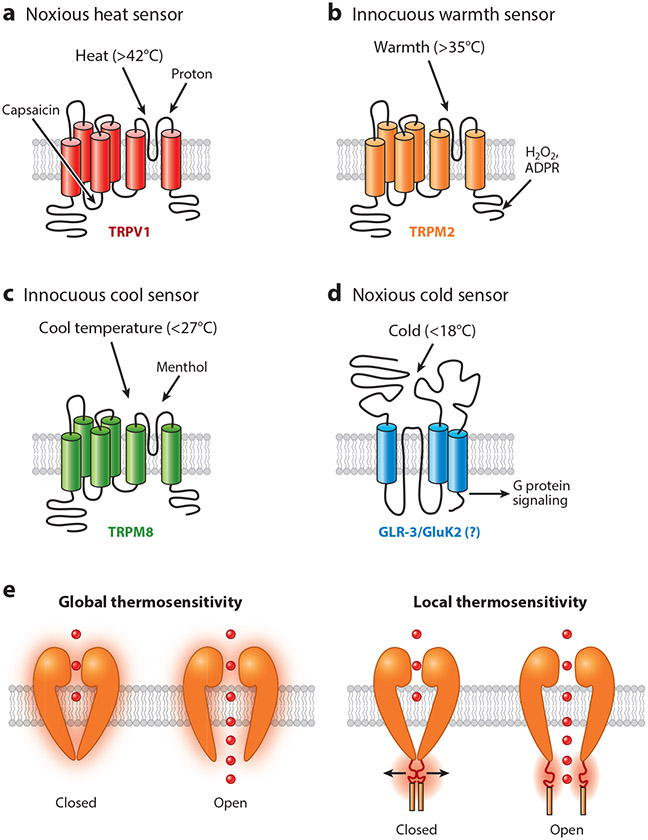
Figure 1
Figure 1
Molecular thermosensors involved in temperature sensation. (a) Shown is the representative noxious heat sensor TRPV1,which can be regulated by multiple environmental and endogenous stimuli, including heat (>42°C), proton, and capsaicin. (b) TRPM2 plays an important role in sensing innocuous warmth (>35°C). (c) Mammalian TRPM8 is the best-studied innocuous cool sensor (<27°C). (d) The ionotropic glutamate receptor GLR-3/GluK2 might act as a noxious cold receptor in both C. elegans and mammals (< 18°C). Notably, GLR-3/GluK2 is a metabotropic cold receptor (G protein signaling mediates its role in cold sensation), and the cold sensitivity of GLR-3/GluK2 is independent of its channel activity. (e) Molecular thermosensors may use both global conformation and local motif mechanisms to respond to temperature changes. Abbreviation: ADPR, adenosine diphosphate ribose.
Figure 2
Figure 2
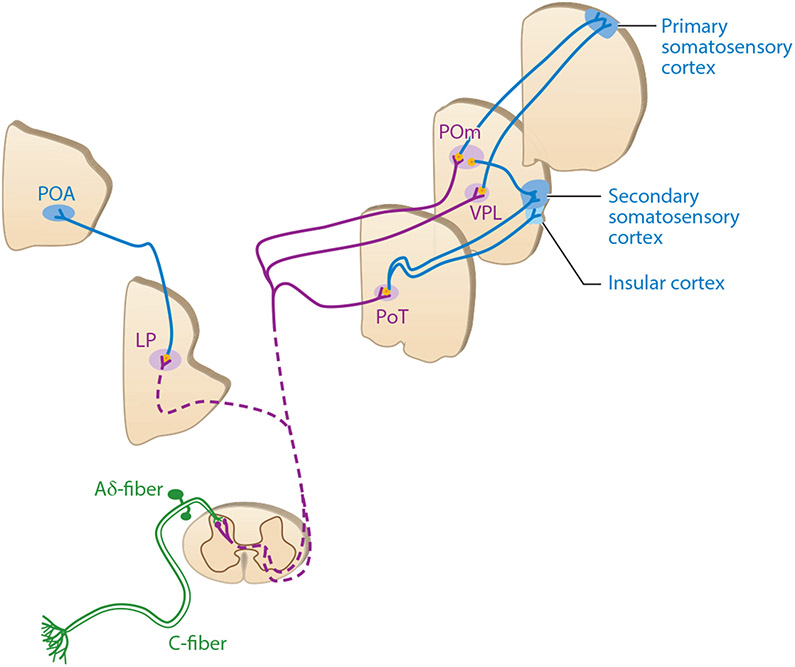
Thermosensory circuits in mammals. Overall, three layers of neurons are involved in transmitting the temperature information (color coded in green, purple, and blue, respectively) (127). Abbreviations: LP, lateral parabrachial; POA, preoptic area; PoT, posterior thalamic; POm, posterior medial; VPL, ventral posterolateral.
Figure 3
Figure 3
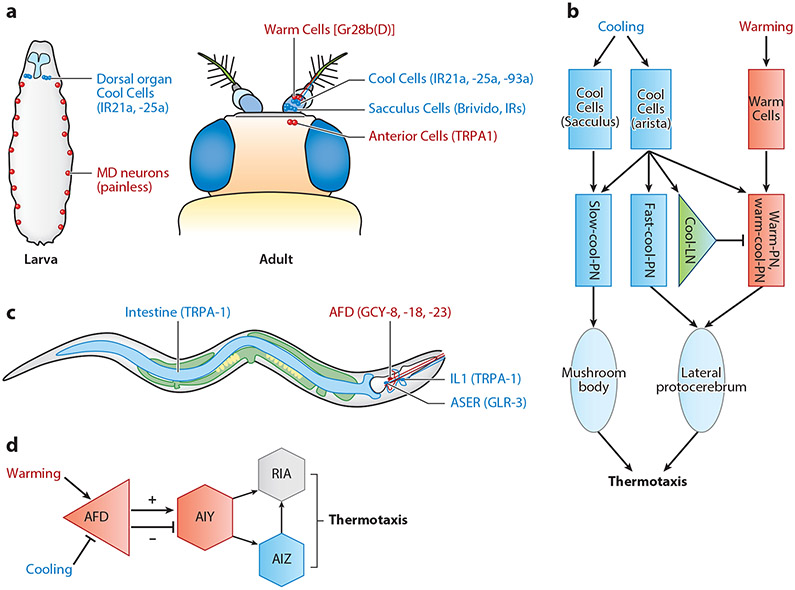
Cellular and circuit mechanisms of temperature sensation in Drosophila and C. elegans. (a) Larval and adult flies use different temperature-sensitive neurons for temperature sensation (130). (b) The neural circuit of temperature sensation in adult flies (131, 132). (c) In C. elegans, the AFD neuron is the primary warmth-sensing neuron. Meanwhile, the head neuron ASER and the intestine are cold sensitive through the cold sensors GLR-3 and TRPA-1, respectively. The other head neuron IL1 senses cooling through TRPA-1. (d) The neural circuit of thermotaxis in C. elegans. Abbreviations: IR, ionotropic receptor; LN, local neuron; md, multiple dendritic; PN, projection neuron.
Figure 4
Figure 4
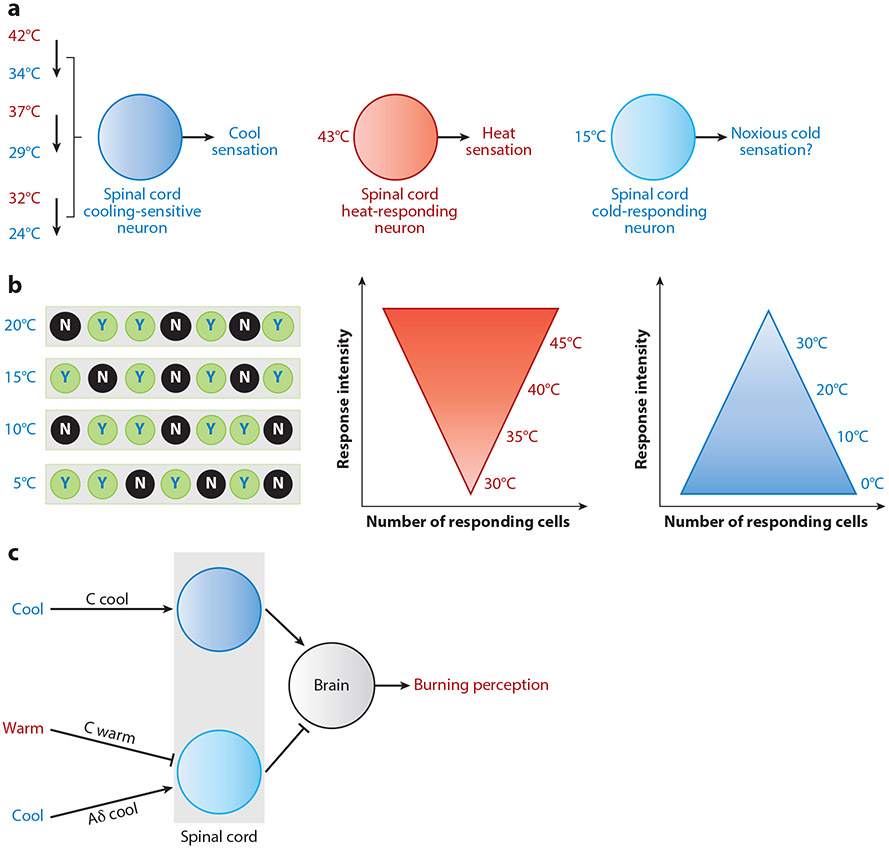
The coding strategies of temperature sensation. (a) The cooling process but not the absolute low temperature seems to trigger cool sensation, while the absolute high temperature activates spinal cord neurons and leads to heat sensation (123). For noxious cold sensation, it is possible that both the cooling process and the absolute temperature are involved in thermal information processing. (b) At the primary sensory neuron level, cold sensation might adopt a combinatorial coding strategy (N denotes nonresponding neurons, and Y indicates responding neurons). By contrast, heat sensation employs a graded response strategy (117). Meanwhile, some sensory neurons also exhibit graded responses upon cold stimulation (47). (c) In the thermal grill scenario, multiple temperature-sensitive afferent fibers transmit innocuous cool and warm temperature information simultaneously, the cross talk of which can eventually induce a burning hot perception in the brain.

References

    1. Frazer JG. 1930. Myths of the Origin of Fire—An Essay. London: Macmillan & Co.
    1. Hall JE. 2016. Guyton and Hall Textbook of Medical Physiology. Philadelphia: Elsevier
    1. Kandel ER. 2013. Principles of Neural Science. New York/London: McGraw-Hill Med.
    1. Gowers WR. 1888. A Manual of Diseases of the Nervous System. Philadelphia: Blakiston
    1. Brown-Séquard E. 1858. Dr. E. Brown-Séquard on the physiology and pathology of the nervous system. J. Psychol. Med. Ment. Pathol 11:i–xvi - PMC - PubMed

Publication types

LinkOut - more resources