


Osteoclast Fusion: Physiological Regulation of Multinucleation through Heterogeneity-Potential Implications for Drug Sensitivity
- PMID: 33086479
- PMCID: PMC7589811
- DOI: 10.3390/ijms21207717
Osteoclast Fusion: Physiological Regulation of Multinucleation through Heterogeneity-Potential Implications for Drug Sensitivity
Abstract
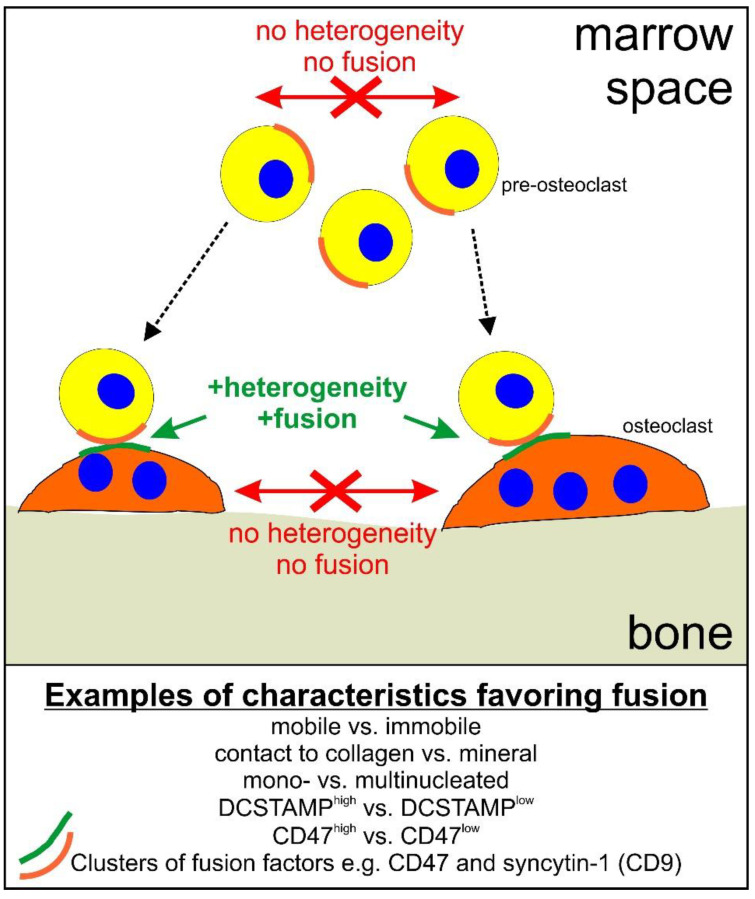
Classically, osteoclast fusion consists of four basic steps: (1) attraction/migration, (2) recognition, (3) cell-cell adhesion, and (4) membrane fusion. In theory, this sounds like a straightforward simple linear process. However, it is not. Osteoclast fusion has to take place in a well-coordinated manner-something that is not simple. In vivo, the complex regulation of osteoclast formation takes place within the bone marrow-in time and space. The present review will focus on considering osteoclast fusion in the context of physiology and pathology. Special attention is given to: (1) regulation of osteoclast fusion in vivo, (2) heterogeneity of osteoclast fusion partners, (3) regulation of multi-nucleation, (4) implications for physiology and pathology, and (5) implications for drug sensitivity and side effects. The review will emphasize that more attention should be given to the human in vivo reality when interpreting the impact of in vitro and animal studies. This should be done in order to improve our understanding of human physiology and pathology, as well as to improve anti-resorptive treatment and reduce side effects.
Keywords: CD47; DC-STAMP; denosumab; fusion; heterogeneity; osteoclast; pathology; physiology; syncytin-1; zoledronic acid.
Conflict of interest statement
The author declare no conflict of interest.
Figures
References
Publication types
MeSH terms
Substances
LinkOut - more resources
Full Text Sources
Research Materials
