


Chemical constituent, minimal inhibitory concentration, and antimicrobial efficiency of essential oil from oreganum vulgare against Enterococcus faecalis: An in vitro study
- PMID: 33088061
- PMCID: PMC7542082
- DOI: 10.4103/JCD.JCD_80_19
Chemical constituent, minimal inhibitory concentration, and antimicrobial efficiency of essential oil from oreganum vulgare against Enterococcus faecalis: An in vitro study
Abstract
Aim: The purpose of this study was to determine the chemical composition of oregano essential oil, minimal inhibitory concentration (MIC) and to assess its antimicrobial efficiency against Enterococcus faecalis.
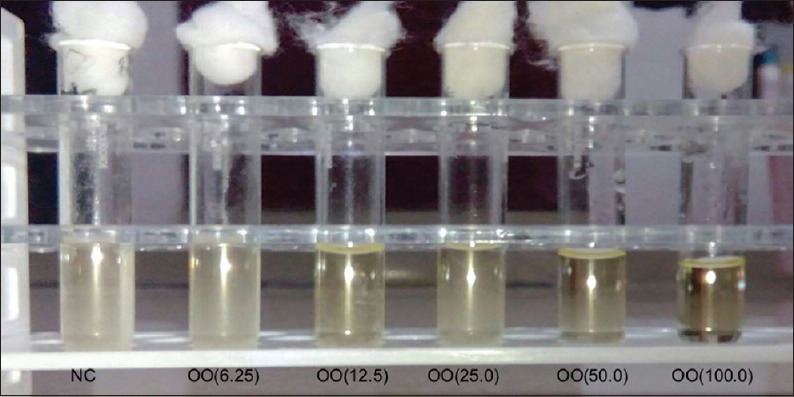
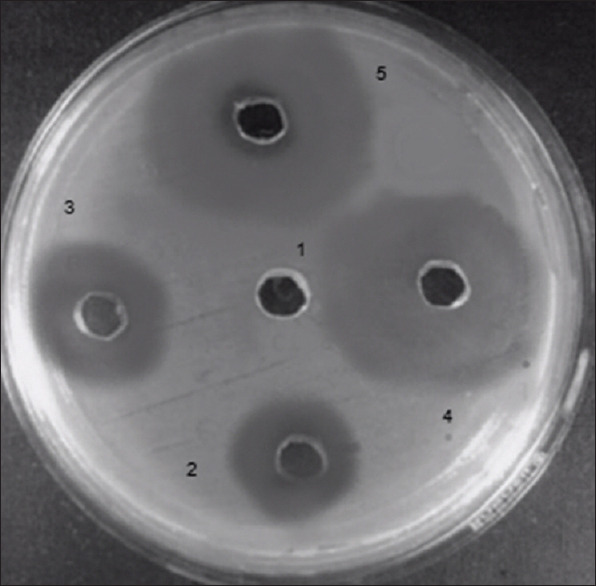
Material and methods: Gas Chromatography and Mass Spectrometry (GC-MS) was used to determine the chemical composition of essential oil from oreganum vulgare. Broth dilution and agar diffusion method was used to evaluate the MIC. For Broth dilution, 100 μL of different concentration of oil (6.25, 12.5, 25.0, 50.0, and 100 μg/ml) was tested. Agar diffusion method was utilized to evaluate the antimicrobial efficiency of different concentration of oil (25.0, 50.0, and 100 μg/mL) against E. faecalis.
Results: GC-MS analysis revealed that oregano essential oil contained carvacrol (41.2%), γ-terpinene (12.68%), p-cymene (9.47%), α-terpinene (1.19%) as the major compounds and β-caryophyllene (0.83%), β-linalool (0.67%), β-bisabolene (0.601%), α-pinene (0.6%), β-pinene (0.5%), terpinen-4-ol (0.41%), borneol (0.4%), 3-thujene (0.4%), spathulenol (0.4%), myristicin (0.25%), and apiol (0.14%). The results of the present study reported Oregano essential oil possess antimicrobial activity against E. faecalis. The MIC was 25 μg/ml and the minimum bacterial concentration (MBC) was 50 μg/ml.
Conclusion: Oregano essential oil was reported to be an effective antimicrobial agent against E. faecalis. The MIC was found to be 25 μg/ml and the MBC was found to be 50 μg/ml.
Keywords: Antimicrobial efficiency; minimal inhibitory concentration; oregano essential oil; oreganum vulgare.
Copyright: © 2020 Journal of Conservative Dentistry.
Conflict of interest statement
There are no conflicts of interest.
Figures
References
-
- Pinheiro ET, Gomes BP, Ferraz CC, Sousa EL, Teixeira FB, Souza-Filho FJ. Microorganisms from canals of root-filled teeth with periapical lesions. Int Endod J. 2003;36:1–11. - PubMed
-
- Young GR, Parashos P, Messer HH. The principles of techniques for cleaning root canals. Aust Dent J. 2007;1(Suppl 52):S52–63. - PubMed
-
- Teja KV, Ramesh S. Shape optimal and clean more. Saudi Endod J. 2019;9:235–6.
-
- Spangberg L, Engström B, Langeland K. Biologic effects of dental materials 3 Toxicity and antimicrobial effect of endodontic antiseptics in vitro. Oral Surg Oral Med Oral Pathol. 1973;36:856–71. - PubMed
-
- Daferera DJ, Tarantilis PA, Polissiou MG. Characterization of essential oils from Lamiaceae species by fourier transform raman spectroscopy. J Agric Food Chem. 2002;50:5503–7. - PubMed
LinkOut - more resources
Full Text Sources
Miscellaneous