


Characterization of Markerless Tumor Tracking Using the On-Board Imager of a Commercial Linear Accelerator Equipped With Fast-kV Switching Dual-Energy Imaging
- PMID: 33089019
- PMCID: PMC7560565
- DOI: 10.1016/j.adro.2020.01.008
Characterization of Markerless Tumor Tracking Using the On-Board Imager of a Commercial Linear Accelerator Equipped With Fast-kV Switching Dual-Energy Imaging
Abstract
Purpose: To describe and characterize fast-kV switching, dual-energy (DE) imaging implemented within the on-board imager of a commercial linear accelerator for markerless tumor tracking (MTT).
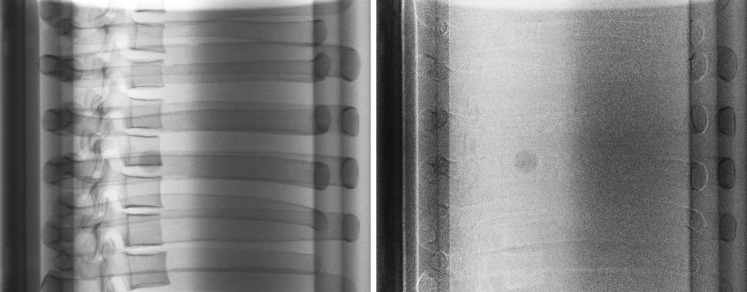
Methods and materials: Fast-kV switching, DE imaging provides for rapid switching between programmed tube voltages (ie, 60 and 120 kVp) from one image frame to the next. To characterize this system, the weighting factor used for logarithmic subtraction and signal difference-to-noise ratio were analyzed as a function of time and frame rate. MTT was evaluated using a thorax motion phantom and fast kV, DE imaging was compared versus single energy (SE) imaging over 360 degrees of rotation. A template-based matching algorithm was used to track target motion on both DE and SE sequences. Receiver operating characteristics were used to compare tracking results for both modalities.
Results: The weighting factor was inversely related to frame rate and stable over time. After applying the frame rate-dependent weighting factor, the signal difference-to-noise ratio was consistent across all frame rates considered for simulated tumors ranging from 5 to 25 mm in diameter. An analysis of receiver operating characteristics curves showed improved tracking with DE versus SE imaging. The area under the curve for the 10-mm target ranged from 0.821 to 0.858 for SE imaging versus 0.968 to 0.974 for DE imaging. Moreover, the residual tracking errors for the same target size ranged from 2.02 to 2.18 mm versus 0.79 to 1.07 mm for SE and DE imaging, respectively.
Conclusions: Fast-kV switching, DE imaging was implemented on the on-board imager of a commercial linear accelerator. DE imaging resulted in improved MTT accuracy over SE imaging. Such an approach may have application for MTT of patients with lung cancer receiving stereotactic body radiation therapy, particularly for small tumors where MTT with SE imaging may fail.
© 2020 The Authors.
Figures



References
-
- Seiler P.G., Blattmann H., Kirsch S., Muench R.K., Schilling C. A novel tracking technique for the continuous precise measurement of tumour positions in conformal radiotherapy. Phys Med Biol. 2000;45:N103–N110. - PubMed
-
- Sharp G.C., Alexander B., Cui Y., Jiang S.B., Dy J.G. Robust fluoroscopic respiratory gating for lung cancer radiotherapy without implanted fiducial markers. Phys Med Biol. 2007;52:741–755. - PubMed
-
- Tang X., Sharp G.C., Jiang S.B. Fluoroscopic tracking of multiple implanted fiducial markers using multiple object tracking. Phys Med Biol. 2007;52:4081–4098. - PubMed
-
- Willoughby T.R., Kupelian P.A., Pouliot J. Target localization and real-time tracking using the Calypso 4D localization system in patients with localized prostate cancer. Int J Radiat Oncol. 2006;65:528–534. - PubMed
-
- Kupelian P., Willoughby T., Mahadevan A. Multi-institutional clinical experience with the Calypso System in localization and continuous, real-time monitoring of the prostate gland during external radiotherapy. Int J Radiat Oncol. 2007;67:1088–1098. - PubMed
Grants and funding
LinkOut - more resources
Full Text Sources
