


The Role of Daylight for Humans: Gaps in Current Knowledge
- PMID: 33089192
- PMCID: PMC7445840
- DOI: 10.3390/clockssleep2010008
The Role of Daylight for Humans: Gaps in Current Knowledge
Abstract
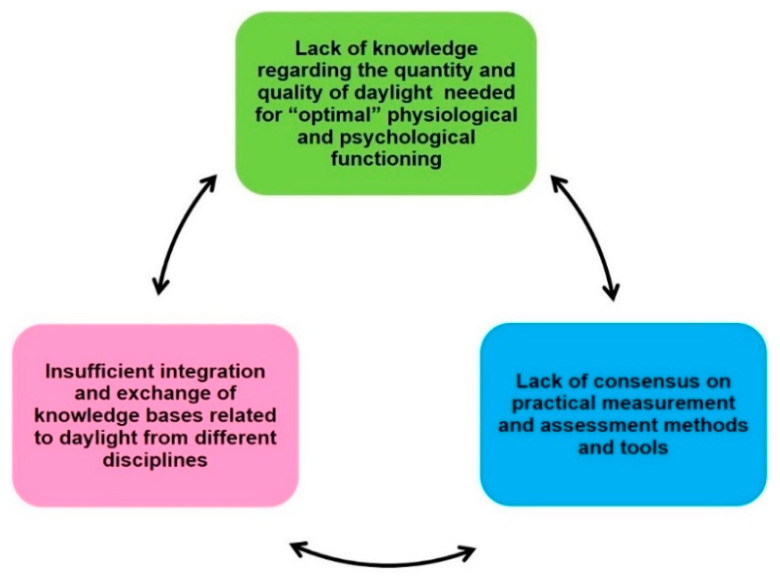
Daylight stems solely from direct, scattered and reflected sunlight, and undergoes dynamic changes in irradiance and spectral power composition due to latitude, time of day, time of year and the nature of the physical environment (reflections, buildings and vegetation). Humans and their ancestors evolved under these natural day/night cycles over millions of years. Electric light, a relatively recent invention, interacts and competes with the natural light-dark cycle to impact human biology. What are the consequences of living in industrialised urban areas with much less daylight and more use of electric light, throughout the day (and at night), on general health and quality of life? In this workshop report, we have classified key gaps of knowledge in daylight research into three main groups: (I) uncertainty as to daylight quantity and quality needed for "optimal" physiological and psychological functioning, (II) lack of consensus on practical measurement and assessment methods and tools for monitoring real (day) light exposure across multiple time scales, and (III) insufficient integration and exchange of daylight knowledge bases from different disciplines. Crucial short and long-term objectives to fill these gaps are proposed.
Keywords: alertness; circadian rhythms; entrainment; health; melatonin; mood; natural light; sleep; spectrum; twilight.
© 2020 by the authors.
Conflict of interest statement
Conflicts of InterestThe authors declared no potential conflicts of interest with respect to the authorship, and/or publication of this article. None of the authors had received monetary payments or gifts other than reimbursement of costs related to workshops’ participation. None of the authors is an employee of the Daylight Academy or the Velux Stiftung Switzerland, or is in any kind related to the VELUX® company. The Daylight Academy is a spin-off of the Velux Stiftung Switzerland. The Velux Stiftung Switzerland is a registered non-profit organization (see https://veluxstiftung.ch/) and its members had at no time influence on the content of this manuscript. M.M., A.W.-J, S.A.B., K.M., K.W. have otherwise no conflict of interest to declare; T.K. is founder of SynOpus, a business involved in consulting to companies with respect to work design and lighting; O.S. is listed as an inventor on the following patents: US8646939B2—Display system having circadian effect on humans. DE102010047207B4—Projection system and method for projecting image content. US8994292B2—Adaptive lighting system. WO2006013041A1—Projection device and filter therefor. WO2016092112A1—Method for the selective adjustment of a desired brightness and/or color of a specific spatial area, and data processing device therefor. O.S. has had the following commercial interests related to lighting: Investigator-initiated research grants from Derungs, Audi, VW, Porsche, Festo, ZDF and Toshiba. Speaker fees for invited seminars from Firalux and Selux; C.V., during the conduct of the study, received research support from the NIH, was a honorary (unpaid) scientific advisory board member of Circadian Light Therapy Inc., and served as a paid consultant to the US Department of Energy outside the submitted work; K.P.W.J., during the conduct of the study, was a scientific advisory board member of and received personal fees from Torvec and received personal fees from Circadian Therapeutics, Inc. and from Kellogg Company; K.P.W.J. received research support from the NIH, the Office of Naval Research, the PAC-12 conference, and Somalogic, Inc. outside the submitted work; D.J.S. is co-inventor on two light patents (EP 1614441A1 and EP3055022A).
Figures
References
LinkOut - more resources
Full Text Sources
